


Basket Size
Basket size (also called average order value or basket count, depending on whether it's measured in items or dollars) refers to how much a customer buys in a single transaction, either counted by number of items or total spend. Tracking basket size distribution — not just the average — reveals whether most orders cluster around a single item or whether multi-item purchases are common, information that shapes bundling and cross-sell strategy. It's one of the simplest but most actionable ecommerce metrics to track.
Definition of Basket Size
Basket size describes how much a customer buys within a single transaction. It’s measured in two related but distinct ways: item-count basket size, the number of distinct products (or units) in an order, and value-based basket size, the total dollar amount spent, which overlaps closely with the more commonly discussed metric average order value. A store might report an average basket size of 2.3 items and an average order value of $68 in the same reporting period — both are basket size measures, just along different axes. Basket size is one of the oldest metrics in retail, borrowed directly from physical grocery and department-store terminology, where it literally referred to how full a shopping basket was at checkout. In ecommerce, the concept carries over unchanged even though there’s no physical basket involved.
How Basket Size Is Measured
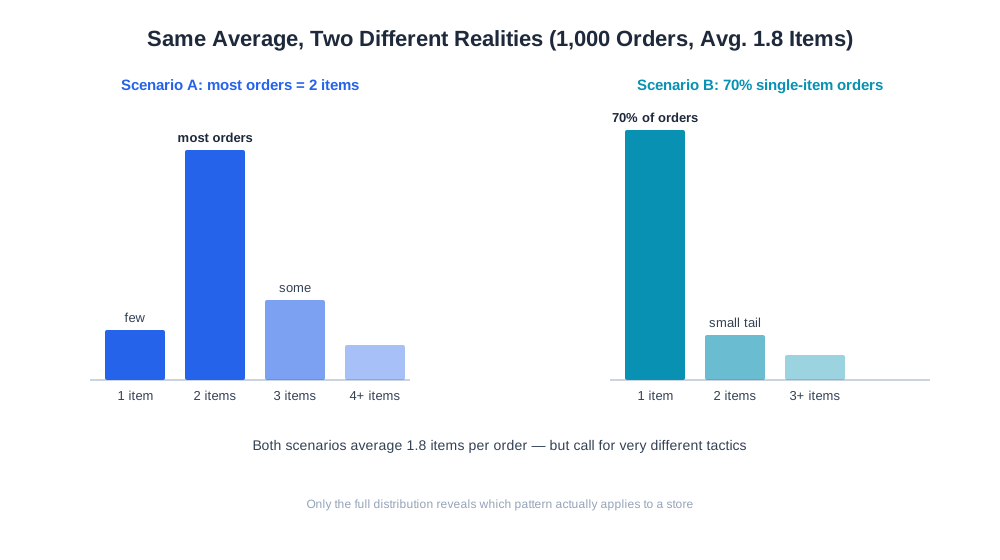
Item-count basket size is calculated by dividing total units sold by total number of orders over a given period. Value-based basket size (average order value) divides total revenue by total number of orders over the same period. Both are simple to calculate but easy to misread if only the average is examined. Consider a store with 1,000 orders in a month: if the average basket size is 1.8 items, that could mean most orders contain exactly 2 items with a handful of single-item orders pulling the average down slightly, or it could mean 70% of orders are single-item purchases with a small number of large multi-item orders pulling the average up. These two scenarios call for completely different tactics — the first suggests basket size is already fairly consistent and further gains require new cross-sell mechanics, while the second suggests there’s a large pool of single-item shoppers who could plausibly be nudged toward a second item with the right prompt. This is why looking at the full distribution of basket sizes across all orders — not just the single average figure — reveals more actionable information than the average alone.

Ready to Monitor Your AI Visibility?
Track how AI chatbots mention your brand across ChatGPT, Perplexity, and other platforms.
Why Basket Size Matters for Ecommerce Brands
Basket size is one of the few metrics that can be increased without any additional traffic or marketing spend, since a store already has a visitor in an active buying mindset when a cross-sell or bundle offer is presented. Growing basket size even modestly compounds meaningfully across a large order volume, since the incremental cost of fulfilling one additional item alongside an existing order (shared shipping, shared packaging) is typically lower than the cost of acquiring an entirely new customer for a separate transaction. Basket size distribution also reveals structural information about a catalog: a store where nearly every order is single-item may have a catalog of largely unrelated products with no natural pairing, while a store with a wide spread of basket sizes may have complementary product lines that customers are already discovering on their own, suggesting untapped bundling opportunity if that pattern were made more explicit at checkout.
Basket Size vs. Related Metrics
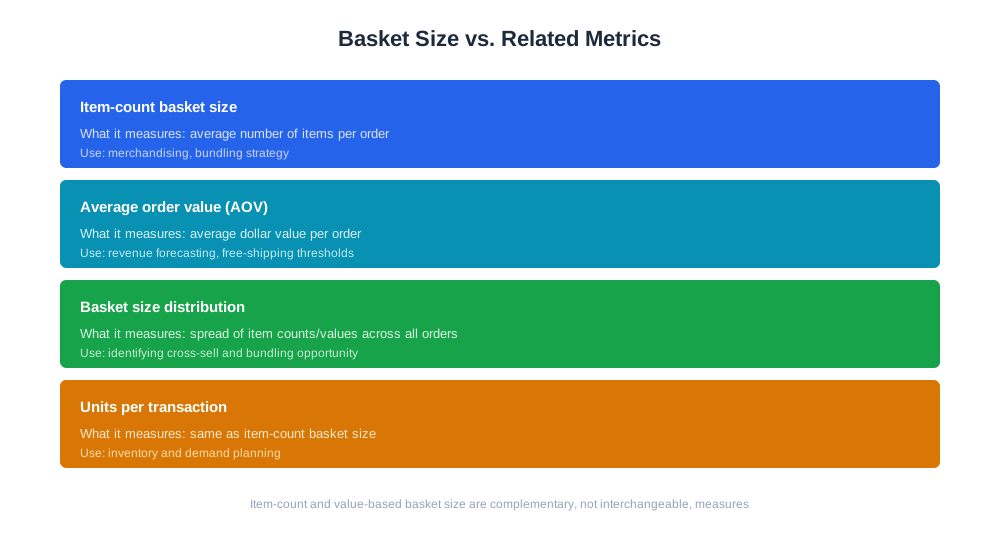
| Metric | What it measures | Typical use |
|---|---|---|
| Item-count basket size | Average number of items per order | Merchandising, bundling strategy |
| Average order value (AOV) | Average dollar value per order | Revenue forecasting, free-shipping thresholds |
| Basket size distribution | Spread of item counts or values across all orders | Identifying cross-sell and bundling opportunity |
| Units per transaction | Same as item-count basket size, used interchangeably in retail | Inventory and demand planning |
Stay Updated on AI Visibility Trends
Get the latest insights on AI mentions, brand monitoring, and optimization strategies.
Basket Size and AI-Driven Commerce
As shopping increasingly happens through conversational AI assistants, basket size takes on a slightly different shape — an AI shopping agent completing a purchase on a customer’s behalf may be more or less inclined to add a complementary item depending on how clearly a brand’s product data expresses natural pairings. A brand whose bundling and affinity data is well-structured gives an AI shopping assistant a clearer basis for suggesting “would you also like X” in the same way a well-tuned on-site cross-sell module would. AmICited’s eshop_get_product_bundles report includes a basket-size distribution alongside its bundling recommendations specifically because the two are connected — knowing which products are already frequently bought together only becomes actionable once it’s paired with an understanding of how much headroom exists in current basket sizes to actually grow.
Best Practices for Growing Basket Size
- Look at the basket-size distribution, not just the average, before deciding whether cross-sell or bundling is worth investing in
- Set free-shipping thresholds slightly above your current average order value to nudge borderline shoppers toward one more item
- Use actual purchase-pattern data (not assumptions) to decide which products to bundle or cross-sell together
- Test cross-sell placement at multiple points — product page, cart, checkout — since different placements convert differently by catalog type
- Avoid pushing cross-sell too aggressively on price-sensitive segments, where it can suppress conversion rather than grow basket size
Common Basket Size Mistakes
A common mistake is chasing average order value in isolation without checking the underlying distribution, which can mask the fact that a small number of large orders are propping up the average while the bulk of the customer base is still buying single items — a metric that looks fine in aggregate but hides where the real opportunity is. Another frequent issue is bundling products with no genuine purchase affinity, based on a merchandiser’s assumption about what “should” pair well rather than actual order data, which tends to produce low-converting bundle offers. A third mistake is setting a free-shipping threshold far above the current average basket size, hoping to force larger orders — this often just suppresses conversion among shoppers unwilling or unable to spend that much, rather than genuinely growing basket size; a threshold set closer to the existing average, then gradually raised, tends to work better than a large jump. Finally, some stores measure basket size only in dollars and never in item count, missing the distinction between a customer buying one expensive item and a customer buying several cheaper ones — the two scenarios call for very different cross-sell strategies even when they produce the same order value.