


Unboxing Experience
Unboxing experience refers to the sensory and emotional impression a customer forms while opening a package they've ordered, shaped by packaging design, presentation, and any included extras. It's a brand touchpoint that happens after the sale is already made, but it directly influences repeat purchases, reviews, and whether a customer shares the moment on social media. A well-designed unboxing experience turns a routine delivery into a piece of brand marketing.
Definition of Unboxing Experience
Unboxing experience describes the sensory and emotional impression a customer forms in the moment they open a package they’ve ordered online. It encompasses the outer shipping box, any inner packaging like tissue paper or inserts, the physical presentation of the product itself, printed materials such as thank-you cards or instructions, and any bonus items included. Unlike packaging’s basic functional job — protecting a product in transit — unboxing experience is a deliberately designed brand touchpoint, one of the few physical, tactile moments a customer has with an otherwise entirely digital brand relationship. It happens after the sale is already closed, which makes it easy to underinvest in relative to acquisition marketing, even though it directly shapes how a customer feels about a purchase they’ve already made.
How Unboxing Experience Works
Unboxing experience is built from a combination of functional and emotional design choices. On the functional side: does the packaging protect the product adequately, is it easy to open without frustration, and is it appropriately sized rather than needlessly oversized. On the emotional side: does the packaging reflect the brand’s visual identity, does it create a small moment of anticipation or delight, and does anything inside exceed a customer’s basic expectation of “the product I ordered arrived.”
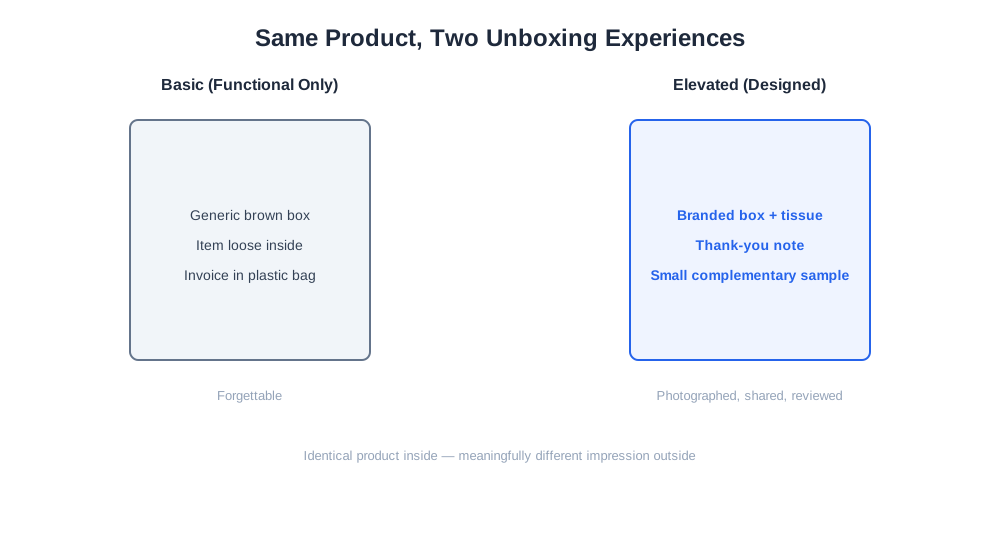
A simple example of the range here: at one end, a product arrives in a generic brown box with the item loose inside and an invoice stapled to a plastic bag — functional, but forgettable. At the other end, the same product arrives in a branded box, wrapped in tissue paper with the brand’s colors, accompanied by a short handwritten-style thank-you note and a small sample of a complementary product. The product itself is identical in both scenarios, but the second version creates a meaningfully different impression, and is far more likely to be photographed, shared, or mentioned in a review.

Ready to Monitor Your AI Visibility?
Track how AI chatbots mention your brand across ChatGPT, Perplexity, and other platforms.
Why Unboxing Experience Matters for E-commerce Brands
Online shopping strips away most of the sensory experience a customer would get in a physical retail store — no ability to touch the product before buying, no store atmosphere, no in-person interaction with staff. The unboxing moment is one of the few chances a brand has to reintroduce that sensory, tactile layer after the purchase decision has already been made, when the customer’s attention is fully on the brand rather than split across a crowded marketplace listing.
A well-designed unboxing experience also functions as free marketing. Customers who feel a package was worth photographing or mentioning create organic content and word-of-mouth that costs the brand nothing beyond the packaging investment itself, unlike paid acquisition channels where every impression has a direct cost.
Unboxing Experience Investment Levels
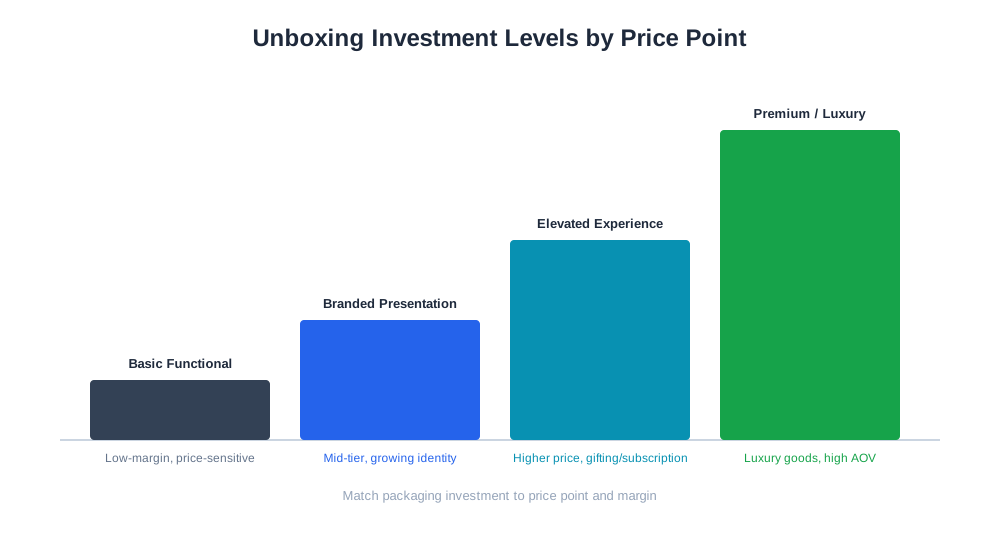
| Level | Typical Elements | Best Suited For |
|---|---|---|
| Basic functional | Standard box, adequate protective filling | Low-margin, price-sensitive products |
| Branded presentation | Custom-printed box or tape, branded tissue paper | Mid-tier price point, growing brand identity |
| Elevated experience | Custom-tooled packaging, printed inserts, small sample or gift | Higher price point, subscription or gifting products |
| Premium / luxury | Fully custom rigid packaging, ribbon, multi-step reveal | Luxury goods, high average order value |
Stay Updated on AI Visibility Trends
Get the latest insights on AI mentions, brand monitoring, and optimization strategies.
Unboxing Experience and AI-Driven Commerce
As more purchase research happens through AI shopping assistants like ChatGPT Shopping or Perplexity Shopping, the actual buying decision increasingly hinges on reviews and reputation signals the assistant surfaces, rather than a customer browsing a brand’s own site extensively. Unboxing experience feeds directly into that reputation layer: a product that consistently earns review mentions like “beautifully packaged” or “felt like a gift” builds the kind of social proof that AI assistants are effectively summarizing when they characterize a brand to a prospective buyer, even though the AI never touches the physical packaging itself.
Because unboxing investment is hard to justify without evidence it moves real behavior, it helps to connect it to concrete post-purchase metrics rather than anecdote alone. AmICited’s eshop reporting tools track repeat purchase and returning customer behavior over time, letting a brand see whether a packaging change correlates with a measurable shift in how often customers come back.
Best Practices for Unboxing Experience
- Match packaging investment to price point and margin — an elevated unboxing experience makes more sense for a $60 product than a $6 one
- Prioritize easy-to-open, frustration-free packaging alongside visual design, since a beautiful box that’s hard to open undercuts the experience
- Include small, low-cost touches (a thank-you card, a sample) before investing in expensive custom-tooled packaging, to test impact cheaply first
- Design packaging with photography and sharing in mind if social content is a goal, since flat lighting and cluttered filling material photograph poorly
- Track packaging costs as part of landed cost and fulfillment expense, since unboxing investment directly affects per-order margin
Common Unboxing Experience Mistakes
A common mistake is investing heavily in premium packaging for a low-margin product, where the added packaging cost erodes a thin margin further without a proportional increase in perceived value or repeat purchases. The fix is scaling unboxing investment to price point and margin rather than applying the same packaging standard across an entire catalog.
Another frequent issue is prioritizing visual design over practical usability — packaging that looks impressive but is genuinely difficult to open, tape that damages the product underneath, or filler material that creates more mess than delight. A frustrating unboxing moment can undercut an otherwise strong first impression regardless of how good the packaging looks.
Some brands also treat unboxing as a one-time design project rather than revisiting it as the product line or price point changes, resulting in packaging that no longer matches the brand’s current positioning or a newer, higher-priced product line that still ships in the same basic packaging used for an earlier, cheaper product.