


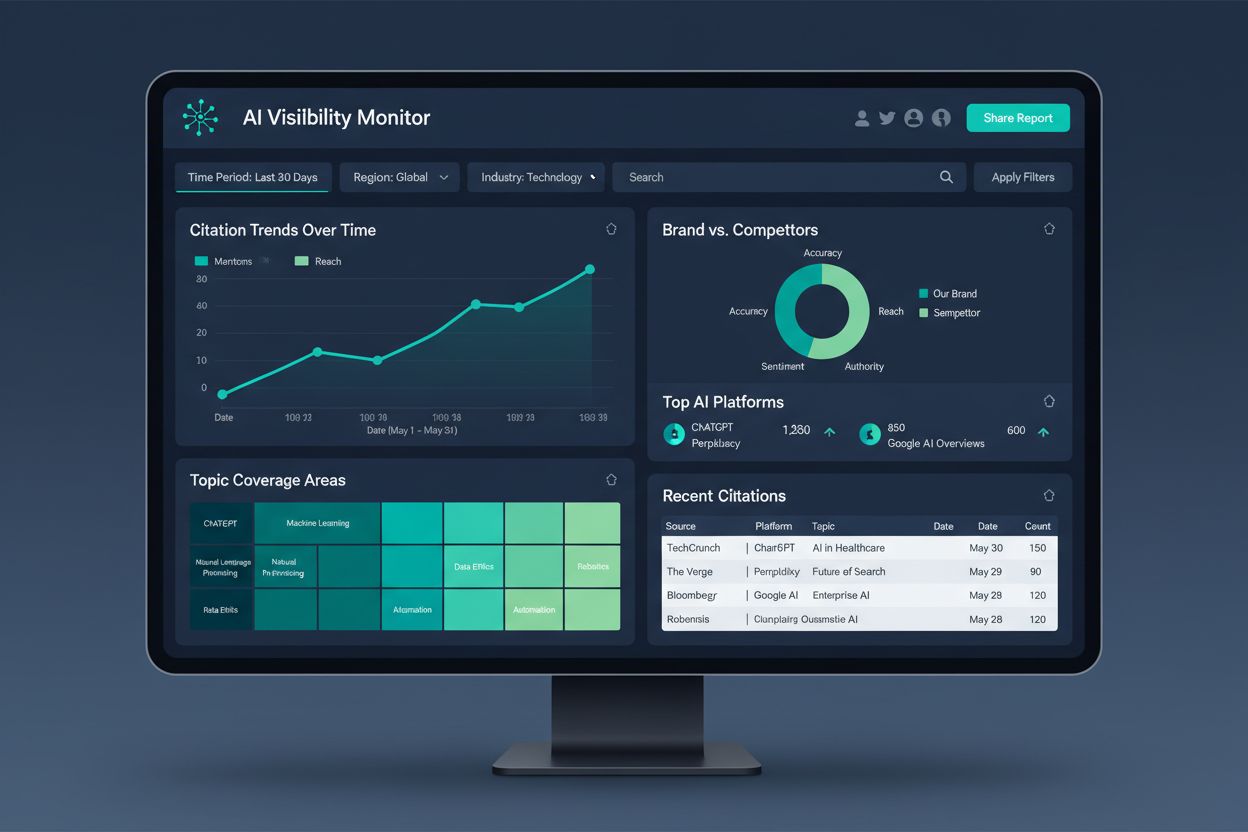
Creating Content to Fill AI Visibility Gaps
Once you know where your AI visibility gaps are, here's how to prioritize them, brief them, produce them, and verify they actually earned citations in ChatGPT, ...
7 min read

A step-by-step method for finding exactly where your AI visibility gaps are: content audits, competitor citation analysis, and testing your brand across ChatGPT, Perplexity, and Google AI Overviews.
AI visibility content gaps are the specific places where your content fails to appear, get cited, or get recommended in AI-generated answers—even when a competitor’s does for the exact same query. Diagnosing a gap is a different exercise from fixing one, and this post is entirely about the diagnostic side: how to find where your gaps actually are, how big they are, and which ones deserve attention first. Once you have that list, the work of writing and publishing content to close each gap—prioritization frameworks, content briefs, production workflow—is covered separately in creating content to fill AI visibility gaps . Treat this post as the audit phase that has to happen before that one: you can’t prioritize what you haven’t measured, and guessing at gaps without testing wastes content budget on topics that were never actually missing.
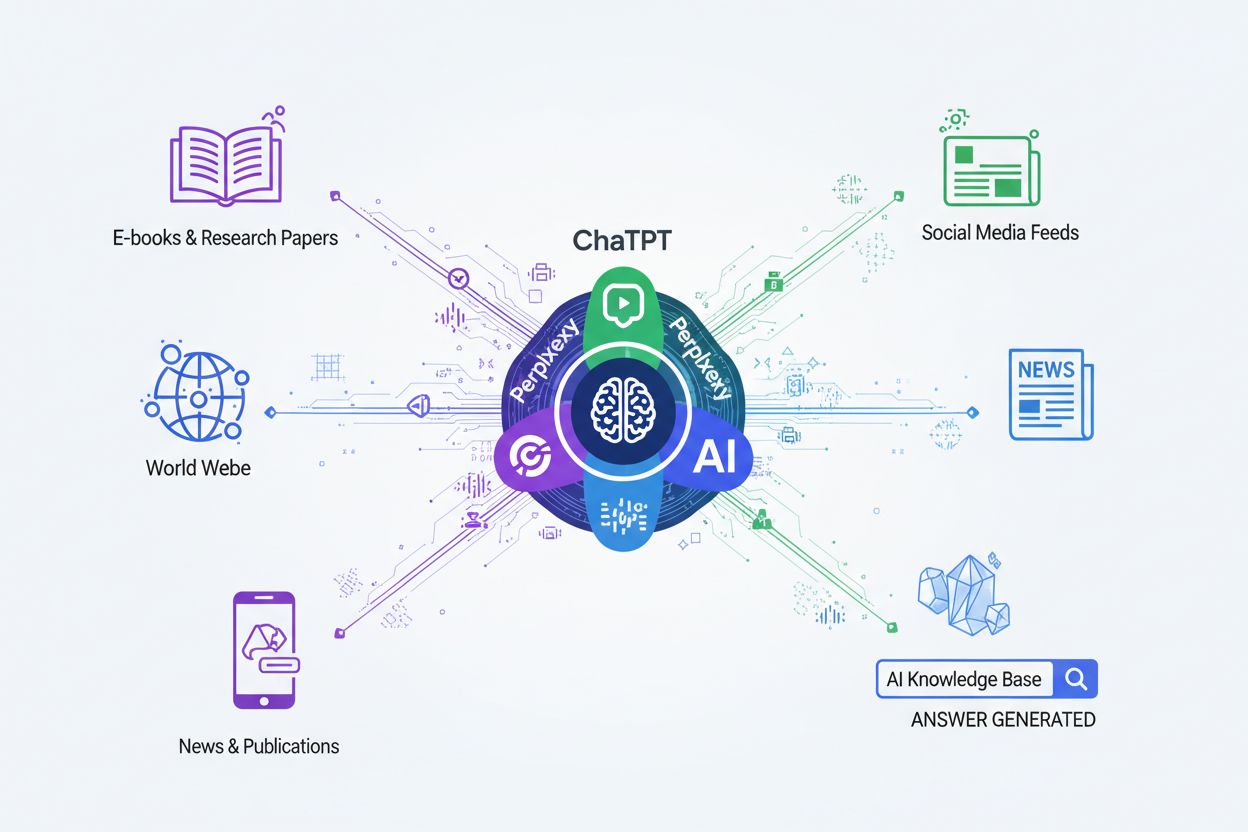
Before you start testing, it helps to know what you’re looking for. Content gaps in the AI visibility space fall into six distinct categories, and the diagnostic method differs for each:

Track how AI chatbots mention your brand across ChatGPT, Perplexity, and other platforms.
Knowing roughly how AI systems evaluate sources makes it much easier to interpret what your audit turns up. Language models weigh semantic relevance (does the content directly address the concept behind the question, not just its keywords), topical depth (does the page thoroughly cover the subject or just touch it), source credibility signals (domain authority, author expertise, how often other authoritative sources reference the work), and structural clarity (clear headings and explicit definitions that are easy to extract). When your audit shows a gap, checking it against these four factors usually tells you which type of gap you’re dealing with—thin coverage points to a topical authority gap, vague terminology points to a semantic understanding gap, and so on.
Start with what you already have. Catalog every piece of content across your site, blog, and other owned channels, noting the topic, publish date, and current performance. For each piece, ask whether you’ve achieved comprehensive topic coverage or only addressed part of the subject—most gaps aren’t a total absence of content, they’re a page that covers 60% of what a comprehensive answer needs. Check structural optimization (clear headings, explicit definitions) and freshness (is this still accurate). The output of this step is a spreadsheet mapping your content against the full set of subtopics and questions in your space, with the uncovered cells marked as candidate gaps.
Get the latest insights on AI mentions, brand monitoring, and optimization strategies.
Your own audit tells you what you’re missing in the abstract; competitor analysis tells you what’s actually costing you citations right now. Pull your top three to five competitors and examine which topics they cover comprehensively that you don’t. Look at their content architecture—pillar pages, topic clusters, comparison tables—since AI systems reward that kind of organization. Then test queries where you’d expect to appear and note which competitor gets cited instead. This is how you formally diagnose Citation Gaps: not by guessing which competitor is “better,” but by recording, query by query, whose content the AI actually pulled from and why yours wasn’t the source.
Auditing and competitor analysis tell you where gaps are likely; direct testing confirms them. Build a list of real prompts your buyers would type—brand name queries, category comparisons, “best X for Y” questions—and run each one across ChatGPT, Perplexity, Claude, and Google AI Overviews. Because a single prompt can return different results on different runs, test each topic with 5-10 phrasing variations before you conclude a gap is real rather than noise. Log which queries return your content, which return competitors, and which return neither. This step is what actually confirms AI-driven discovery gaps versus theoretical ones—a topic can look uncovered in your audit and still turn out to surface your content once you test the real phrasing users use.
Search intent works differently in AI systems than in traditional search. Users ask conversational, multi-part questions and AI systems evaluate whether your content provides the most comprehensive, authoritative answer to the whole question—not just a keyword match. Look at the follow-up questions AI systems generate in conversation, since these reveal information needs your original content doesn’t address. Map these patterns against your existing coverage to catch Semantic Understanding Gaps that a simple topic audit would miss: you might have a page “about” the right subject that never uses the phrasing or structure the AI is actually matching against.
Several tools support this diagnostic process, each covering a different part of it. AmICited.com and Wellows are purpose-built for AI citation monitoring—they automate the prompt-testing step across platforms so you’re not running queries by hand every week. Semrush and Ahrefs help with the competitor content gap side, surfacing topics competitors rank for that you don’t, which you can then cross-reference against AI citation patterns. InfraNodus specializes in topic mapping and knowledge graph visualization, useful for the content audit step when you need to see relationships between concepts at a glance. None of these tools replace direct testing in the AI platforms themselves—they make the process faster and repeatable, but the ground truth is always what the AI actually returns when you ask it a real question.
By the end of steps 1-4 you’ll have more candidate gaps than you can address at once, so the last diagnostic step is turning raw findings into an ordered list. Score each gap on business relevance, how often it shows up in your prompt testing, and how strong the competitor currently occupying that citation is—a gap where a weak competitor holds the citation is a faster win than one where an established authority does. That scored list becomes the direct input for content production: the detailed prioritization framework, content brief format, and publishing workflow for turning this list into content that actually earns citations is covered in creating content to fill AI visibility gaps .
Viktor Zeman is a co-owner of QualityUnit. Even after 20 years of leading the company, he remains primarily a software engineer, specializing in AI, programmatic SEO, and backend development. He has contributed to numerous projects, including LiveAgent, PostAffiliatePro, FlowHunt, UrlsLab, and many others.

Test your brand against competitors across ChatGPT, Perplexity, and Google AI Overviews, and get a clear map of where you're missing and why.
Once you know where your AI visibility gaps are, here's how to prioritize them, brief them, produce them, and verify they actually earned citations in ChatGPT, ...
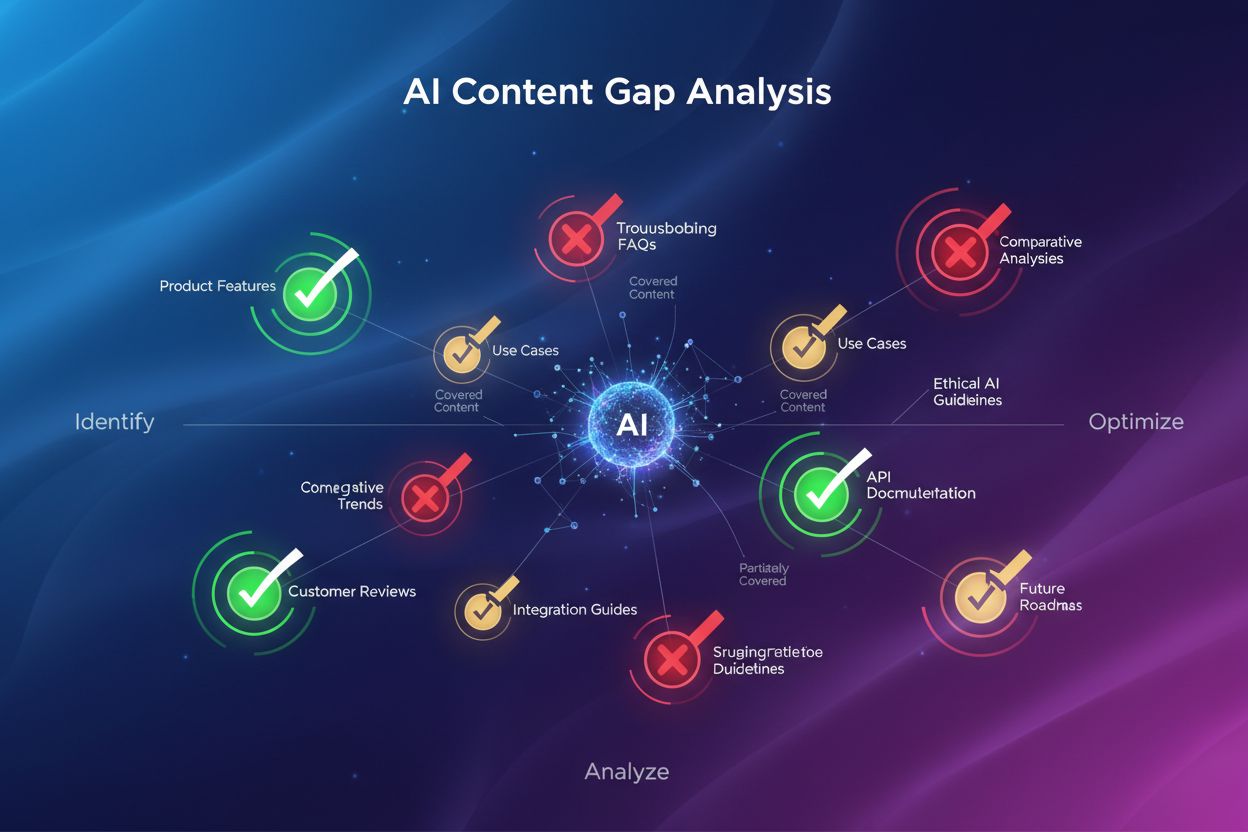
Learn what AI Content Gap Analysis is and how to identify content gaps to improve your visibility in AI Overviews, ChatGPT, and generative search engines. Disco...

Learn how to identify content gaps for AI search engines like ChatGPT and Perplexity. Discover methods to analyze LLM visibility, find missing topics, and optim...
Cookie Consent
We use cookies to enhance your browsing experience and analyze our traffic. See our privacy policy.