


Chargeback Ratio
Chargeback ratio is the percentage of a merchant's total transactions that result in a chargeback, calculated by dividing the number of chargebacks by the total number of transactions over a given period. Card networks monitor this ratio closely, and exceeding their thresholds can trigger penalties, higher processing fees, or loss of payment processing privileges.
Definition of Chargeback Ratio
Chargeback ratio is the percentage of a merchant’s total transactions in a given period that result in a chargeback — a forced reversal of a card payment initiated by the customer’s bank rather than the merchant. It’s calculated by dividing the number of chargebacks received in a period, usually a calendar month, by the total number of transactions processed in that same period, then expressing the result as a percentage. Card networks like Visa and Mastercard track this ratio for every merchant account because it’s their primary tool for identifying businesses with fraud problems, poor customer service, or misleading sales practices, and both networks operate formal monitoring programs that escalate consequences — fines, mandatory remediation, and eventually account termination — for merchants whose ratio stays above defined thresholds.
How Chargeback Ratio Is Calculated
The basic formula is straightforward: chargeback ratio equals the number of chargebacks divided by the total number of transactions in the same period, multiplied by 100 to express it as a percentage. Card networks generally calculate this on a monthly rolling basis, and it’s worth noting that a chargeback filed in a given month often relates to a transaction from an earlier month, since disputes can take weeks to be filed and resolved — most monitoring programs account for this by looking at the ratio of chargebacks to transactions within the same calendar month regardless of when the original sale occurred.
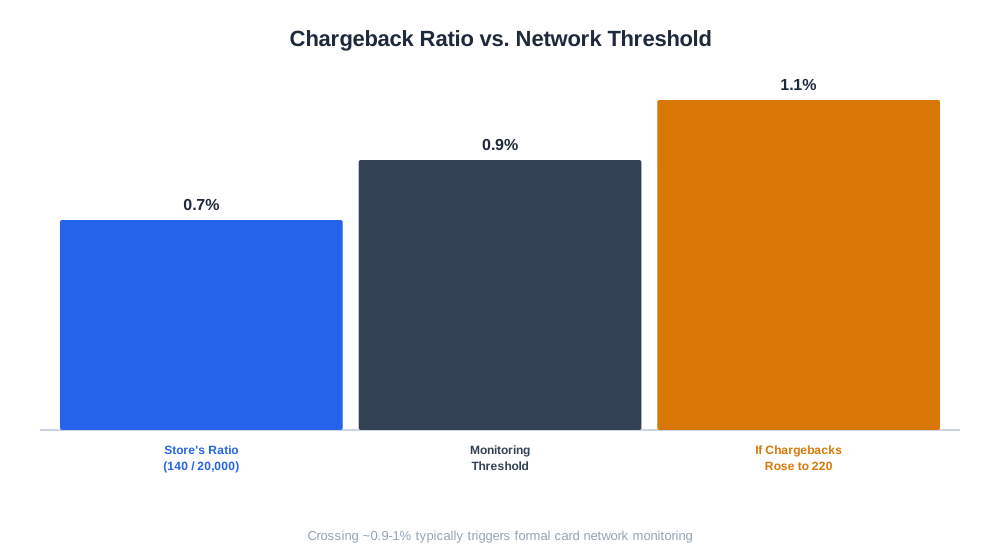
A worked example: an online electronics store processes 20,000 transactions in a month and receives 140 chargebacks in that same month. The chargeback ratio is 140 divided by 20,000, multiplied by 100, equaling 0.7 percent — below most network monitoring thresholds, which typically begin around 0.9 to 1 percent, though a merchant this close to the threshold should be actively working to reduce disputes rather than treating the current number as safely acceptable. If that same store’s chargebacks rose to 220 in a subsequent month while transaction volume stayed flat, the ratio would climb to 1.1 percent, likely triggering formal monitoring and associated fees from the card networks.

Ready to Monitor Your AI Visibility?
Track how AI chatbots mention your brand across ChatGPT, Perplexity, and other platforms.
Why Chargeback Ratio Matters for E-commerce Brands
Chargeback ratio matters far beyond the direct cost of the reversed transactions themselves, though that cost is real — each chargeback typically carries a fee from the payment processor on top of the lost revenue and product, regardless of whether the merchant ultimately wins the dispute. The larger risk is structural: card networks use chargeback ratio as their primary signal for merchant risk, and a business that crosses monitoring thresholds faces escalating fines, a mandatory remediation plan, and in persistent cases, termination of its ability to process card payments altogether — a consequence severe enough to end an e-commerce business outright, since most online stores depend entirely on card payments for revenue. Even short of that worst case, a rising chargeback ratio often signals an underlying operational problem — confusing billing descriptors, slow customer support, or unaddressed fraud — that is costing the business in ways beyond the chargebacks themselves, including lost customer trust and repeat business.
Chargeback Ratio vs. Related Dispute Metrics
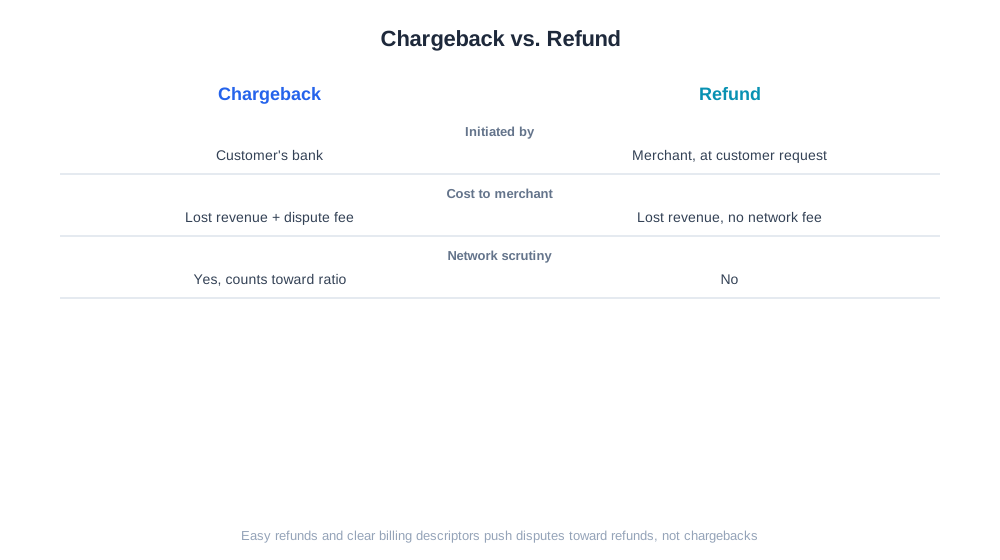
| Metric | What It Measures | Who Initiates It | Typical Cost to Merchant |
|---|---|---|---|
| Chargeback Ratio | Percentage of transactions disputed via the card network | Customer’s bank | Lost revenue plus dispute fee |
| Refund Rate | Percentage of transactions refunded directly | Merchant, at customer request | Lost revenue, no network fee |
| Dispute Win Rate | Percentage of contested chargebacks the merchant wins | Merchant (in response) | Recovers revenue if won |
| Friendly Fraud Rate | Chargebacks from customers disputing legitimate purchases | Customer, often mistakenly or in bad faith | Lost revenue, no recourse if unproven |
Stay Updated on AI Visibility Trends
Get the latest insights on AI mentions, brand monitoring, and optimization strategies.
Chargeback Ratio and AI-Driven Commerce Analytics
As online payment volume grows and fraud tactics evolve, keeping a close eye on chargeback ratio has become a continuous monitoring task rather than something to check only after a card network sends a warning notice. AmICited’s eshop_get_order_mix tool breaks down a store’s orders by outcome — including refunds, disputes, and chargebacks — as a share of total order volume, giving a merchant visibility into whether their chargeback ratio is trending toward a network threshold well before a formal monitoring notice arrives. This kind of ongoing visibility matters increasingly as more transactions originate from AI shopping assistants and conversational commerce flows, where a customer completing a purchase through an unfamiliar interface may be more likely to later not recognize the charge on their statement and file a dispute rather than contact the merchant directly — making a clear, recognizable billing descriptor and easy access to order history even more important as these new purchase paths grow.
Best Practices for Managing Chargeback Ratio
- Use a clear, recognizable billing descriptor that matches your storefront name, since a large share of avoidable chargebacks stem from customers not recognizing a charge on their statement.
- Make customer support easy to reach and refunds straightforward, so a dissatisfied customer contacts the merchant first rather than going straight to their bank.
- Send order and shipping confirmation emails promptly, reducing the odds a customer disputes a charge simply because they’re unsure whether the order is legitimate or has shipped.
- Use available fraud screening tools to flag high-risk orders before fulfillment, particularly for high-value items or unusual shipping-billing address mismatches.
- Respond to every dispute with available evidence — proof of delivery, customer communication, order confirmation — since winning disputes not only recovers revenue but keeps the ratio calculation lower over time in some monitoring frameworks.
Common Chargeback Ratio Mistakes
A common mistake is treating chargebacks purely as a cost of doing business and not investigating the underlying cause, which allows a fixable problem — like a confusing billing descriptor or a slow refund process — to continue driving disputes indefinitely instead of being addressed at the source. Another frequent issue is failing to distinguish between fraud-driven chargebacks and friendly fraud, where a customer disputes a legitimate purchase rather than requesting a refund directly; these require different responses, since fraud calls for better screening while friendly fraud often calls for better customer communication and easier self-service refunds. Some merchants also underestimate how close they are to a network monitoring threshold, only realizing the ratio has crept upward after receiving a fine or remediation notice, rather than tracking it proactively on a monthly basis. It’s also common to ignore evidence submission entirely when disputing a chargeback, assuming the case is unwinnable, when in many instances proof of delivery or clear customer communication is enough to reverse the dispute and recover the revenue. Finally, businesses experiencing rapid growth sometimes see their chargeback ratio spike not because fraud has increased in absolute terms but because new customer acquisition channels bring in less familiar or lower-intent buyers who are statistically more likely to dispute a charge — a pattern worth investigating by channel rather than treating the overall ratio as a single undifferentiated problem.