


- Direct to consumer (DTC) means the company that makes a product sells it straight to the people who use it, through its own site, app, social shop or store.
- DTC keeps the full retail margin but pays for what a retailer used to do: fulfillment, payment fees and the ad spend to win each customer.
- First-order profit is often no better than wholesale. DTC pays off through repeat orders, so acquisition cost against lifetime value is the number to watch.
- DTC is a subset of B2C: the seller and the maker are the same company.
Where AmICited fits
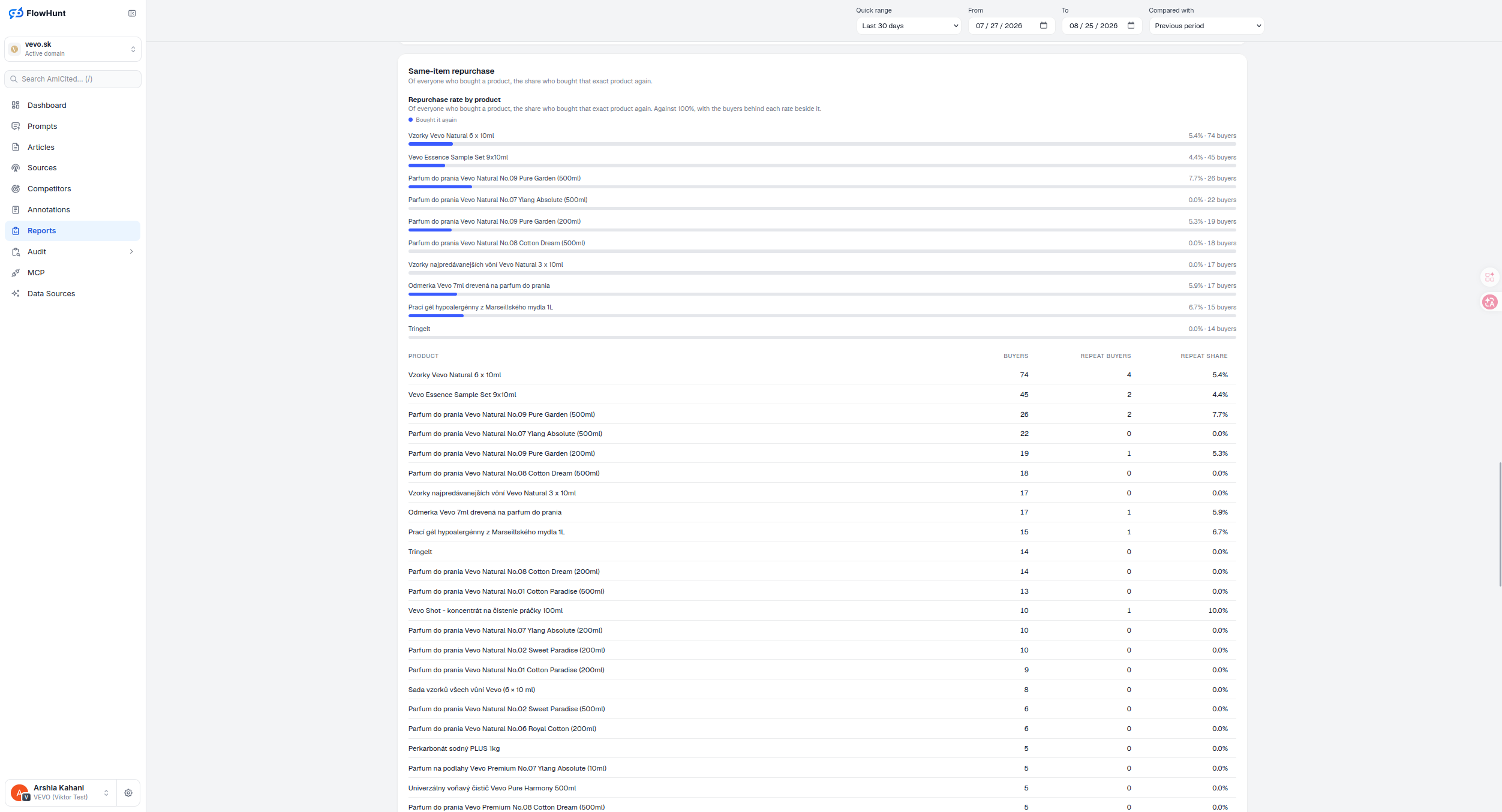
AmICited covers both sides of DTC growth: it tracks how ChatGPT, Perplexity, Gemini and Google’s AI answers mention your brand next to competitors, and its shop reports show repeat purchase, lifetime value and contribution margin from your store data.
See competitor analysis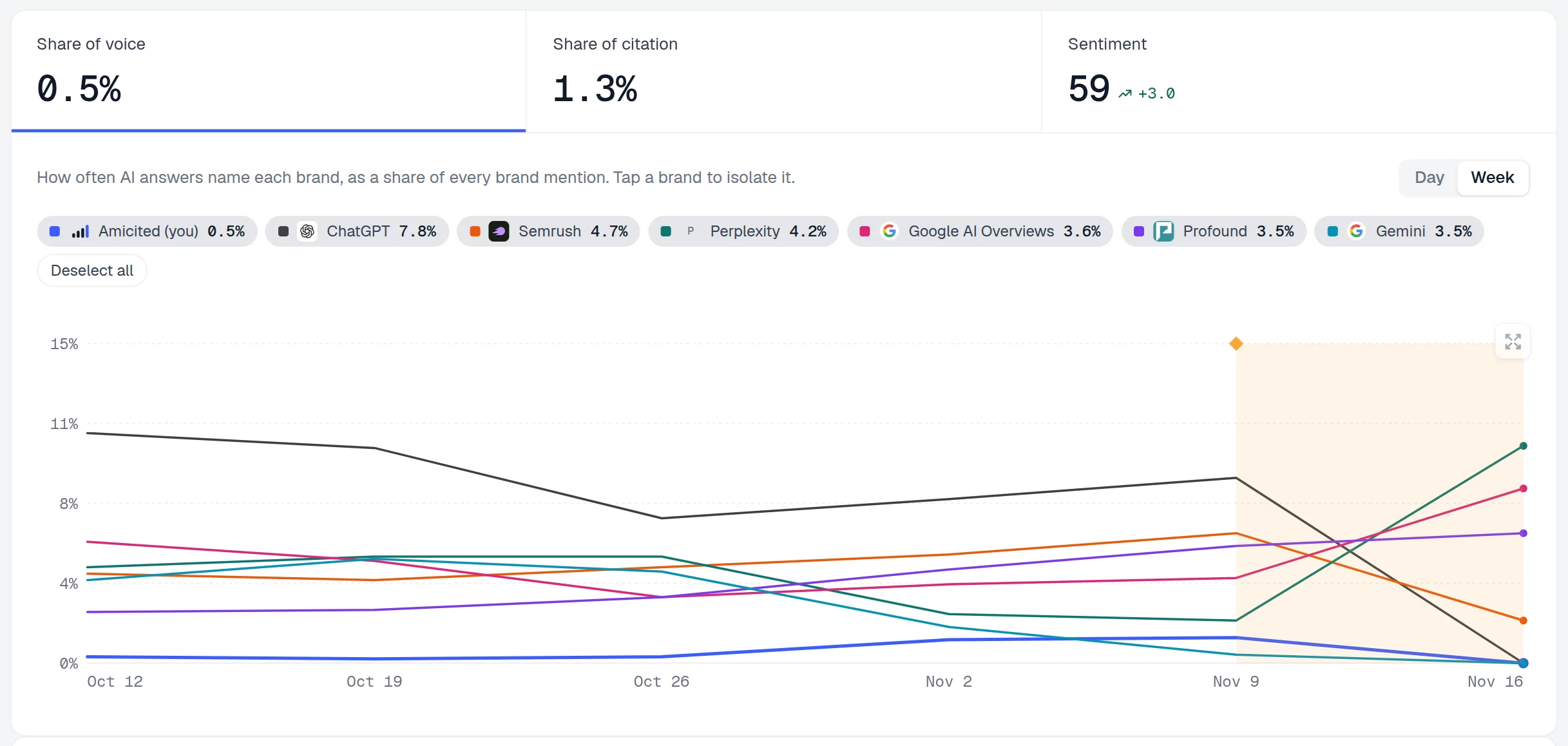
What Is Direct to Consumer?
Direct to consumer (DTC, sometimes D2C) is a model where the company that makes a product sells it straight to the people who use it. There is no distributor, wholesaler or retail store in between. The sale happens on the brand’s own website, app, social shop or physical store, and the brand handles marketing, payment, shipping and customer service.
DTC took off in the 2010s as Shopify, Facebook and Instagram ads made it cheap to launch a brand online. Warby Parker, Casper, Glossier and Allbirds became the textbook examples. Today the term covers both digital-native brands and established manufacturers, such as Nike, that push a bigger share of sales through their own channels. It is one of the main routes in B2C ecommerce, next to retailers and marketplaces.
How the Direct to Consumer Model Works
The DTC trade-off is simple: you keep more of each sale, but you pay for everything a retailer used to do. A worked example makes it concrete.
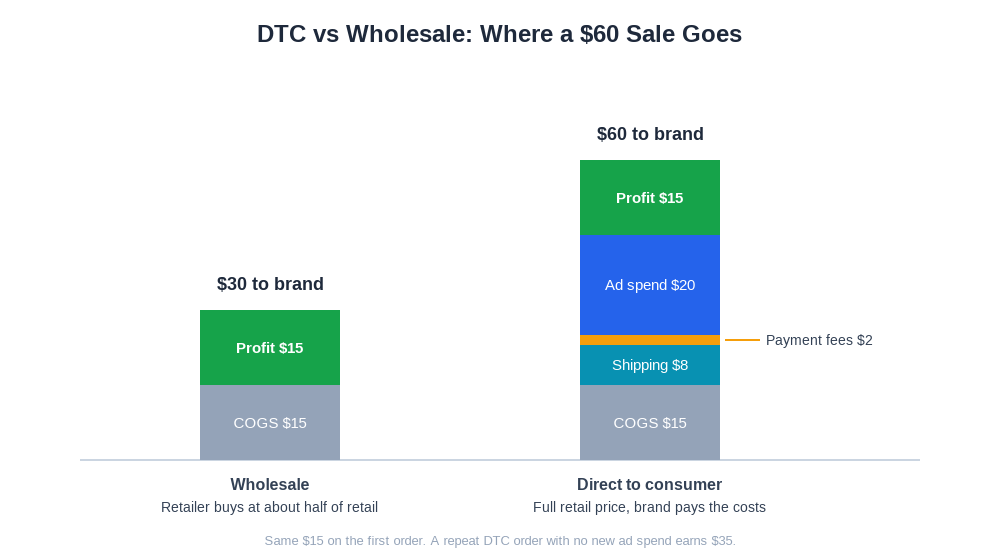
Say a product retails for $60 and costs $15 to make (COGS).
- Wholesale route. A retailer typically buys at about half the retail price, so you sell at $30. Your gross profit is $30 − $15 = $15 per unit. The retailer pays for shelf space, shoppers and returns.
- DTC route. You sell at the full $60. Then you pay $8 to pick, pack and ship, $2 in payment fees and $20 in ad spend to win the customer. Your profit is $60 − $15 − $8 − $2 − $20 = $15 per unit.
Same profit on the first order. The difference shows up later. If that DTC customer orders again without new ad spend, the second order earns $35. That is why DTC economics depend on customer acquisition cost and repeat purchases, not on first-order margin. A brand that can’t get second orders often ends up worse off than if it had sold wholesale.
DTC vs Wholesale vs Marketplace
| Direct to consumer | Wholesale / retail | Marketplace (e.g. Amazon) | |
|---|---|---|---|
| Who sets the price | Brand | Retailer | Brand, within marketplace rules |
| Margin kept | Full retail margin | Wholesale margin only | Retail price minus fees |
| Customer data | Brand owns it | Retailer owns it | Mostly the marketplace |
| Demand generation | Brand pays for all of it | Retailer’s foot traffic helps | Marketplace traffic helps |
| Fulfillment | Brand or its 3PL | Retailer after delivery | Brand or marketplace (e.g. FBA) |
| Main risk | Rising acquisition cost | Price pressure, returns, deductions | Fees and dependence on one platform |
Most brands end up mixing these routes. That is multichannel ecommerce: the DTC site carries full-price sales and customer data, while Amazon and retail partners bring reach.
DTC vs B2C
People mix these up. B2C (business to consumer) says who buys: consumers. DTC says how the product gets to them: straight from the maker. A grocery chain selling a cereal brand is B2C but not DTC. The cereal brand selling a subscription box on its own site is both. In short, DTC is a subset of B2C where the seller and the manufacturer are the same company.
A brand that has its products made by a contract manufacturer still counts as DTC when it sells them straight to consumers. What matters is that the brand owner sets the price, owns the customer relationship and handles the sale itself, rather than handing those jobs to a retailer. Replenishable products such as razors, coffee and supplements often run as subscription commerce, which suits DTC well because one acquisition cost turns into many orders.

Stay Updated on AI Visibility Trends
Get the latest insights on AI mentions, brand monitoring, and optimization strategies.
Direct to Consumer and AI Search
DTC brands rely on being found, since they don’t get the passive discovery of a store shelf. A growing share of discovery now starts in AI answers, where someone asks ChatGPT or Perplexity for “the best mattress for side sleepers” and gets a short list. Those lists are built from review sites, Reddit threads, comparison articles and brand pages, not from your ad account.
That makes AI visibility a real DTC channel to measure. AmICited’s AI visibility tracking records how ChatGPT, Perplexity, Gemini and Google’s AI answers cite and mention your brand, and competitor analysis shows which rival brands appear beside you and in which prompts.
Best Practices for Direct to Consumer Brands
- Judge channels on customer lifetime value against acquisition cost, not first-order ROAS.
- Build a second-purchase path from day one: replenishment emails, bundles, subscriptions or a loyalty offer.
- Track contribution margin per order after shipping, returns and payment fees, so you know what each sale really earns.
- Collect first-party data at checkout and post-purchase (email, SMS consent, survey answers) and actually use it.
- Diversify acquisition beyond paid social: SEO, creators, affiliates, PR and AI answer visibility.
- Add marketplaces or retail when they bring customers you can’t reach profitably, and price consistently across channels.
Common Direct to Consumer Mistakes
The classic DTC mistake is scaling paid ads on first-order ROAS while customer acquisition cost climbs and repeat rate stays flat. Revenue grows, cash disappears. A close second is ignoring fulfillment and return costs in the margin model, which looks fine at 100 orders a month and painful at 10,000.
Brands also tend to treat “DTC only” as an identity rather than a strategy. Refusing Amazon or retail on principle can cap growth when customers already look for the product there, and unauthorized resellers fill the gap. Finally, many DTC brands underinvest in organic and AI discovery, so when ad costs rise there is no free channel to fall back on.