


- Multichannel ecommerce is selling the same products in several online places at once: your own store, marketplaces like Amazon or eBay, Google Shopping and social shops.
- It widens reach because buyers start in different places, but every channel adds its own fees, rules and listing format.
- Keep one product catalog and one inventory pool synced to every channel, with buffers on fast sellers, or you will oversell.
- Compare channels on contribution margin after fees, ads, shipping and returns, not on revenue.
Where AmICited fits
AI answers are one more place products get discovered. AmICited’s Shopping report shows which products and sellers appear on AI product cards for your tracked prompts, with position and price, and the Sources report shows which domains, marketplaces included, the engines cite.
See AI visibility tracking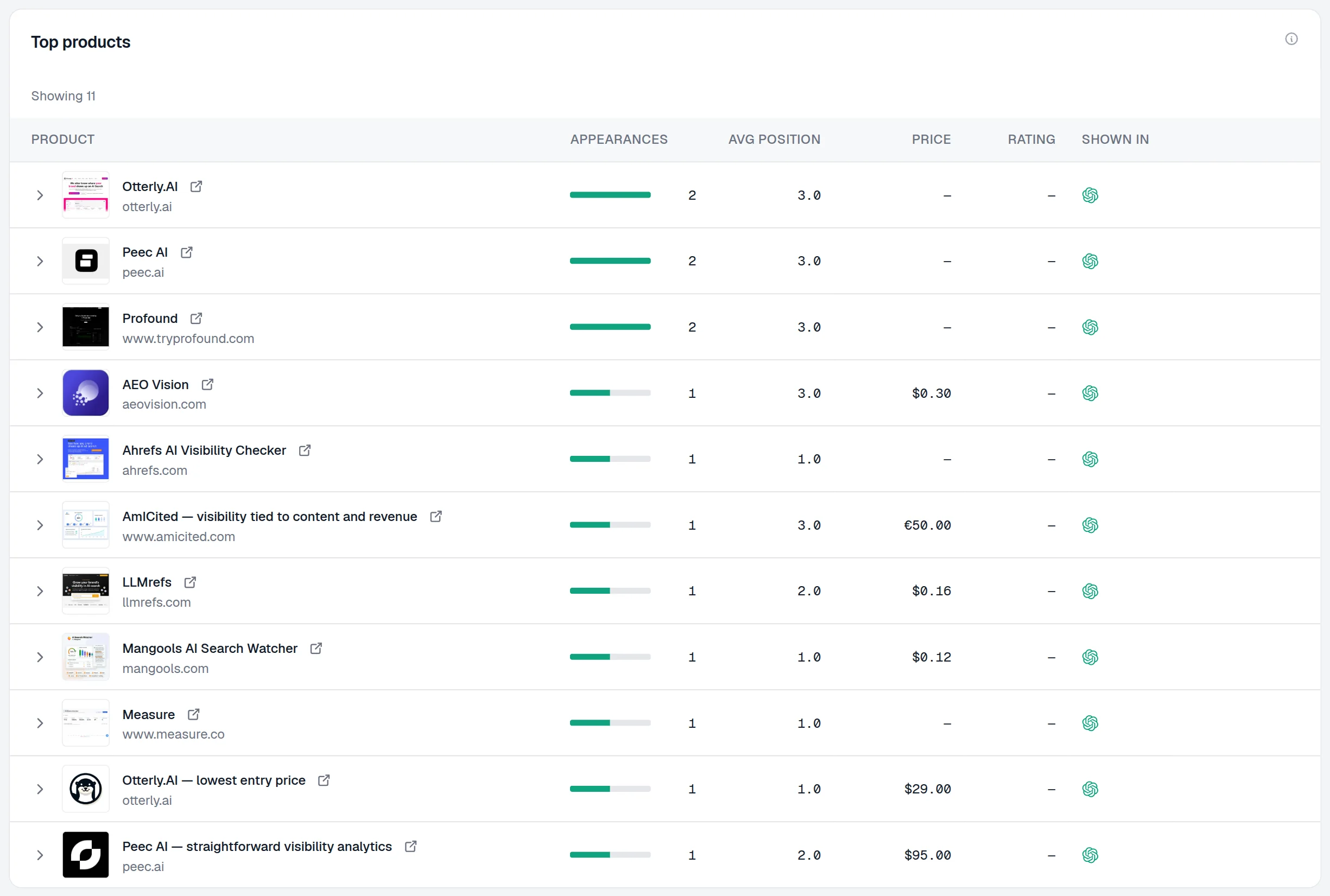
What Is Multichannel Ecommerce?
Multichannel ecommerce is selling your products in more than one online place at the same time. A typical setup is a branded store on Shopify, WooCommerce or BigCommerce, plus listings on Amazon, eBay or Walmart Marketplace, plus product feeds to Google Shopping and social shops on TikTok, Instagram or Pinterest.
The reason is simple: buyers don’t all shop in the same place. Many product searches start on Amazon, others on Google, others in a social feed. Selling where they already are widens reach without having to pull every buyer to your site. The cost is complexity. Each channel has its own listing format, fees, rules and customer expectations, and all of them draw on the same stock. That’s why multichannel sellers lean on an order management system and solid inventory management.
How Multichannel Ecommerce Works
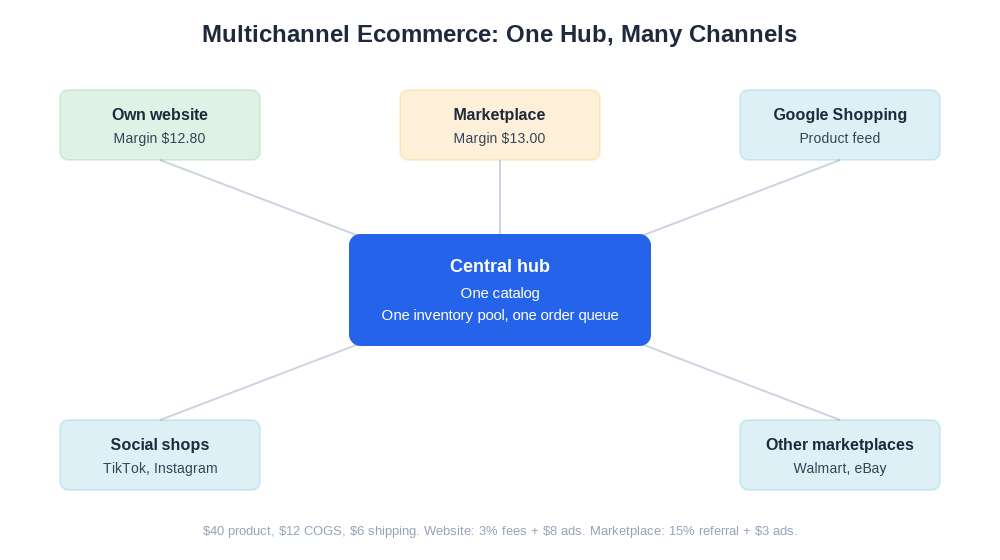
A working multichannel setup has a hub and spokes:
- One product catalog. Titles, descriptions, images and identifiers such as GTIN live in one place, often a PIM or the main store platform.
- One inventory pool. Stock counts sit in a single system and sync to each channel, with buffers to prevent overselling.
- Channel connectors. Apps or integrations push listings and prices out and pull orders back in.
- Central order processing. Orders from every channel flow into one queue for picking, packing and shipping, whether in-house, through a 3PL or through a marketplace program like Amazon FBA.
Margins differ by channel, so compare them per order. Take a $40 product with $12 COGS and $6 shipping:
- Own website: $40 − $12 − $6 − $1.20 payment fees (3%) − $8 average ad cost = $12.80.
- Marketplace: $40 − $12 − $6 − $6 referral fee (15%) − $3 in marketplace ads = $13.00.
Close on paper. The difference is that the website order gives you the customer’s email and a chance at repeat business, while the marketplace mostly keeps the customer. Run this math per channel, using your real fees, before deciding where to push.
Multichannel Ecommerce Channels Compared
| Channel | Strength | Trade-off | Watch closely |
|---|---|---|---|
| Own website | Full margin, customer data, brand control | You pay for all traffic | Acquisition cost, conversion rate |
| Amazon | Huge built-in demand | Referral fees, strict rules, price competition | Buy Box share, account health |
| Walmart, eBay, other marketplaces | Extra demand with less competition in some categories | Separate listing rules and fees | Fulfillment speed, cancellation rate |
| Google Shopping and free listings | Product-level visibility in search | Needs a clean feed and ad spend for paid placement | Feed errors, cost per sale |
| Social shops (TikTok Shop, Instagram, Pinterest) | Discovery through content and creators | Volatile reach, creator fees | Content output, return rate |
Multichannel vs Omnichannel Ecommerce
Multichannel is about presence: you sell in several places. Omnichannel is about continuity: the customer gets one experience across those places. In a multichannel business, a customer who buys on Amazon and later visits your site is a stranger to it. In an omnichannel business, their purchase history, loyalty points and returns work across web, app and stores.
Most brands start multichannel and move toward omnichannel or unified commerce as they grow. You don’t have to connect everything at once. Shared inventory and a single order queue are the first two pieces that matter.
Multichannel selling often turns into cross-border selling too. Listing on Amazon in another country, or on a regional marketplace, adds currencies, taxes, duties and local returns to the mix. Treat each new country as a new channel with its own margin math, not as a copy of your home setup.

Stay Updated on AI Visibility Trends
Get the latest insights on AI mentions, brand monitoring, and optimization strategies.
Multichannel Ecommerce and AI Search
AI assistants have become a discovery layer that sits on top of every other channel. When ChatGPT or Perplexity recommends a product, it may link to your site, to Amazon or to a review page. The more consistent your product names, specs and prices are across channels, the easier it is for an engine to recognize them as the same product and describe it correctly.
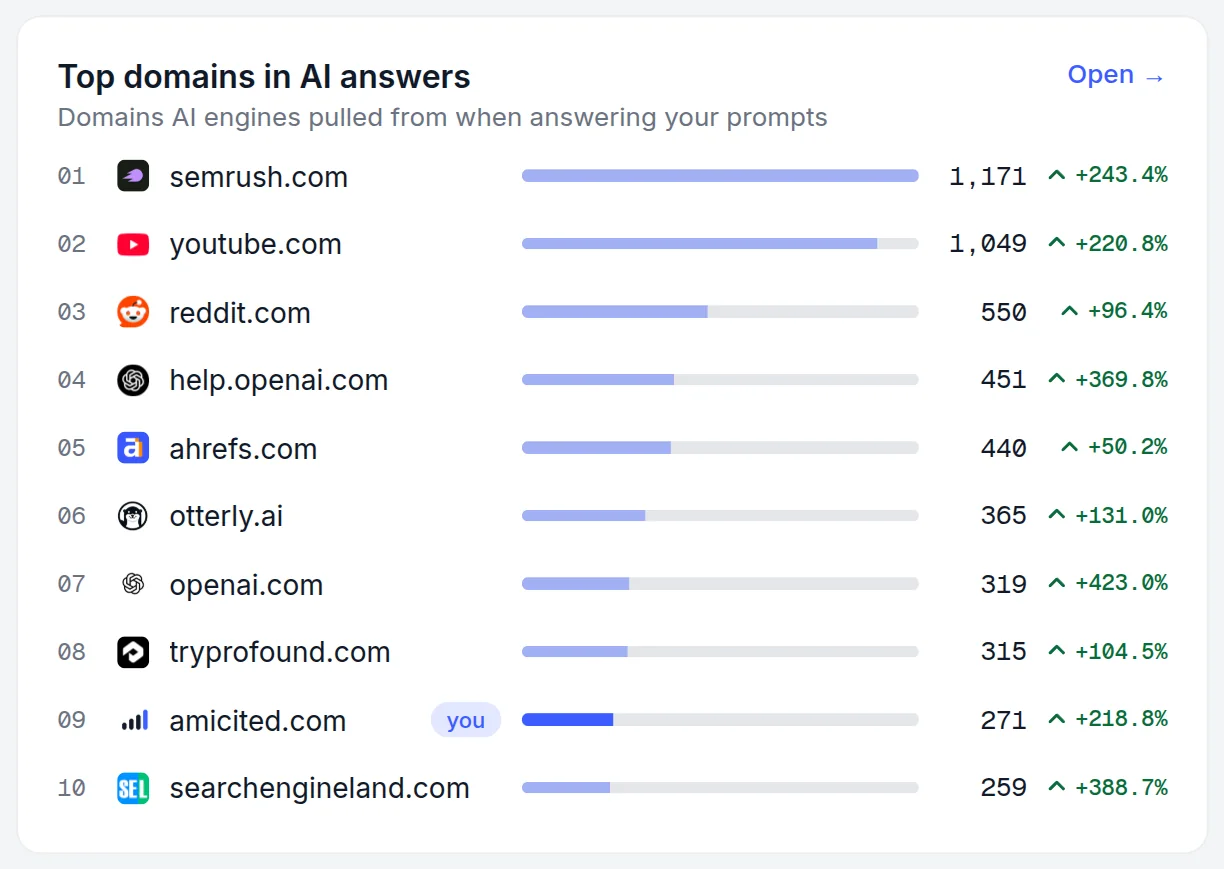
Treat AI answers as a channel you measure. AmICited’s AI visibility tracking records how ChatGPT, Perplexity, Gemini, Google AI Overviews and Google AI Mode mention your brand, and Source and Citation Intelligence shows which domains, including marketplaces, those engines cite.
Best Practices for Multichannel Ecommerce
- Add one channel at a time and get it profitable before adding the next.
- Keep one source of truth for product data and push the same core content everywhere, adapted to each channel’s format.
- Sync inventory automatically and hold per-channel buffers on fast sellers.
- Calculate contribution margin per channel after fees, ads, shipping and returns, not just revenue.
- Keep pricing consistent enough that you don’t train buyers to wait for the cheapest channel.
- Route every channel’s orders into one fulfillment process with the same shipping standards.
Common Multichannel Ecommerce Mistakes
Overselling is the classic one. Stock syncs every hour, two channels sell the last unit, and you cancel an order, which hurts marketplace metrics. A close second is judging channels on revenue, so a marketplace with high fees and returns looks like the star while it loses money on every sale.
Sellers also copy and paste the same listing to every channel without adapting titles and attributes to each platform’s search rules, which leaves easy visibility on the table. And many brands let marketplaces grow until they’re most of the business, then get hit by a fee change or suspension with no other channel strong enough to carry them.