


- A GTIN (Global Trade Item Number) is the unique number in a product’s barcode for one item in one variant and pack size. GS1 runs the system.
- UPC-A is a GTIN-12 and EAN-13 is a GTIN-13. An ASIN is Amazon’s own catalog ID, valid only on Amazon, and is not a GTIN.
- The last digit is a mod-10 check digit, so scanners and feed tools catch most typos.
- Google Merchant Center and product schema use GTINs to match your offer to a known product. Reused or bought-in numbers can merge or suppress listings.
Where AmICited fits
AI shopping answers need clean identifiers to match your products. AmICited’s Shopping report shows which products and sellers appear on AI product cards for the prompts you track, with appearances, position, price and rating.
See AI visibility tracking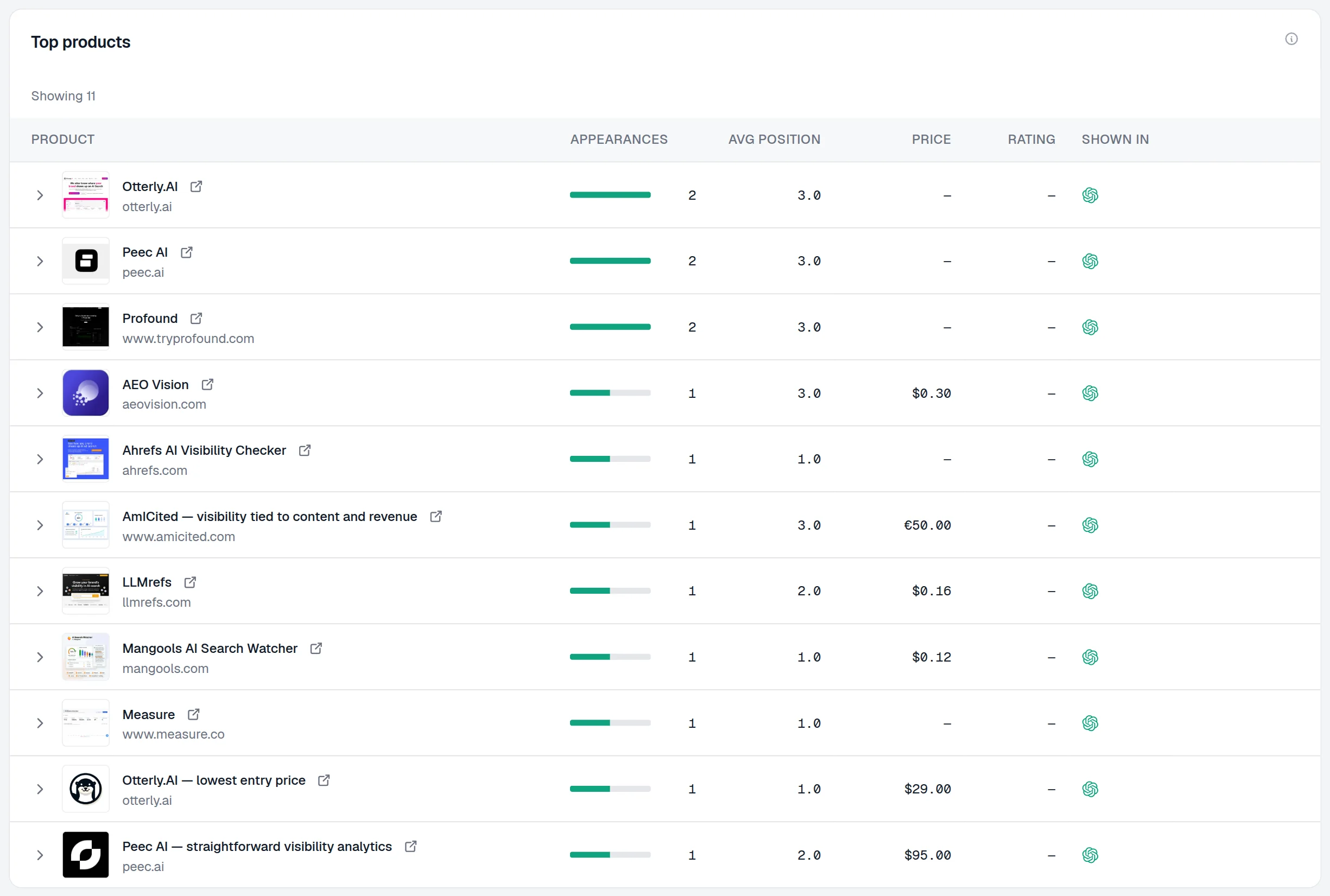
What Is a GTIN?
A GTIN (Global Trade Item Number) is the globally unique number that identifies a trade item: a specific product, in a specific variant and pack size. It is the number encoded in the barcode on the box, and it is managed by GS1, a nonprofit standards body with member organizations in over 100 countries. Whoever owns the brand assigns the GTIN, using a company prefix licensed from GS1.
GTINs matter wherever products have to be matched across systems. Retail point-of-sale scanners read them. Google Merchant Center uses the gtin attribute to tie your offer to a known product. Amazon uses them (as UPC, EAN or ISBN) when you create a listing, before assigning its own
ASIN. Your internal
SKU is yours alone, but the GTIN means the same thing to every retailer and marketplace on the planet.
How a GTIN Is Built
Every GTIN has three parts:
- GS1 company prefix. Identifies the brand owner. Its length varies, which is why big companies can number more products.
- Item reference. The number the company assigns to each product variant.
- Check digit. The last digit, calculated from the others, so scanners catch typos and misreads.
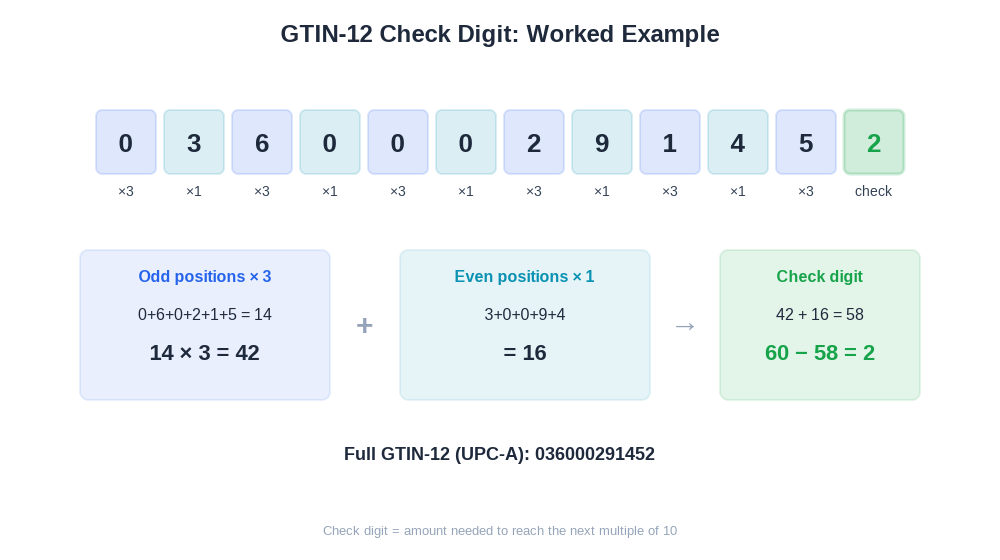
The check digit uses a simple mod-10 rule. Take the UPC 03600029145 plus a missing last digit:
- Starting from the right, multiply digits alternately by 3 and 1. For a 12-digit code, that means the 1st, 3rd, 5th, 7th, 9th and 11th digits get ×3.
- Digits in odd positions: 0 + 6 + 0 + 2 + 1 + 5 = 14, and 14 × 3 = 42.
- Digits in even positions: 3 + 0 + 0 + 9 + 4 = 16.
- Total: 42 + 16 = 58. The check digit is the amount needed to reach the next multiple of 10: 60 − 58 = 2.
So the full GTIN-12 is 036000291452. If a single digit is mistyped, the check usually fails.
GTIN Formats
| Format | Digits | Common barcode name | Typical use |
|---|---|---|---|
| GTIN-8 | 8 | EAN-8 | Very small packages where a full barcode won’t fit |
| GTIN-12 | 12 | UPC-A | Retail products in the US and Canada |
| GTIN-13 | 13 | EAN-13 (also ISBN-13 for books) | Retail products in most of the world |
| GTIN-14 | 14 | ITF-14 or GS1-128 | Cases, cartons and other shipping units |
Any shorter GTIN can be written as 14 digits by padding with leading zeros. That is why databases often store every GTIN as 14 digits.
The length of your GS1 company prefix decides how many GTINs you can create. In a GTIN-13, the prefix and the item reference share the 12 digits before the check digit. A 7-digit prefix leaves 5 digits for items, enough for 100,000 products. A 10-digit prefix leaves 2, enough for 100. Small brands that need only a handful of numbers can license single GTINs from GS1 US instead of a full prefix.
GTIN vs UPC vs EAN vs ASIN
GTIN is the family name; UPC and EAN are barcode formats within it. A UPC-A is a GTIN-12. An EAN-13 is a GTIN-13. Put a leading zero in front of a UPC and you get the equivalent EAN-13, which is why US products scan fine in Europe.
An ASIN is different. It is Amazon’s own 10-character catalog ID, valid only on Amazon, and many products have both. MPN (manufacturer part number) is another identifier, assigned by the manufacturer without any global registry. Schema.org supports all of these in
product markup through properties such as
gtin, gtin12 and gtin13 and mpn.

Stay Updated on AI Visibility Trends
Get the latest insights on AI mentions, brand monitoring, and optimization strategies.
GTINs and AI Search
AI shopping answers need to know that the “Sony WH-1000XM5” on your site is the same item a review site tested and a marketplace sells. Unique identifiers are one of the clearest signals for that match. Google uses GTINs in Merchant Center and Shopping, and Google’s product structured data guidelines recommend including them. A product feed or page that carries a correct GTIN is simply easier to reconcile than one that relies on fuzzy title matching.
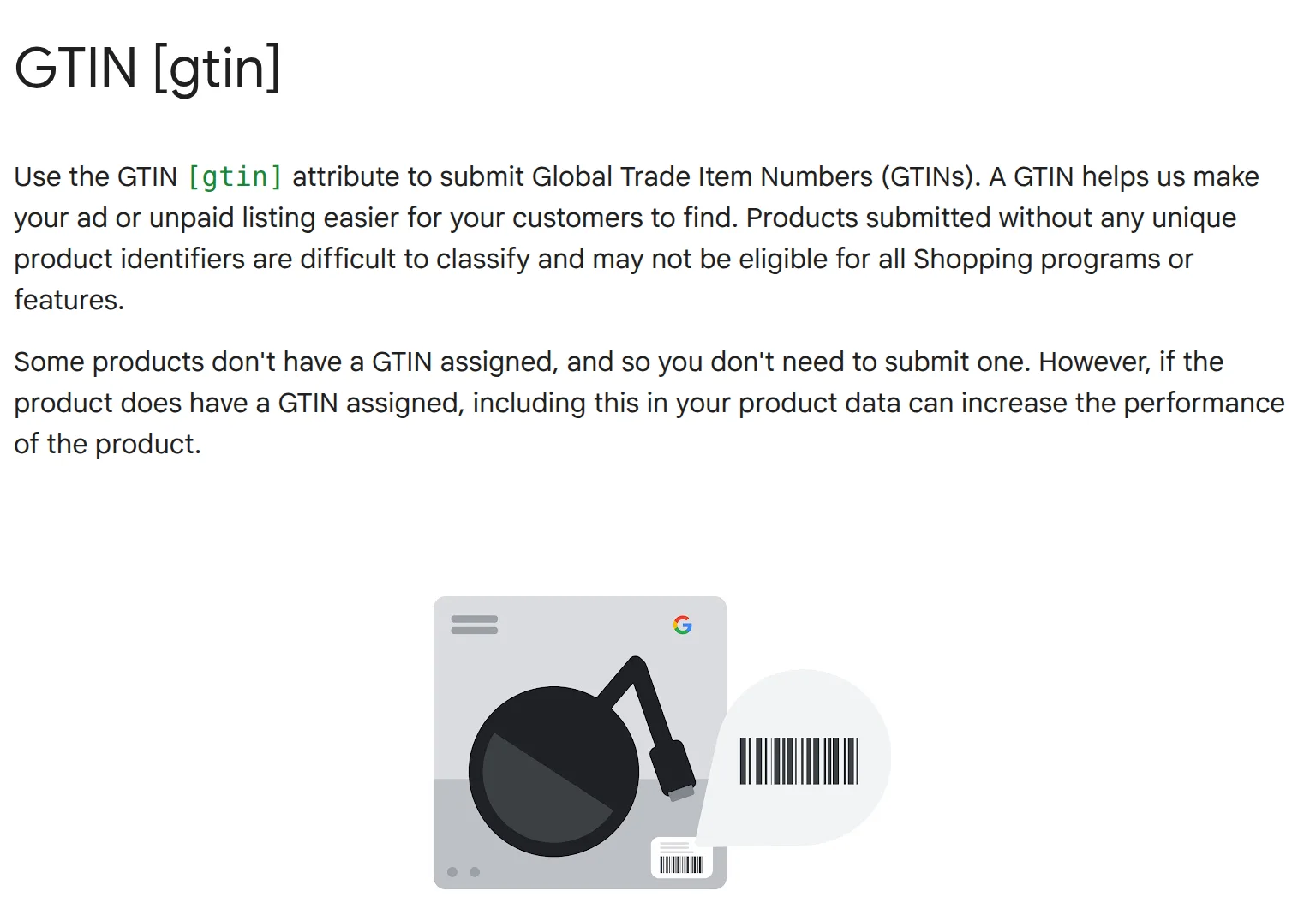
GTINs won’t make an engine recommend you, but missing or wrong ones can split a product into several weak entries. If you sell through Google Merchant Center and want your products in AI shopping results, start with clean identifiers in your product feed. Then use AmICited’s AI visibility tracking to see whether ChatGPT, Perplexity, Gemini and Google’s AI answers actually mention your brand.
Best Practices for GTINs
- License GTINs from GS1 directly, so the numbers are registered to your company and pass marketplace checks.
- Assign a new GTIN to every variant (size, color, flavor, pack count), and never reuse a GTIN for a different product.
- Store GTINs in one place, such as your PIM or platform barcode field, and push them to every feed and channel from there.
- Include the GTIN in Product schema on product pages and in your Merchant Center feed.
- Validate check digits before uploading. Most feed tools and spreadsheets can do this with a formula.
- For resold goods, use the manufacturer’s GTIN, not one you create.
Common GTIN Mistakes
The most expensive mistake is buying cheap barcodes from resellers. Those numbers were often licensed to another company years ago, so Amazon and Google may see them as belonging to someone else, which leads to listing errors or suppression. Another is putting the same GTIN on several variants, which makes marketplaces merge listings and show the wrong size or color.
Sellers also enter SKUs or MPNs in the GTIN field, drop the leading zero from UPCs in spreadsheets (Excel does this automatically to numbers), or type a made-up number for products that don’t have one. If a product truly has no GTIN, leave the field empty and use brand plus MPN instead.