


One-Click Checkout
One-click checkout is a checkout feature that lets a returning customer complete a purchase in a single action using previously saved payment and shipping details, without re-entering information or navigating a multi-step checkout flow. It reduces friction at the point of highest purchase intent, often improving conversion for repeat and mobile customers.
Definition of One-Click Checkout
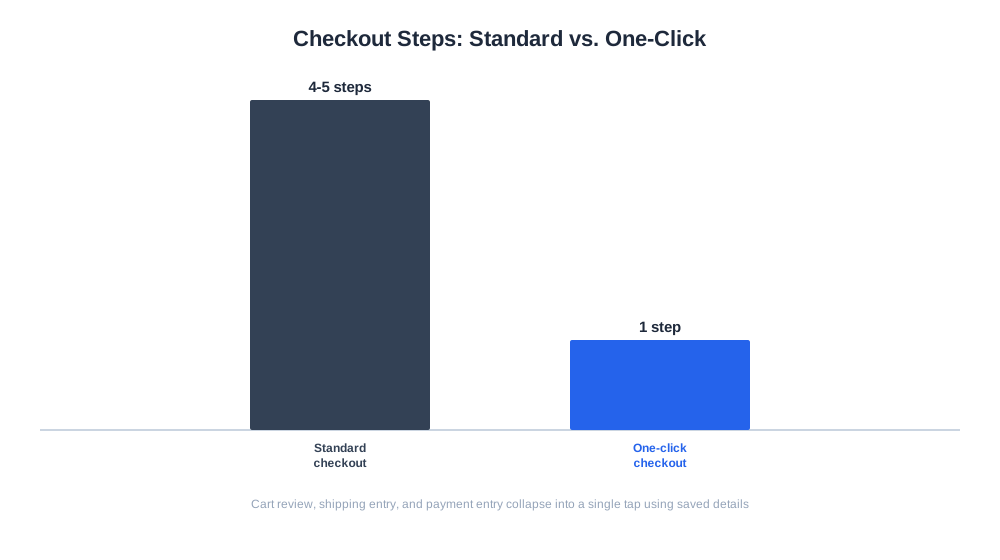
One-click checkout is a purchasing feature that allows a returning, recognized customer to complete an order with a single action — typically one tap or click — by using payment and shipping details the customer previously saved, bypassing the standard multi-step checkout flow of cart review, shipping entry, and payment entry. First popularized by Amazon’s patented 1-Click ordering and since replicated across the industry in various forms — Shop Pay on Shopify-powered stores, Apple Pay and Google Pay express checkout buttons, and platform-native saved-card systems — one-click checkout targets the specific moment where a customer has already decided to buy and simply wants the fewest possible steps between that decision and a completed order. It’s a conversion tool aimed squarely at returning customers and existing account holders, since a first-time visitor has no saved details to draw on.
How One-Click Checkout Works
The mechanism depends on securely storing a tokenized version of a customer’s payment method (never the raw card number itself, for PCI compliance reasons) along with their shipping address, tied to their account or a persistent browser/device identifier. On a customer’s first purchase, they go through a standard checkout and, often with an explicit opt-in, their details are saved for future use. On subsequent visits, if the customer is recognized — logged in, or identified via a stored session — a one-click checkout button appears, and tapping it immediately places the order using the saved payment token and shipping address, sometimes with a brief confirmation screen rather than a full checkout flow.
A worked example: a customer completes a standard checkout on a store’s site, opting to save their card details. Three weeks later, they return, browse a new product, and tap a “Buy Now” button on the product page itself rather than adding it to a cart. The order is placed immediately using their saved Visa card ending in the digits already on file and their saved shipping address, with an order confirmation appearing within seconds — no cart page, no shipping form, no separate payment entry step.

Ready to Monitor Your AI Visibility?
Track how AI chatbots mention your brand across ChatGPT, Perplexity, and other platforms.
Why One-Click Checkout Matters for E-commerce Brands
One-click checkout matters because checkout friction is one of the most well-documented causes of cart and purchase abandonment, and returning customers — who already trust the brand and have already provided their details once — are the segment for whom removing that friction has the clearest payoff. A returning customer forced through a full multi-step checkout every time, despite having purchased before, faces unnecessary friction relative to a competitor offering a one-tap purchase experience; over time, this friction differential can measurably affect repeat purchase rate and customer lifetime value, not just single-session conversion.
It also matters competitively: as one-click and express checkout options (Shop Pay, Apple Pay, Google Pay buttons) become standard across much of e-commerce, a store without any accelerated checkout option increasingly stands out as slower and more cumbersome by comparison, even if its standard checkout flow is otherwise well designed.
One-Click Checkout vs. Standard and Guest Checkout
| Checkout Type | Steps Required | Best For | Fraud Consideration |
|---|---|---|---|
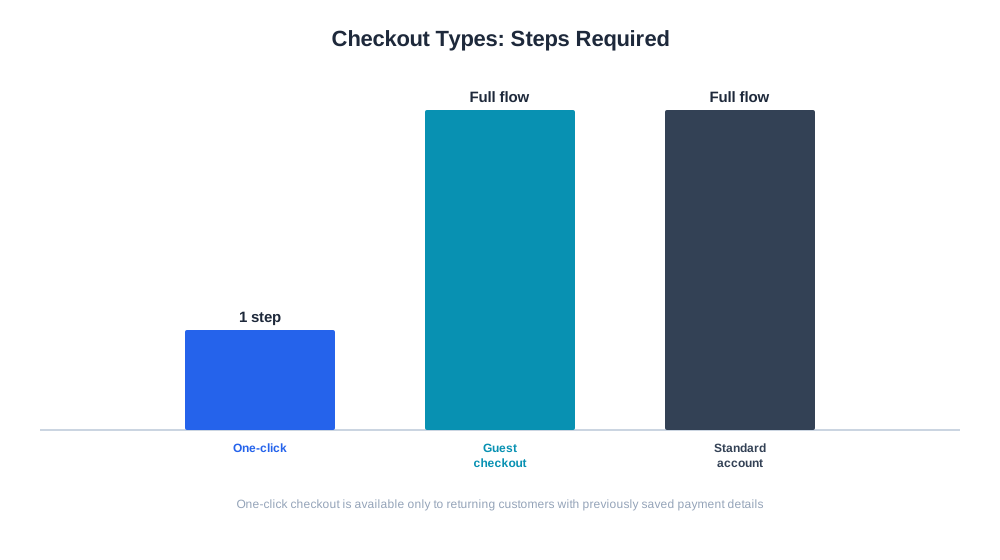
| One-click checkout | One action, using saved details | Returning, recognized customers | Requires backend fraud scoring since checkout friction is minimal |
| Guest checkout | Full checkout flow, no account required | First-time or privacy-conscious customers | Standard checkout-level fraud checks apply |
| Standard account checkout | Full checkout flow, logged in | Customers willing to create an account | Standard checkout-level fraud checks apply |
Stay Updated on AI Visibility Trends
Get the latest insights on AI mentions, brand monitoring, and optimization strategies.
One-Click Checkout and AI-Driven Commerce
One-click checkout is directly relevant to the emergence of agentic commerce and features like ChatGPT Instant Checkout, where an AI assistant completes a purchase on a customer’s behalf using stored payment credentials, functioning conceptually as an even more automated extension of one-click checkout — the customer’s role shrinks from “click one button” to “approve an AI-initiated purchase.” Merchants who already support one-click checkout with clean, tokenized payment storage and reliable fraud screening are generally better positioned to plug into these newer agentic checkout flows, since the underlying technical requirements — secure stored credentials, fast order placement, and backend fraud detection rather than checkout-step friction — largely overlap.
As one-click and accelerated checkout options grow as a share of total orders, it becomes useful to track how payment method mix shifts alongside them — a store might see its share of Shop Pay or saved-card orders climb while cash-on-delivery or manual bank transfer orders shrink. AmICited’s eshop_get_order_mix report breaks orders down by payment method, which lets merchants see this shift concretely rather than assuming it based on anecdotal checkout logs.
Best Practices for One-Click Checkout
- Require an explicit customer opt-in to save payment details, and make it easy to review or remove saved payment methods later.
- Pair one-click checkout with strong backend fraud scoring, since removing checkout steps also removes friction a fraudster might otherwise face.
- Offer one-click checkout as a clearly visible option (a “Buy Now” button on product pages, not just buried in account settings) so returning customers actually notice and use it.
- Ensure the one-click flow still confirms order details clearly enough that a customer doesn’t feel surprised by what they purchased, since accidental one-click orders drive support tickets and refund requests.
- Support multiple express checkout options (Apple Pay, Google Pay, Shop Pay) rather than betting on a single provider, since customer preference for stored payment method varies.
- Monitor conversion and chargeback rate separately for one-click orders versus standard checkout orders to confirm the feature is a net positive on both fronts.
Common One-Click Checkout Mistakes
A frequent mistake is enabling one-click checkout without correspondingly strengthening backend fraud detection, since the convenience that makes one-click checkout attractive to legitimate customers also makes it attractive to fraudsters testing stolen card details — a store that doesn’t compensate for reduced checkout friction with stronger invisible fraud screening can see its chargeback rate rise disproportionately. Another common issue is making the one-click flow so frictionless that customers accidentally place unintended orders, particularly on mobile where an errant tap can trigger an immediate purchase without the customer registering what happened — this drives avoidable refund requests and customer frustration. Some merchants also fail to make saved payment methods easy to manage or remove, which creates a subtle trust problem for privacy-conscious customers who might otherwise be willing to use the feature. Finally, a subtler mistake is treating one-click checkout as a complete substitute for fixing broader checkout usability issues; it primarily benefits already-converted repeat customers, and a store with fundamental problems in its standard checkout flow will still lose new customers regardless of how well its one-click option performs for existing ones.