


Product Affinity
Product affinity measures which products tend to be purchased together, in sequence, or by the same type of customer, revealing hidden relationships between items in a catalog. It's used to power cross-sell, bundling, and recommendation strategies based on actual purchase patterns rather than guesswork.
Definition of Product Affinity
Product affinity describes the measurable relationship between products based on how customers actually buy them — which items appear in the same order, which item a customer buys next after a first purchase, and which products tend to be favored by the same customer segments. Unlike merchandising decisions based on intuition (“these look like they’d go together”), product affinity is derived from real transaction data, which means it frequently surfaces pairings a merchandiser wouldn’t have guessed — a phone case and a screen protector might be the obvious pairing, but affinity data might reveal that a surprising share of phone-case buyers also purchase a specific brand of coffee three weeks later. Product affinity underpins most cross-sell recommendations, “frequently bought together” widgets, bundle design, and post-purchase email flows in modern e-commerce.
How Product Affinity Is Calculated
Product affinity is typically measured using three related statistics borrowed from market basket analysis:
- Support — how often two products appear together, as a percentage of all orders.
- Confidence — given that a customer bought product A, the probability they also bought product B.
- Lift — how much more likely that co-purchase is than would be expected if the two products were bought independently. A lift score of 1 means no relationship; anything meaningfully above 1 indicates real affinity.
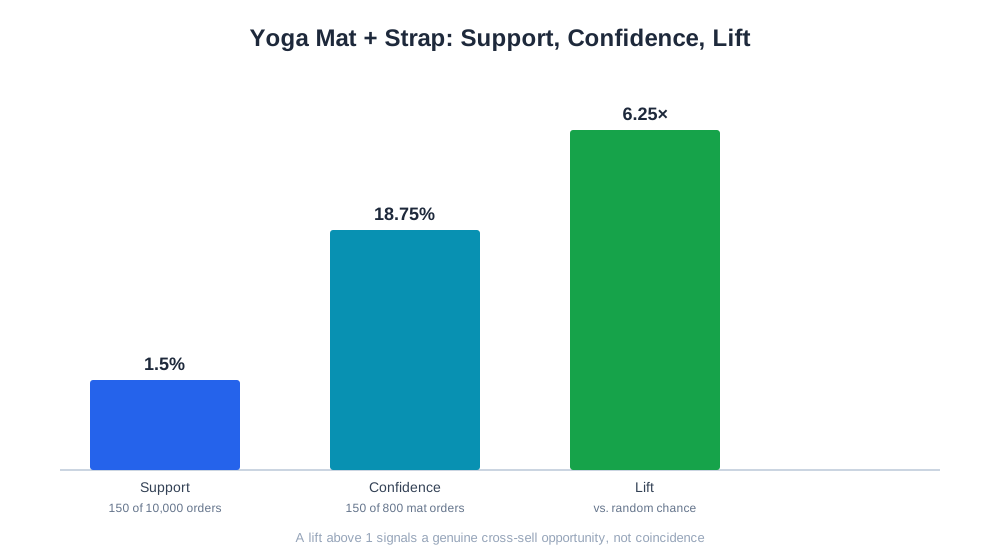
A worked example: a store sells 10,000 orders in a quarter. Product A (a yoga mat) appears in 800 of them. Product B (a mat strap) appears in 300 orders total, and 150 of those orders also contain the yoga mat.
- Support for the A+B pair = 150 / 10,000 = 1.5%
- Confidence (A → B) = 150 / 800 = 18.75%
- Expected co-purchase rate if independent = (800/10,000) × (300/10,000) = 0.24%
- Lift = 18.75% ÷ (300/10,000 × 100) = roughly 6.25×
A lift of 6.25 is a strong signal: customers who buy the yoga mat are over six times more likely than average to also buy the strap, making it an obvious cross-sell candidate on the mat’s product page and in post-purchase email.

Ready to Monitor Your AI Visibility?
Track how AI chatbots mention your brand across ChatGPT, Perplexity, and other platforms.
Why Product Affinity Matters for E-commerce Brands
Product affinity turns cross-selling from a guessing game into a data-backed strategy. Instead of manually deciding which products to feature in “you might also like” sections, a merchant can let actual purchase patterns drive those recommendations — which typically produces higher attach rates than intuition-based merchandising, because the pairings reflect genuine customer behavior rather than assumed logic.
Affinity data also improves bundle design. A bundle built from two high-affinity products (like the yoga mat and strap above) converts differently than one built from two products that merely share a category but rarely co-occur in real orders. And because affinity can be layered with customer value data, merchants can prioritize promoting the pairings that come from their most valuable customer segments, rather than treating every high-lift pair equally.
Product Affinity vs. Related Concepts
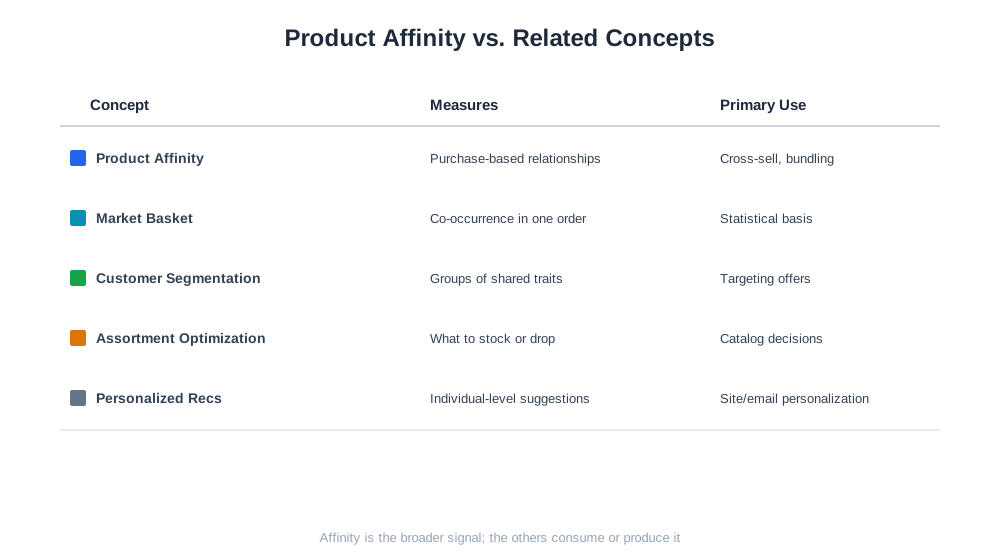
| Concept | What It Measures | Primary Use |
|---|---|---|
| Product Affinity | Relationship between products based on purchase behavior | Cross-sell, bundling, recommendations |
| Market Basket Analysis | Co-occurrence within a single transaction | Statistical basis for affinity |
| Customer Segmentation | Groups of customers by shared traits | Targeting which customers see which offers |
| Assortment Optimization | Which products to stock or discontinue | Catalog and inventory decisions |
| Personalized Recommendations | Individual-level product suggestions | On-site and email personalization |
Stay Updated on AI Visibility Trends
Get the latest insights on AI mentions, brand monitoring, and optimization strategies.
Product Affinity and AI-Driven Commerce
As AI shopping assistants like ChatGPT Shopping and Perplexity Shopping increasingly answer questions like “what goes well with X” or generate multi-product shopping lists on a customer’s behalf, having clean, well-structured affinity data becomes more valuable — it’s effectively the same signal these assistants are trying to infer from product descriptions and reviews, except a merchant already has it from first-party order history. Feeding accurate “frequently bought together” and bundle data into product feeds gives AI shopping tools a stronger basis for recommending complementary items from your own catalog rather than substituting a competitor’s product.
AmICited’s eshop_get_product_affinity tool is purpose-built around this concept — for any given product, it surfaces the lifetime value of the customers who buy it and the specific products they tend to buy alongside or after it, giving merchants a direct, data-backed answer to “what should we cross-sell here” without building the underlying basket analysis themselves.
Best Practices for Using Product Affinity
- Use lift, not just co-occurrence count, to judge affinity strength — a pairing that occurs often simply because both products are bestsellers isn’t necessarily a real affinity.
- Refresh affinity calculations regularly, since new product launches, seasonal shifts, and discontinued items all change the underlying purchase patterns.
- Combine affinity with customer value data so cross-sell efforts prioritize pairings that come from higher-value segments.
- Test affinity-driven recommendations against your current “frequently bought together” logic before fully replacing it — sometimes a category-based heuristic still outperforms a thin data sample for new products.
- Apply affinity insights beyond the product page: post-purchase email sequencing and bundle design benefit just as much as on-site recommendation widgets.
Common Product Affinity Mistakes
Confusing category similarity with real affinity. Two products in the same category don’t necessarily sell together — in fact, competing products within a category often show negative affinity, since a customer buys one or the other, not both. Affinity should be measured on actual co-purchase data, not assumed from catalog structure.
Relying on too little order history. A newly launched product with only a handful of orders can show misleadingly strong or weak affinity purely from small-sample noise. Category-level affinity is a more reliable fallback until enough SKU-level data accumulates.
Ignoring lift in favor of raw co-occurrence counts. Two bestsellers will appear together often simply because they’re both bought frequently, not because there’s a meaningful relationship. Lift corrects for this by comparing against the expected co-occurrence if the products were purchased independently.
Never updating affinity models after catalog changes. Discontinued products, new variants, and seasonal items shift the affinity landscape, and a stale model will keep recommending pairings that no longer make sense or missing new ones that have emerged.
Applying affinity uniformly across all customer segments. A pairing that’s strong among first-time buyers might not hold for repeat, high-value customers, who often have different purchase patterns. Segment-aware affinity produces more relevant recommendations than a single blended model.