


Returning Customer Rate
Returning customer rate is the percentage of a store's orders, or its total customers, that come from people who have purchased before, as opposed to first-time buyers. It's a direct measure of how much a business relies on repeat business versus continuous new customer acquisition. A rising returning customer rate generally signals improving loyalty and reduces dependence on paid acquisition to sustain revenue.
Definition of Returning Customer Rate
Returning customer rate measures what share of a store’s orders — or, in some reporting setups, what share of its unique customers — come from people who have purchased before, rather than first-time buyers. It’s a direct window into how much of a business’s revenue depends on continually acquiring new customers versus retaining and reselling to the customers it already has. A store can look successful purely on total revenue while quietly depending on an ever-increasing new customer count to sustain that growth; returning customer rate is one of the clearest ways to catch that pattern before it becomes unsustainable.
How Returning Customer Rate Is Calculated
The standard formula, measured by order count, is:
Returning Customer Rate = (Orders from Returning Customers ÷ Total Orders) × 100
It can also be calculated by unique customer count rather than order count: (returning customers who ordered in the period ÷ total customers who ordered in the period) × 100. The two versions can diverge meaningfully if returning customers place multiple orders per period while new customers typically place just one, so it’s worth being explicit about which version any given report uses.
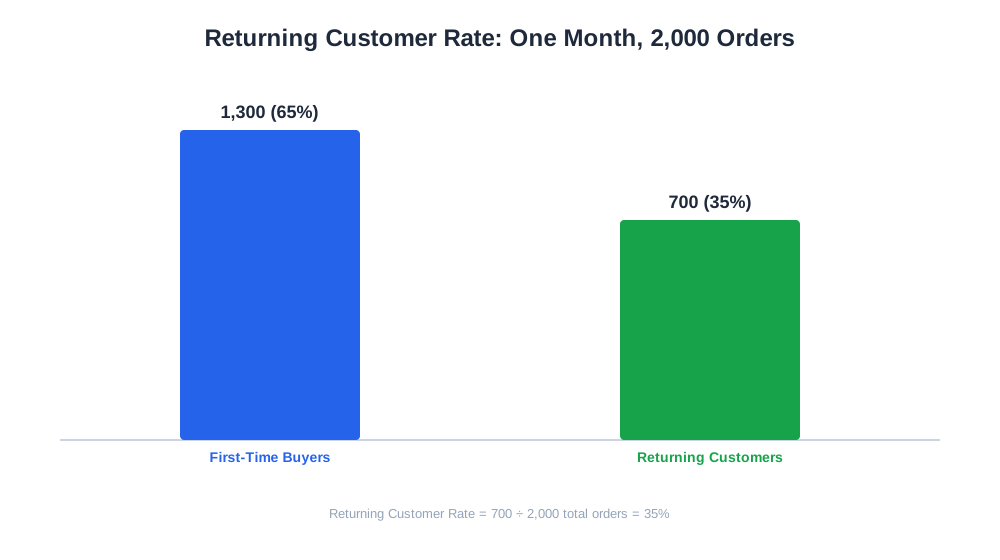
As a worked example: a store processes 2,000 orders in a given month. Of those, 700 orders come from customers who had made at least one prior purchase, and 1,300 come from first-time buyers. Returning customer rate for that month is 700 ÷ 2,000 = 35%.

Ready to Monitor Your AI Visibility?
Track how AI chatbots mention your brand across ChatGPT, Perplexity, and other platforms.
Why Returning Customer Rate Matters for E-commerce Brands
Returning customer rate is a direct proxy for how efficient a business’s growth actually is. Orders from returning customers typically arrive at a much lower marginal acquisition cost than orders from new customers, since the marketing spend to win that customer was already made in a prior period. A brand with a rising returning customer rate is compounding the value of past acquisition spend, while a brand stuck at a flat or declining rate is essentially rebuilding its revenue from scratch every period through fresh acquisition.
It also serves as a health check during periods of aggressive growth marketing. A brand pouring significant budget into new customer acquisition might see strong headline revenue growth while its returning customer rate quietly declines as a share of the mix — not necessarily a problem if it’s a deliberate land-grab strategy, but worth knowing rather than discovering by surprise later.
Returning Customer Rate vs. Related Metrics
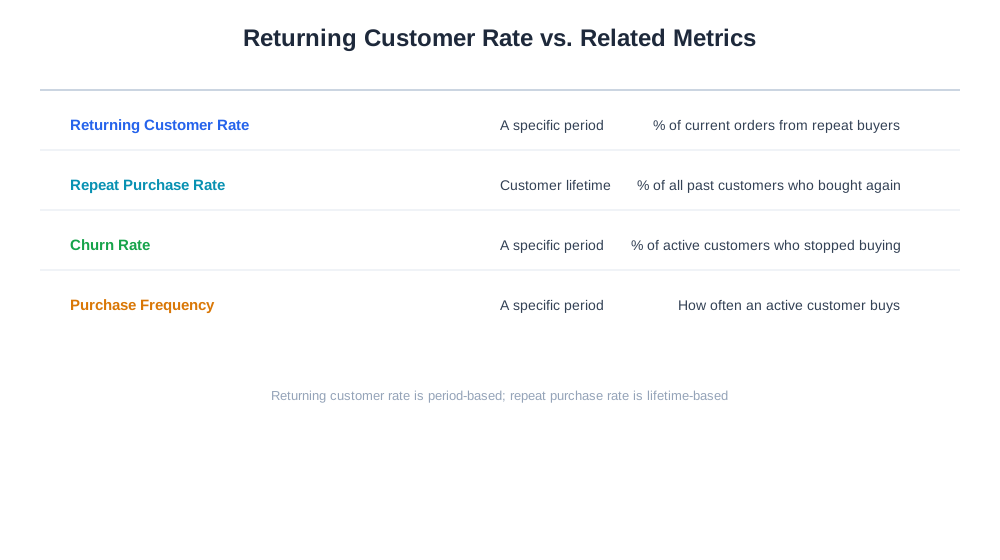
| Metric | Time Frame | What It Answers |
|---|---|---|
| Returning Customer Rate | A specific period (e.g., this month) | What share of current orders are from repeat buyers |
| Repeat Purchase Rate | Customer lifetime | What share of all past customers ever bought again |
| Churn Rate | A specific period | What share of previously active customers stopped buying |
| Purchase Frequency | A specific period | How often an active customer buys on average |
Stay Updated on AI Visibility Trends
Get the latest insights on AI mentions, brand monitoring, and optimization strategies.
Returning Customer Rate and AI-Driven Commerce
As AI shopping assistants like ChatGPT Shopping and Perplexity Shopping increasingly influence where a customer’s next purchase happens, brands risk losing returning customers to a competitor surfaced by an assistant at exactly the reorder moment, even if that customer was previously loyal. This makes tracking returning customer rate over time more important as an early signal — a rate that starts drifting down after being stable for a long stretch can indicate customers are being intercepted earlier in their decision process, before they even think to return directly to the brand’s site or app.
Reliable measurement starts with accurately distinguishing new orders from returning ones, which is harder than it sounds once guest checkouts, multiple email addresses, and account merges are involved. AmICited’s eshop_get_order_mix tool splits a connected store’s orders by buyer type, new versus returning, giving merchants a consistent, accurate returning customer rate rather than an estimate built from imperfect manual segmentation.
Best Practices for Returning Customer Rate
- Track returning customer rate by both order count and customer count, and be clear in reporting about which version is being referenced
- Segment returning customer rate by acquisition channel to see whether certain channels attract customers who are more or less likely to return
- Watch the trend over multiple periods rather than a single month’s snapshot, since seasonal and promotional effects can distort any single period
- Pair returning customer rate with customer acquisition cost to understand the full picture of growth efficiency, not just one side of it
- Investigate a declining returning customer rate promptly rather than assuming it’s simply diluted by strong new customer growth
Common Returning Customer Rate Mistakes
A common mistake is conflating returning customer rate with repeat purchase rate, since the two measure different things — a period-based mix versus a lifetime-based percentage — and using them interchangeably in reporting can lead to confused or contradictory conclusions about how loyal the customer base actually is.
Another frequent issue is failing to deduplicate customers across guest checkout and account-based orders, which can undercount returning customers if the same person orders once as a guest and once with an account, appearing as two separate first-time buyers in the data. The fix is matching customers by email or another reliable identifier regardless of checkout method.
Some brands also look at returning customer rate in isolation without checking whether a declining rate is due to a genuine retention problem or simply a period of unusually strong new customer acquisition diluting the mix. Pairing the metric with absolute returning order counts, not just the percentage, helps distinguish the two scenarios before drawing the wrong conclusion.