


Unit Economics
Unit economics measures the direct revenues and costs associated with a single unit of business — typically one product, one order, or one customer — to show whether the underlying business model is profitable at its most granular level. It strips away scale and overhead to answer a simple question: does selling one more of this actually make money?
Definition of Unit Economics
Unit economics is the analysis of profit and cost at the level of a single, granular unit of a business — typically one product sold, one order placed, or one customer acquired — rather than at the level of the whole company. The purpose is to answer a deceptively simple question that revenue and total profit figures can hide: does the core transaction of the business actually make money, one unit at a time, before scale, overhead, and financing are factored in? A business can look impressive on total revenue while having deeply negative unit economics, meaning every additional sale actually loses money — a pattern that eventually collapses once growth slows or outside funding dries up.
How Unit Economics Is Calculated
A basic per-unit calculation looks like this:
Unit Profit = Revenue per unit − COGS per unit − Variable costs per unit (shipping, payment processing, packaging, returns)
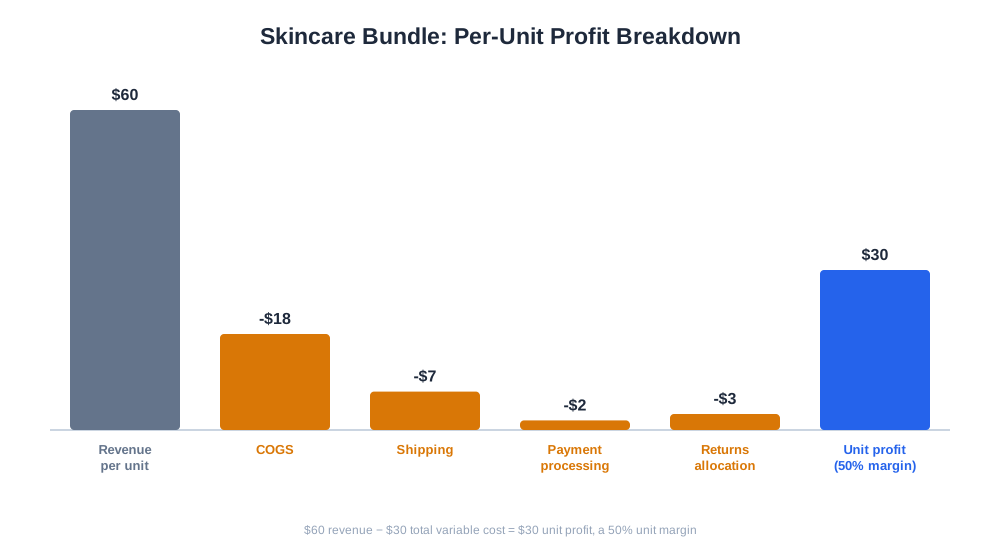
Worked example: a store sells a skincare bundle for $60. The cost of goods sold (manufacturing, packaging materials) is $18. Shipping averages $7 per order, payment processing fees run about $2, and an allocated return-and-refund cost (based on the product’s historical return rate) averages $3 per unit sold. Total variable cost = $18 + $7 + $2 + $3 = $30. Unit profit = $60 − $30 = $30, a 50% unit margin.
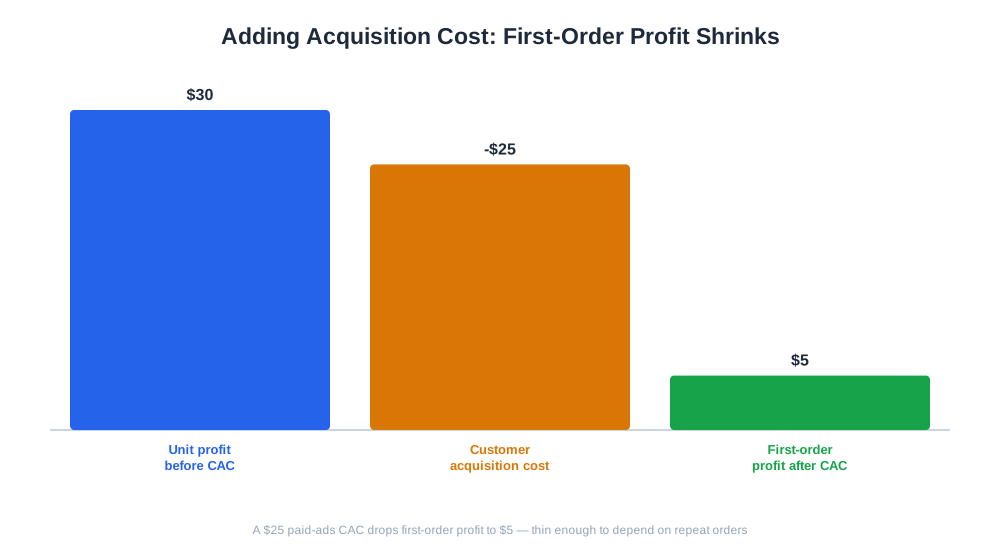
A fuller version of unit economics also allocates a share of customer acquisition cost (CAC) to judge whether the full economics, including the cost of finding the customer in the first place, work out. If this same customer cost $25 to acquire through paid ads on their first order, first-order unit profit drops to $5 — still positive, but thin enough that the business depends heavily on that customer coming back for a second order to be truly profitable.

Ready to Monitor Your AI Visibility?
Track how AI chatbots mention your brand across ChatGPT, Perplexity, and other platforms.
Why Unit Economics Matters for E-commerce Brands
Unit economics is the health check that revenue growth alone cannot provide. A store scaling ad spend to grow top-line revenue while unit economics are negative is effectively buying revenue at a loss, a strategy that only works as long as external capital or investor patience holds out. Strong unit economics, by contrast, mean that growth is genuinely self-funding: every additional sale contributes real profit that can be reinvested. Unit economics is also the right lens for comparing products or lines within the same catalog — a bestselling product by unit volume is not automatically the most valuable one if its unit economics are thin, while a lower-volume product with strong per-unit profit may deserve more marketing attention than its sales rank suggests.
| Metric | What It Measures | What It Misses |
|---|---|---|
| Revenue | Total sales value | Says nothing about profitability |
| Gross margin | Revenue minus COGS | Ignores shipping, processing, returns, acquisition cost |
| Contribution margin | Revenue minus all variable costs | Usually excludes acquisition cost |
| Unit economics | Full per-unit or per-order profit, often including CAC | Requires accurate cost allocation to be meaningful |
Unit Economics and AI-Driven Commerce
As AI shopping assistants like ChatGPT Shopping and Perplexity Shopping route more first-time discovery traffic to merchants, the acquisition cost side of unit economics is shifting — some AI-driven traffic may arrive with lower acquisition cost through organic citation, while paid placement in AI-adjacent channels adds a new cost line to track. Either way, the core discipline stays the same: knowing true, fully-loaded cost per order is what lets a merchant judge whether a new traffic source is actually profitable, not just a revenue add. AmICited’s eshop_get_cost_mix and eshop_get_kpis tools break revenue down against cost of goods and other cost drivers directly from connected store and cost data, giving merchants the ingredients for a real unit economics calculation instead of an estimate built from partial numbers.
Stay Updated on AI Visibility Trends
Get the latest insights on AI mentions, brand monitoring, and optimization strategies.
Best Practices for Unit Economics
- Calculate unit economics at the product level, not just the storewide average, since it varies widely across a catalog
- Include all real variable costs — shipping, payment processing, packaging, and expected returns — not just cost of goods sold
- Layer in an allocated customer acquisition cost when judging whether growth spend is sustainable
- Recalculate regularly, since shipping rates, ad costs, and return rates shift faster than most teams expect
- Treat any product with consistently negative unit economics as a deliberate strategic choice (a loss-leader) rather than an unexamined default
Common Unit Economics Mistakes
The most common mistake is calculating unit economics using only cost of goods sold and calling it done, which overstates profitability by ignoring shipping, payment fees, and return costs that can easily consume 15-20% of revenue on their own. Another frequent error is calculating unit economics once at product launch and never revisiting it, even as input costs, shipping rates, and ad costs change — a product profitable at launch can quietly become unprofitable a year later without anyone noticing until margins overall start slipping. Some teams also average unit economics across an entire catalog, which hides individual products or categories that are actually losing money and being subsidized by stronger performers elsewhere in the same order. A related issue is ignoring returns entirely in the calculation — a product with a high return rate can look profitable on paper while actually destroying margin once the cost of restocking, refunding, and lost shipping is properly allocated. Finally, businesses sometimes treat positive unit economics on a first order as proof of a healthy model without checking whether repeat purchases are needed to reach true profitability, missing that thin first-order margins combined with a low repeat purchase rate is a much riskier business than the same numbers with strong repeat behavior.