



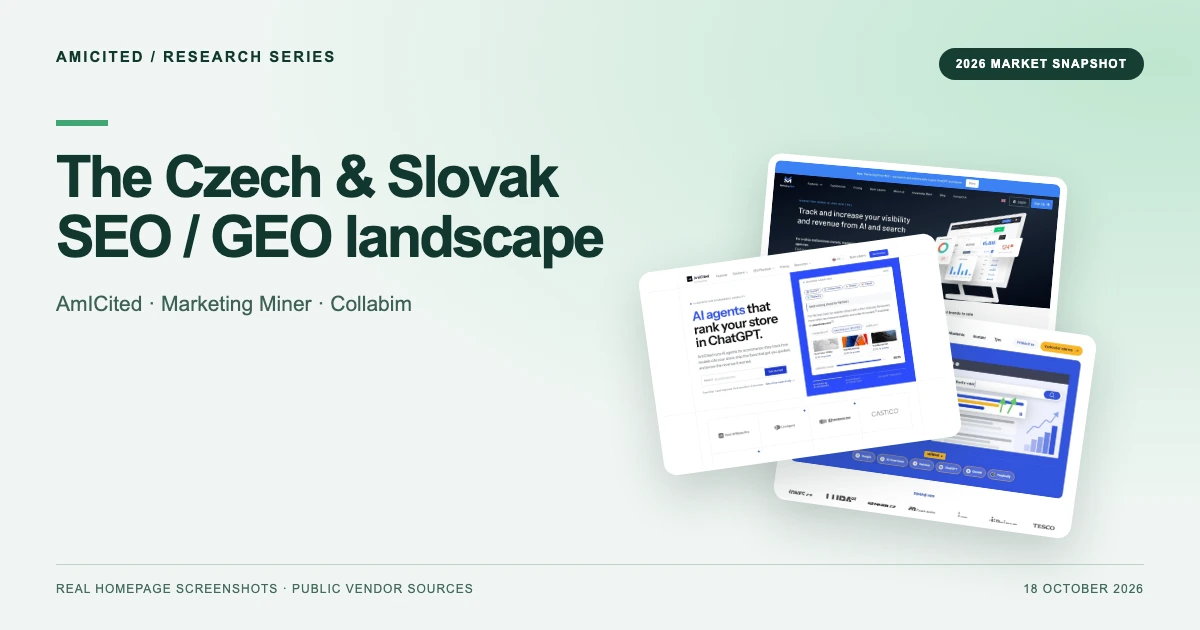
Central Europe now has a credible home-grown choice for measuring visibility in both Google and AI answers. The interesting question is no longer whether a Czech or Slovak team can buy a local tool. It is which measurement system matches the work the team is trying to do.
Three products deserve the closest comparison: AmICited, Marketing Miner and Collabim. Marketing Miner and Collabim grew from established Czech SEO workflows. AmICited begins with prompt-level AI citation monitoring and connects that evidence to optimization work, search data and agents.
The regional label needs care. Marketing Miner and Collabim are operated by companies registered in České Budějovice. AmICited is operated by AiMingle in Prague; the related Quality Unit group also has locations in Bratislava and the United States. That gives AmICited real Slovak roots through its wider group, but it would be inaccurate to call it a Slovak-headquartered product.
The short answer: choose the workflow, not the flag
Choose Marketing Miner when Czech and Slovak keyword data, bulk SEO checks and exports are already the center of your process, and AI visibility should sit beside them. Choose Collabim when you want familiar rank tracking and client reporting with a clearly packaged AI measurement add-on. Choose AmICited when the main job is repeatedly testing buyer questions across AI engines, inspecting citations and fan-out queries, and turning gaps into work through integrations, content tools or MCP-connected agents.
An agency with 80 local clients has different economics from an international ecommerce brand monitoring several answer engines and countries. Buyer fit matters more than a universal ranking.
Marketing Miner: local SEO data with metered AI monitoring
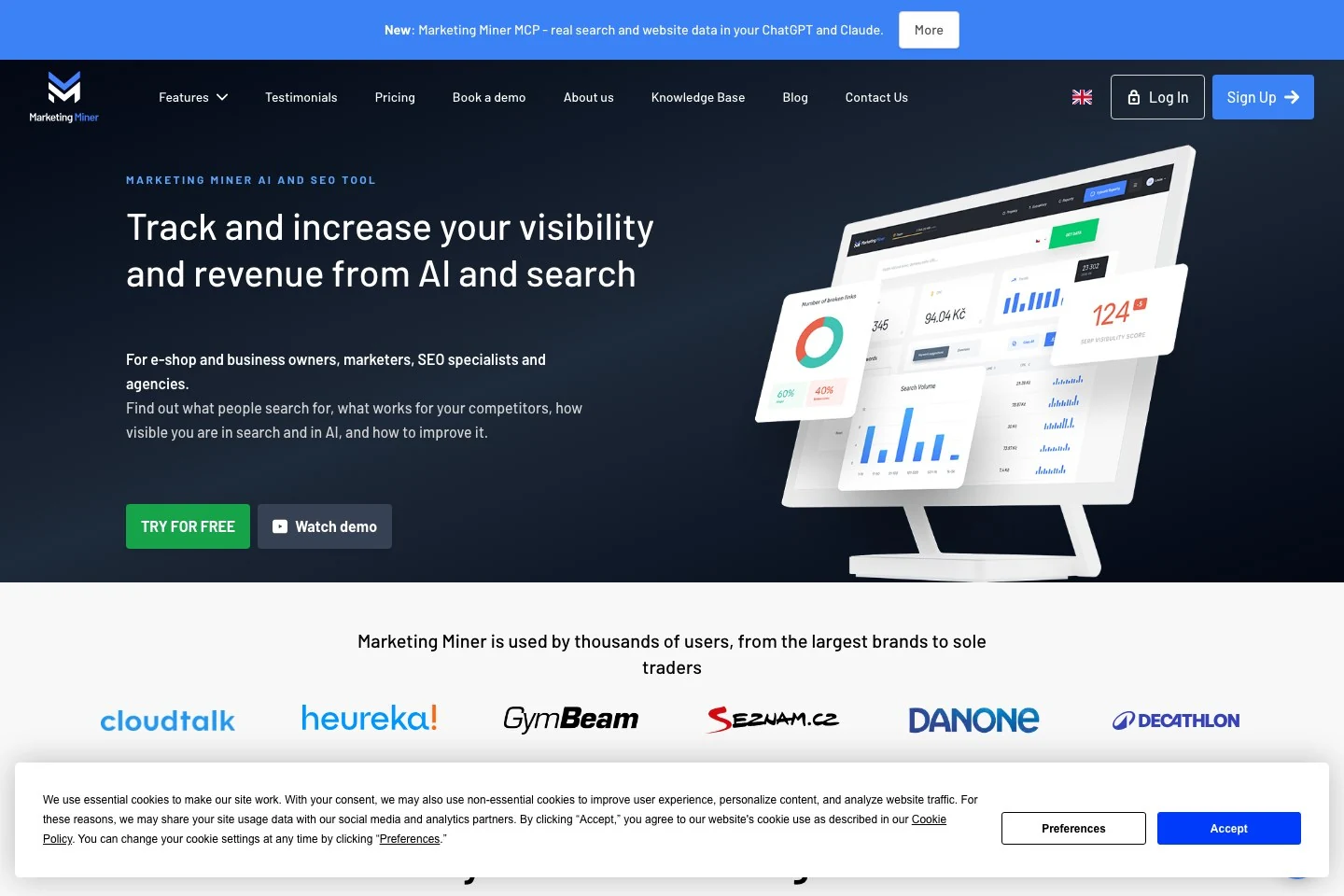
Marketing Miner remains the clearest fit for teams that think in bulk datasets. Its established workflow covers keyword research, rank tracking, competitor research, brand monitoring and technical checks. Its AI Visibility module adds recurring brand monitoring, sentiment, cited sources and query fan-out. The product page also documents ChatGPT advertising monitoring and an MCP connection, which makes the tool relevant beyond a conventional dashboard.
The attraction for a Czech or Slovak SEO team is continuity. The same vendor that supplies familiar local-market data can now answer a second question: not only “where does this page rank?” but also “does an AI assistant mention the brand, in what context, and from which sources?” That reduces tool switching for agencies whose reporting already begins in Marketing Miner.
Pricing needs one extra line of arithmetic. The researched offer combines a base plan starting at €19 per month with AI credit packs starting at €20 per month. A prompt sent to one model consumes two AI credits, and the AI credits expire after 30 days. The meaningful number is therefore the cost of the base account plus the pack required for the planned prompt × model × frequency workload, rather than “AI from €20.” Prices and credit rules were verified on the AI Visibility page and should be rechecked at purchase.

Ready to Monitor Your AI Visibility?
Track how AI chatbots mention your brand across ChatGPT, Perplexity, and other platforms.
Collabim: rank-tracker familiarity with a transparent measurement pack
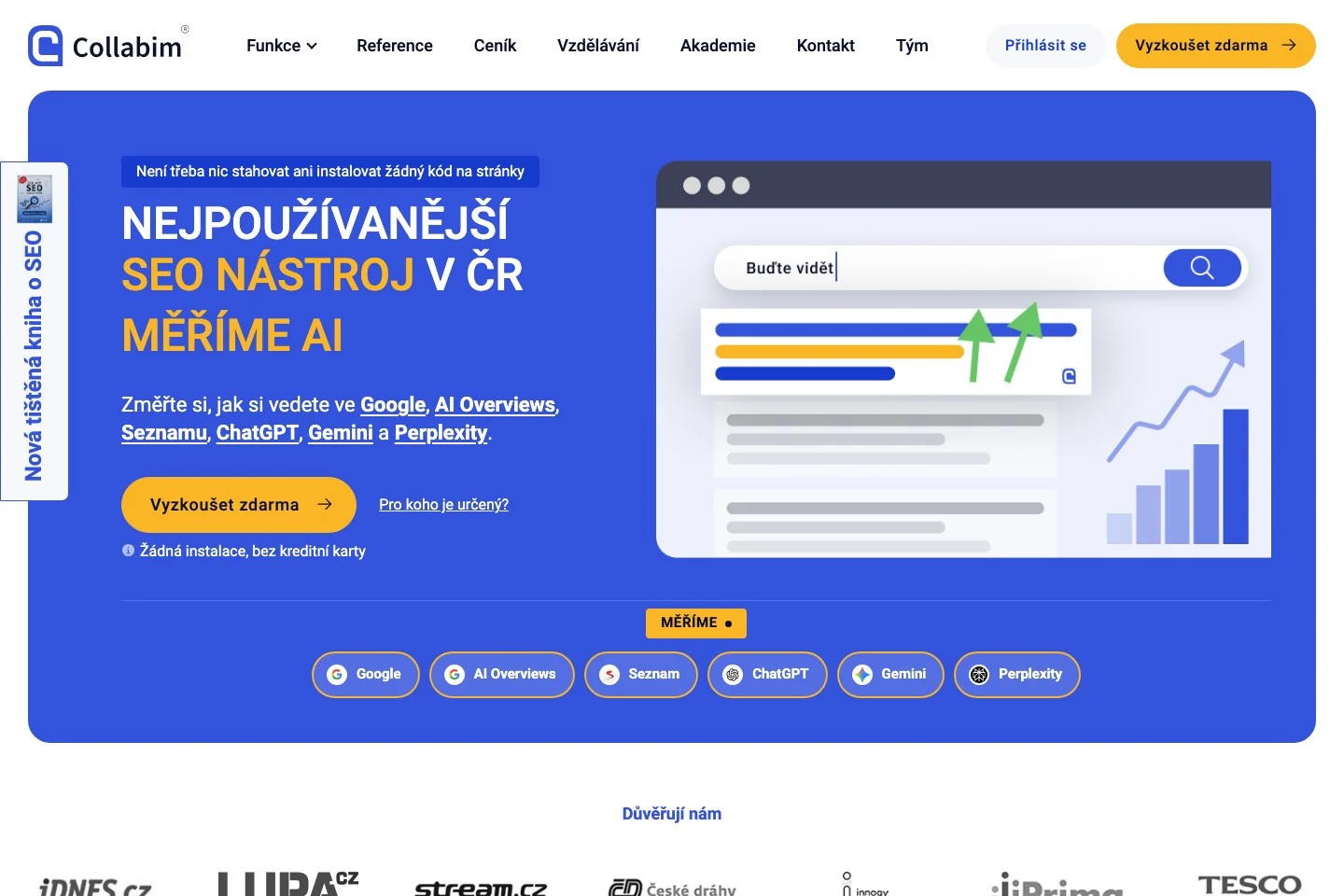
Collabim takes a similarly practical route. Its AI visibility module tracks visibility, sentiment and share of voice over time; compares competitors; preserves answer history; and exposes sources and fan-out queries. Its main product description names ChatGPT, Gemini and Perplexity, with daily, weekly and 14-day schedules. Other sections of the same page also reference Google AI surfaces, so buyers should confirm which engines apply to their chosen analysis and plan.
The packaging is unusually easy to explain: 500 measurements for CZK 383, excluding VAT, with larger packs available. Collabim translates that pack into examples such as 17 prompts checked daily, 125 weekly or 250 every two weeks. This is useful because frequency is visible at the buying stage. The remaining question is whether a Collabim base plan is required and how a “measurement” expands across selected engines; the public material reviewed for this article did not settle that dependency well enough to assume it.
For a Czech agency, Collabim’s natural advantage is operational familiarity. Its fan-out view can connect the searches behind a buyer question back to keyword research and content briefs. Buyers with multinational prompts or agent-led workflows should validate country controls, language behavior, API/MCP scope and engine-level consumption in a trial.
AmICited: broad AI-engine coverage and an action layer
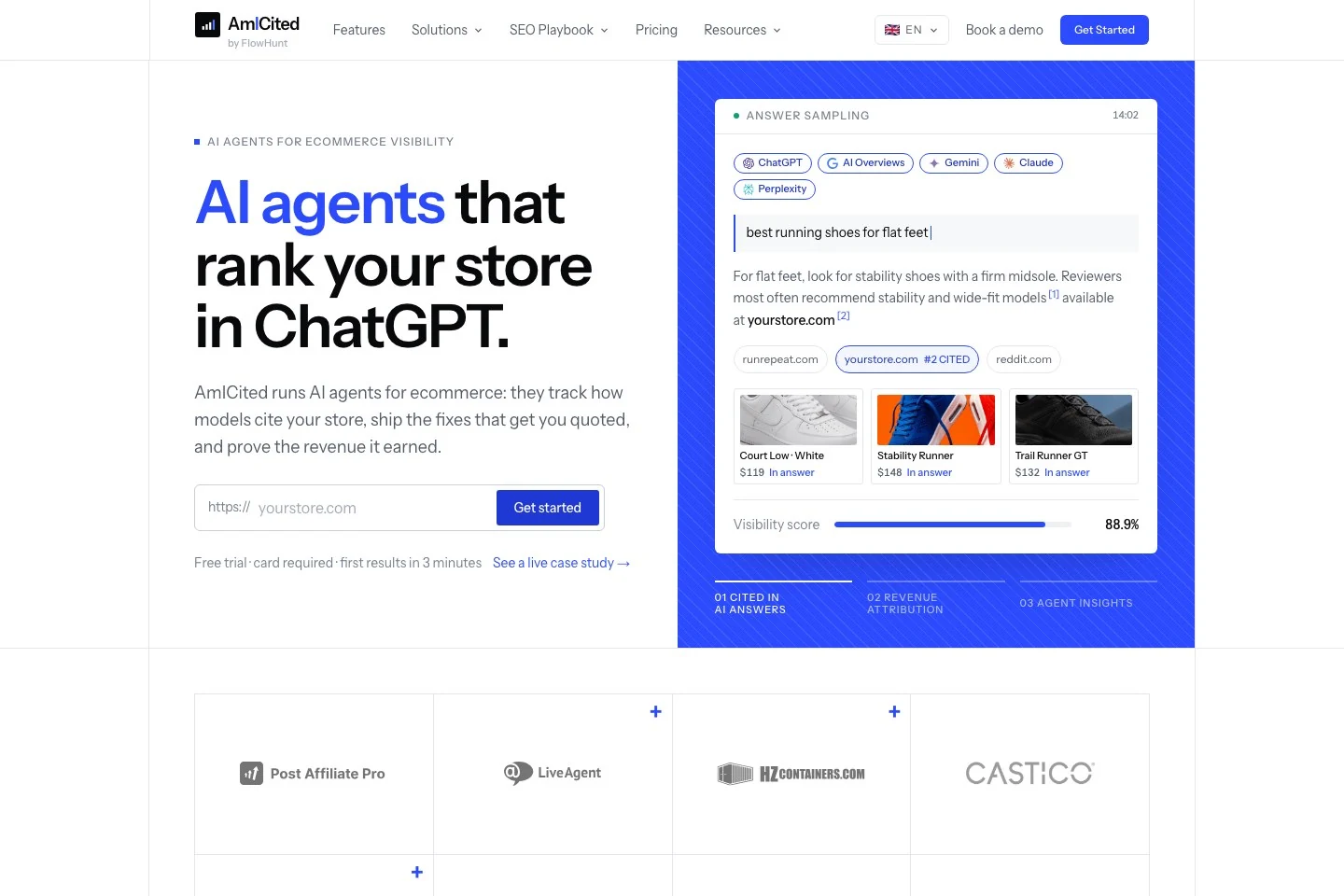
AmICited starts with a different object: the buyer prompt. It records whether the brand is mentioned, which pages are cited, how it ranks within an answer and which competitors appear beside it. Its documentation lists eight AI engines—ChatGPT, Perplexity, Gemini, Google AI Overviews, Google AI Mode, Claude, Copilot and Grok—and 139 selectable countries. Engine access and schedules vary by plan.
The differentiator is the distance from observation to action. AmICited connects AI evidence with Google Search Console and Bing data, offers citation-gap and prompt-coverage analysis, and includes content and SEO-agent workflows. Its SEO MCP exposes workspace data and actions to compatible assistants. That matters when a team wants an agent to investigate a decline, assemble a briefing or work from live citation evidence instead of manually copying charts between products.
AmICited pricing was €50, €120 and €500 per month for the listed paid tiers on the verification date. The allowance is a shared credit pool: AI responses, agents and content tasks can draw from it, while engines and schedules are also plan-gated. A stored-prompt limit is therefore not a monitoring-capacity figure. Estimate response volume first, then leave room for the work that follows the measurement.
AmICited fits when a team treats GEO as an operating process: measure across engines and countries, find the pages behind the result, act, annotate the intervention and monitor what changes. It can be excessive for an occasional AI check beside ordinary rank tracking.
Stay Updated on AI Visibility Trends
Get the latest insights on AI mentions, brand monitoring, and optimization strategies.
Google coverage and AI coverage are separate purchasing questions
A tool can have excellent Czech and Slovak Google data without reproducing an answer that a user in Bratislava receives from ChatGPT. It can also run AI prompts without offering a keyword database for market sizing.
Ask four questions during a trial:
- Market database: Does the product have useful keyword and SERP data for Czechia and Slovakia?
- Execution country: From which country does it run each AI prompt, and can that be configured?
- Answer language: Is language chosen directly, inferred from the country or simply carried in the prompt?
- Surface identity: Is the product measuring ordinary Google results, AI Overviews, AI Mode, a chatbot answer or several of these?
AmICited documents country and language controls. Marketing Miner’s strength begins with its CZ/SK SEO datasets. Collabim explicitly markets classic search and AI measurement to Czech and Slovak users. Their outputs remain sensitive to location, model and collection time.
MCP matters only when it closes a real workflow
MCP lets an AI assistant query a product without manual exports. AmICited documents an extensive tool surface for analysis and actions; Marketing Miner advertises MCP in its AI offer; Collabim lists API/MCP among its platform features. Ask each vendor to demonstrate the exact tools, permissions, plan gates and data freshness in your weekly workflow.
Three buyer scenarios
A Czech SEO agency adding AI reporting to retainers may find Marketing Miner or Collabim easier to introduce. Marketing Miner suits bulk analysis; Collabim offers a legible recurring-measurement pack.
A Slovak ecommerce brand selling across Europe should shortlist AmICited for its country and engine matrix, ecommerce connections and path from evidence to action. Marketing Miner remains relevant when local keyword research is central.
A freelancer running a quarterly audit may prefer a smaller Collabim pack or Marketing Miner add-on. AmICited becomes more relevant when recurring, multi-engine diagnosis justifies the wider system.
How to run a defensible trial
Use the same 25 to 50 buyer questions in every product, split across discovery, comparison, purchase and support intent. Align country, language and collection date. Record the full answer, cited URLs, sentiment method and competitors, then score how quickly the team can explain a loss and turn it into a useful brief.
This regional comparison is one view of a much larger market. Continue with our 2026 SEO/GEO monitoring market map, pricing-model comparison, enterprise-versus-specialist analysis, local and commerce tool guide and multilingual country comparison.
The encouraging conclusion for Czech and Slovak teams is choice. Local SEO suites are moving rapidly into AI answers, while a Prague-operated platform with Slovak group roots is building from GEO outward. The winning purchase is the one whose evidence, unit economics and workflow match the decisions your team must make every week.
 LinkedIn