



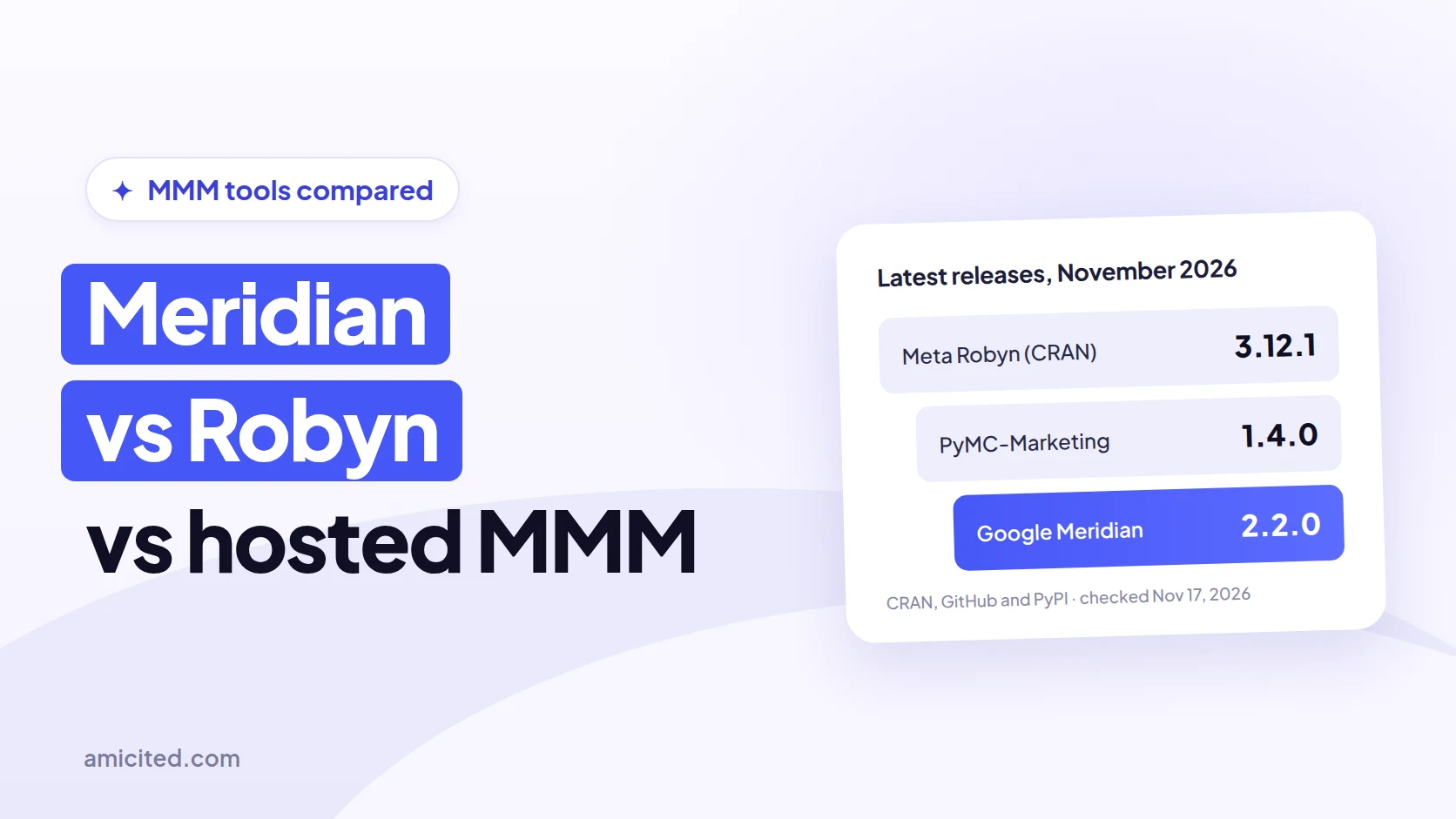
Google Meridian and Meta Robyn are both free, open-source marketing mix modeling (MMM) packages, but they suit different teams. Meridian is Google’s Bayesian model in Python, built for geo-level data and calibration with experiments; version 2.2.0 shipped on November 5, 2026. Robyn is Meta’s R package that fits ridge regressions and tunes them with an evolutionary search; its latest CRAN release, 3.12.1, dates from July 2025.
A hosted MMM tool is a paid service that runs a model like these for you, with data connectors, a UI and support. The choice depends less on the algorithm than on who will own the model: a Python data scientist, an R analyst, or nobody on your team.
This guide compares Meridian, Robyn and PyMC-Marketing, the third serious open-source option, with five hosted tools, including our own. Every tool fact was checked on the project’s or vendor’s own pages in November 2026. For what MMM is and how it works, start with our marketing mix modeling guide.
Key Takeaways
- Google Meridian is an open-source Bayesian MMM in Python under Apache 2.0. It has been generally available since January 29, 2025 and reached version 2.2.0 on November 5, 2026.
- Meta Robyn is an open-source MMM in R under the MIT license. It uses ridge regression with Nevergrad’s evolutionary hyperparameter search and returns a set of Pareto-optimal candidate models, per its documentation.
- Robyn’s last tagged GitHub release is v3.12.0 from December 2024, and its README still labels the package “experimental”. Meridian and PyMC-Marketing both shipped releases in November 2026.
- Google’s Meridian docs recommend at least two years of weekly data for geo-level models and three years for national ones.
- The packages are free; the cost is people and compute. Meridian’s README recommends at least one GPU, and Robyn’s docs recommend at least 2,000 iterations and 5 trials per run.
- Hosted tools trade control for speed. As of November 2026, published prices run from €500 a month (Cassandra Starter) to $8,500 a month (Sellforte Enterprise), and several vendors don’t publish prices at all.
Meridian, Robyn and PyMC-Marketing compared
The three open-source MMM packages differ most in method and language. Meridian and PyMC-Marketing are Bayesian Python libraries that return full uncertainty and support geo-level models. Robyn is an R package built on ridge regression that gives a fast, automated first model at national level. All three can take experiment results and include a budget optimizer.
| Google Meridian | Meta Robyn | PyMC-Marketing | |
|---|---|---|---|
| Maintainer | Meta Marketing Science | PyMC Labs | |
| Language | Python (README lists 3.11 to 3.13) | R, plus a Python API in beta that needs R | Python (3.12 or newer) |
| License | Apache 2.0 | MIT | Apache 2.0 |
| Method | Bayesian causal inference with priors | Ridge regression, Nevergrad evolutionary hyperparameter search, Prophet for trend and season | Bayesian (PyMC) |
| What you get back | Posterior distributions, credible intervals | A set of Pareto-optimal candidate models, clustered; you pick one | Posterior distributions |
| Geo-level model | Yes, and recommended | No hierarchical geo model | Yes, hierarchical |
| Reach and frequency | Yes | Curve calibrator in beta; allocator is a prototype | Not listed in its comparison page |
| Calibration with experiments | Yes, experiments as ROI priors | Yes, lift and geo tests as an objective (MAPE.LIFT) | Yes, lift-test calibration |
| Budget optimizer | Yes, plus scenario planning | Yes, max response or target ROAS/CPA | Yes |
| Latest release (Nov 2026) | 2.2.0, November 5, 2026 | v3.12.0 on GitHub (Dec 2024), 3.12.1 on CRAN (Jul 2025) | 1.4.0, November 9, 2026 |
| Best for | Python teams with geo data and lift tests | R teams wanting a fast national first read | Python teams that need a custom model |
Sources: the Meridian README and docs, the Robyn README and feature docs, and PyMC-Marketing’s own comparison page, checked November 17, 2026.

Ready to Monitor Your AI Visibility?
Track how AI chatbots mention your brand across ChatGPT, Perplexity, and other platforms.
Google Meridian
Google Meridian is an open-source Bayesian marketing mix model that estimates the causal effect of each media channel on a KPI such as sales. It runs in Python, works best with geo-level data, accepts reach and frequency inputs and lift-test results as priors, and includes budget optimization. It is free, and it needs a data scientist to run.
Meridian succeeds Google’s earlier LightweightMMM library, and the README links a migration guide. Google made it available to everyone on January 29, 2025, with a partner program of “over 20 measurement partners trained and certified on Meridian.”
What sets it apart:
- Priors and experiments. You can encode what you already know as priors. Google’s docs call incrementality experiments
“perhaps the strongest basis” for an ROI prior, and a
CalibrationBuilderhelps translate them. - Geo-level modeling. Google recommends collecting data by region; a national model is the fallback when geo data isn’t available.
- Reach and frequency. For video channels, Meridian can model reach and frequency, not only impressions.
- Search demand as a control. The introduction suggests Google Query Volume as a control for organic brand interest.
- Planning tools. Google added a no-code Scenario Planner on February 19, 2026 for testing budget scenarios, and the MMM Data Platform supplies Google media data (impressions, clicks, cost).
What it asks of you: Python, Bayesian modeling skills to set priors and read convergence diagnostics, and hardware. The README says Meridian was tested on a T4 GPU with 16 GB of RAM and recommends at least one GPU. The data bar is high too: at least two years of weekly data for geo models and three for national ones.
One honest caveat: Google sells ads and built the model that measures them. The code is open, so you can inspect every assumption, which is the main safeguard.
Meta Robyn
Meta Robyn is an open-source, semi-automated marketing mix modeling package in R from Meta Marketing Science. It fits ridge regressions, searches adstock and saturation hyperparameters with Nevergrad’s evolutionary algorithm, and returns a set of Pareto-optimal models instead of one answer. It suits digital, direct-response advertisers with national weekly data.
Robyn’s feature documentation describes the mechanics:
- Model search. Ridge (L2) regression, tuned with TwoPointsDE from Nevergrad. Prophet decomposes trend, season and holidays.
- Three objectives. Each candidate is scored on prediction error (NRMSE), a business-plausibility error (DECOMP.RSSD) and, if you have experiments, calibration error (MAPE.LIFT). K-means clustering groups similar candidates so you can choose.
- Calibration. Conversion lift and geo experiments can be used to steer the model toward causal results.
- Budget allocator. Two modes: maximum response for a given budget, or a target efficiency such as ROAS or CPA.
- Reach and frequency. A curve calibrator for reach and frequency data is in beta; the reach and frequency allocator is “a prototype and not yet available.”
What it asks of you: R, plus the Python library Nevergrad, and patience with compute. The docs recommend at least 2,000 iterations and 5 trials. Robyn’s analyst’s guide asks for at least two years of weekly data and about 10 observations per variable. A Python API (beta) exists, but it is a wrapper that needs the R package installed.
The status question matters. The Robyn README still describes it as an “experimental” package. The last tagged GitHub release is v3.12.0 from December 2024, and CRAN’s latest version is 3.12.1 from July 2025. That doesn’t mean it’s broken, but a team starting today should weigh slower updates against Meridian and PyMC-Marketing, which both released in November 2026.
Stay Updated on AI Visibility Trends
Get the latest insights on AI mentions, brand monitoring, and optimization strategies.
PyMC-Marketing
PyMC-Marketing is an open-source Python library from PyMC Labs for Bayesian marketing mix models and customer lifetime value models. It is the most flexible of the three: its documentation lists hierarchical geo models, lift-test calibration, a budget optimizer, time-varying intercepts and coefficients, custom priors and custom model terms.
The PyMC-Marketing repository is Apache 2.0 licensed, and version 1.4.0 was released on November 9, 2026. Its comparison page recommends Robyn for R teams that want a simpler approach, Meridian for a simpler API with Google ecosystem ties, and PyMC-Marketing for maximum flexibility.
The same page reports faster sampling and lower error than Meridian in a benchmark PyMC Labs ran itself. Treat that as a maker’s claim: it hasn’t been independently replicated in anything we found. Pick PyMC-Marketing when your team writes Python, knows Bayesian modeling, and needs model structure the other two don’t offer.
Which is more accurate?
No independent, head-to-head benchmark of Meridian, Robyn and PyMC-Marketing on the same real data exists that we could find. The only published comparison by a maker is PyMC Labs’ own. Accuracy depends more on your data, priors and validation than on the package.
So test any model the same way, whichever you pick:
- Holdout fit. Train on most of your weeks and check how well the model predicts the weeks it didn’t see.
- Plausibility. Channel contributions and ROI should be in a believable range. A model that credits brand search with most of your sales usually hasn’t separated existing demand from spend.
- Experiments. Run a lift or geo holdout test on your largest channel and compare. Our post on whether Google Ads increases organic traffic walks through a pause-test design.
- Stability. Refit with new weeks or different priors. Estimates that swing wildly aren’t ready for budget decisions.
Hosted MMM tools
A hosted marketing mix modeling tool runs the model for you: it connects your data sources, fits and refreshes the model, and shows contributions and budget scenarios in a UI. You pay a subscription and give up some control over the model. The tools below were checked on their own websites; facts and prices are as of November 2026.
| Tool | Model, per the vendor | Experiments | Who runs it | Published price |
|---|---|---|---|---|
| Recast | Proprietary Bayesian MMM | GeoLift tests that feed back into the MMM | Recast’s team or a certified Operator partner | None found on its site |
| Sellforte | “Always-on Causal Bayesian MMM” with daily incremental ROAS by campaign and ad set | Geo Lift, Conversion Lift and A/B tests | Vendor platform with a customer success manager | $1,900 to $8,500 a month; Full-Funnel MMM $4,500, at $300,000 average monthly media spend |
| Haus | Incrementality experiments plus a “Causal MMM” | The core product | Measurement strategists and data scientists, by tier | Not published; Causal MMM is in the Plus and Enterprise tiers |
| Cassandra | MMM plus incrementality testing, used through an AI assistant in Slack, Teams or Google Chat | Incrementality testing product | Self-serve to managed tiers | Starter €500 a month for up to €1M yearly ad spend; Self-serve from €3,000 |
| AmICited (ours) | Google Meridian, run and hosted | No lift-test input | Self-serve in the app or through MCP tools | Premium and Enterprise plans, plus a model package charge; see pricing |
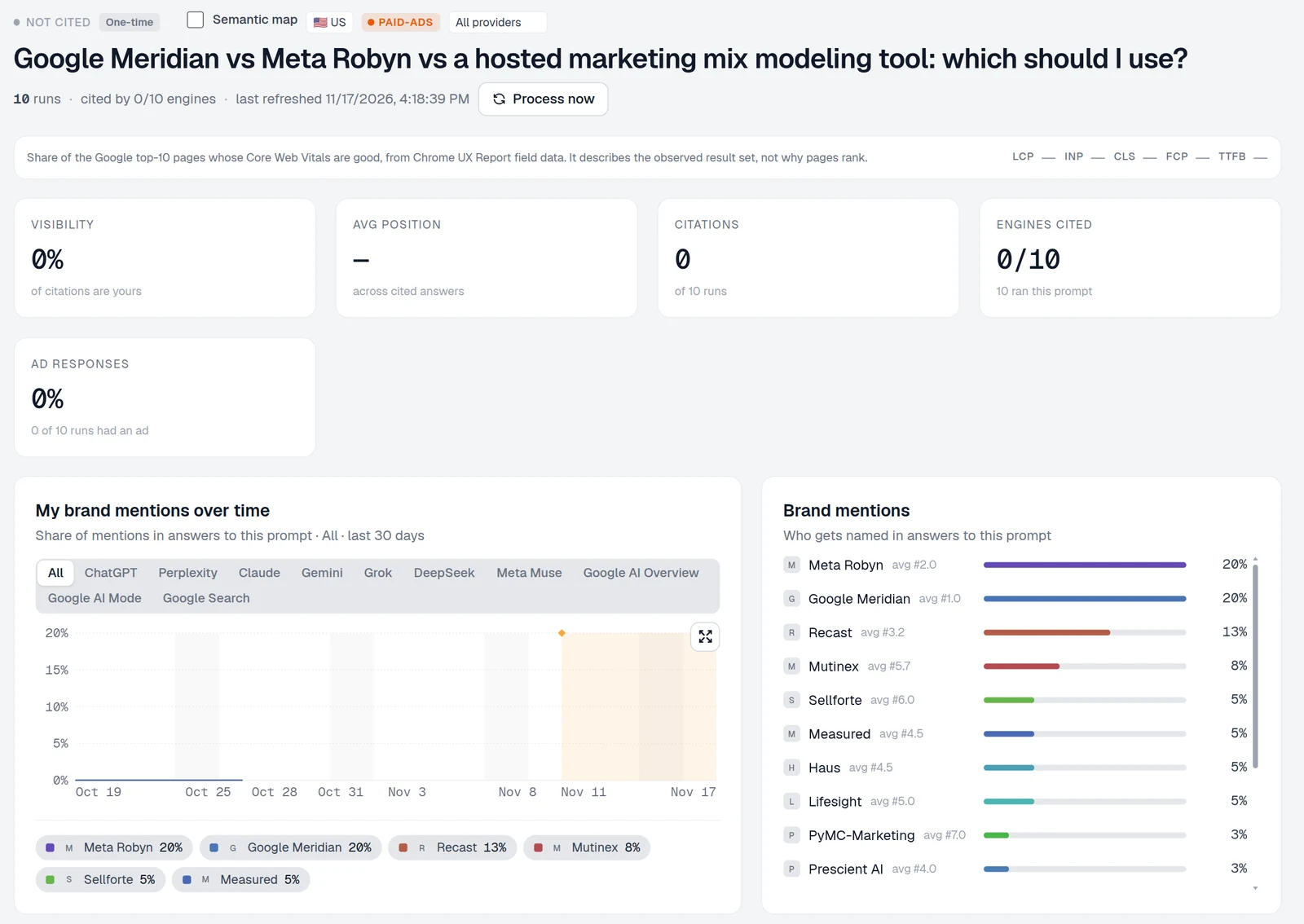
AI answers to this question also name Measured, Lifesight, Mutinex and Analytic Partners. We didn’t verify those vendors for this article, so they’re not in the table.
Before you sign with any hosted vendor, ask three things. Is the model its own or a managed Meridian or Robyn? Can you export the data and model outputs if you leave? How does it validate the model against lift tests?
Where AmICited fits
AmICited is our product, so read this section with that in mind. Its Media Marketing Mix (MMM) fits a Bayesian model with Google Meridian and hosts it: you pick an outcome (store revenue or orders, GA4 purchases or any GA4 conversion) and channels in the app, and it reports each channel’s contribution with 90% credible intervals, response curves from 0× to 3× of spend, a best split of today’s budget and convergence diagnostics. Spend and impressions come from the five ad platforms in our ad integrations, plus custom costs for offline channels.
What’s different from a generic hosted MMM: a paid-to-organic mode that sets the outcome to Search Console clicks, Bing clicks or GA4 organic sessions and estimates whether paid search adds to or takes from your organic traffic. You could build the same thing yourself in Meridian or PyMC-Marketing by using organic clicks as the KPI; AmICited packages it.
Its limits, stated plainly:
- Plan gating and cost. Premium and Enterprise plans only. A recurring model package charge starts at the first confirmed training run, and readiness checks and training use metered credits.
- History. A standard model needs 164 complete weeks (156 weeks of outcome plus an 8-week carryover lag). A limited-history mode starts at 24 weeks, but it can’t reliably learn yearly seasonality and its recommendations are labelled indicative only. Google Ads keeps about 13 months of history, so most new accounts start in limited-history mode.
- Revenue, not profit. ROI is revenue per unit of spend. For margin-aware returns, use profit-true ROAS or our explainer on true ROAS.
- Narrower than raw Meridian. The app models one weekly series for the whole site or store. It doesn’t offer a geo-level model, reach and frequency inputs or a lift-test calibration input as of November 2026.
Which should you choose?
Choose by who will own the model and what data you have, not by which company built the code. Open-source packages fit teams with an analyst who can prepare data, set priors and validate results. Hosted tools fit teams without that person, at a monthly cost. With under two years of clean weekly data, fix the data or run a test first.
| Your situation | Best fit | Why |
|---|---|---|
| Python data scientist, regional sales data, lift tests planned | Google Meridian | Geo-level Bayesian model, experiments as priors, active development |
| R analyst, national weekly data, need a first read fast | Meta Robyn | Automated hyperparameter search and a ready budget allocator; check its slower release pace |
| Python team that needs time-varying effects or custom model terms | PyMC-Marketing | The most flexible of the three, and the most demanding |
| No one to own a model; ecommerce with offline or marketplace sales | A hosted vendor such as Sellforte, Recast or Haus | Data connectors, refreshes and support included |
| Want Meridian without code; store or GA4 data and ad accounts already connected | AmICited | Hosted Meridian, plus a paid-to-organic mode; weekly account-level model only |
| Need to know whether Google Ads changes organic search clicks | A paid-to-organic model | Set organic clicks as the outcome, in AmICited or your own Meridian build |
| Under two years of clean weekly data | Fix data first, or run a holdout test | Any MMM leans on its priors when history is short |
| Small budget, one or two channels | Skip MMM for now | A pause or geo test answers the question more cheaply |
What you need to run it
Every option needs the same raw material: weekly outcome data (sales, conversions or organic clicks), weekly spend and impressions per channel, and controls such as promotions, pricing and seasonality. What changes is who does the work and how much skill and compute it takes.
| Requirement | Meridian | Robyn | PyMC-Marketing | Hosted tool |
|---|---|---|---|---|
| Skills | Python, Bayesian modeling | R, regression, judging candidate models | Python, Bayesian modeling | Marketing analyst to review output |
| Compute | GPU recommended | CPU; 2,000+ iterations × 5 trials | CPU or GPU | Vendor’s |
| Data prep | You build the dataset | You build the dataset | You build the dataset | Connectors, varies by vendor |
| Spend variation | Needed in every channel | Needed in every channel | Needed in every channel | Needed in every channel |
The last row is the one people miss. A model can only learn a channel’s effect if spend for that channel actually moved over time. A channel that spent the same amount every week for two years gives any MMM, open source or hosted, almost nothing to learn from.
Open source vs hosted
Open-source MMM is free to license and keeps your data in your own environment, but you pay for analyst time, compute and maintenance. Hosted MMM costs a subscription and means sharing sales and spend data with a vendor, in exchange for connectors, refreshes and support. The trade-off is people and control versus money and speed.
On security, open source wins by default: nothing leaves your infrastructure. With a hosted vendor, ask for its security certifications (Recast, for example, states it is SOC 2 compliant), where data is stored, and whether you can delete it.
Is hosted MMM worth it on a small budget? Usually not as a first step. If you spend on one or two channels, a holdout test on the larger one will tell you more for less. MMM pays off once you spend across several channels and need to split the budget between them.
How to get started
- Write down the decision. “Should we move budget from Meta to Google Ads?” needs a sales model. “Does brand search cannibalize organic clicks?” needs a paid-to-organic one.
- Audit your history. Count complete weeks of outcome and spend per channel. Under two years, plan for a limited model or a test first.
- Check spend variation. List channels whose spend barely moved; group them or leave them out.
- Pick the owner. A Python data scientist points to Meridian or PyMC-Marketing, an R analyst to Robyn, nobody to a hosted tool such as AmICited’s MMM.
- Validate before you act. Check holdout fit and plausibility, and run one lift test on your largest channel.
- Compare with platform numbers. Set the model’s estimates against what ad platforms report; our Meta attribution report shows how far platform-claimed purchases drift from real orders.
- Refit on a schedule. Refit as new weeks arrive and treat a big swing between versions as a warning, not a new truth.
The takeaway
Meridian, Robyn and PyMC-Marketing are all credible, free MMM engines, and the method differences matter less than the team that runs them. Pick Meridian for Python teams with geo data, Robyn for R teams that want a fast national model and accept slower updates, PyMC-Marketing when you need a custom model, and a hosted tool when nobody can own the work. Whatever you choose, an MMM gives estimates with uncertainty, not proof, so check it against an experiment before you move real budget.
 LinkedIn