



Google Ads doesn’t raise your organic rankings. Google’s Ads help center says it directly: “Investment in paid search has no impact on your organic search ranking.” What ads can change is how many organic clicks you get, and the effect runs both ways.
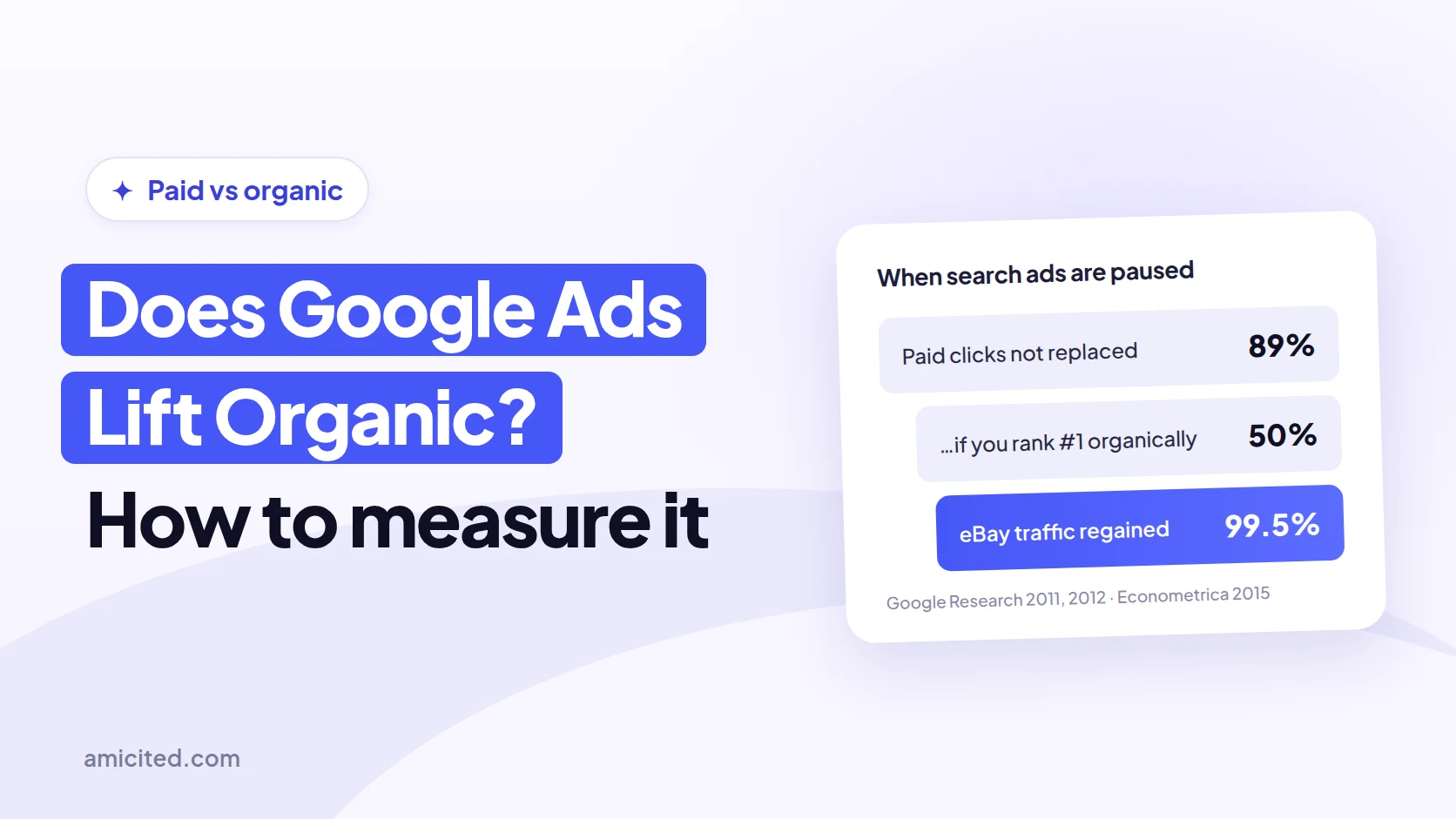
On brand searches where you already rank first, ads mostly take clicks your organic listing would have earned: when eBay paused brand ads on Bing, 99.5% of the lost traffic came back through organic results. On other searches, most paid clicks are new: Google’s analysis of over 400 pause studies found 89% of paid clicks weren’t replaced when ads stopped. Ads can also raise brand searches over time, but that has to be measured, not assumed.
This guide covers what the research found, when to bid on your brand name, and how to measure paid search’s effect on your own organic traffic, from a pause test to a paid-to-organic model.
Key Takeaways
- Google states that paid search has no effect on organic rankings, per its Ads help center.
- Google’s 2011 analysis of over 400 ad pause studies found 89% of paid clicks were incremental: organic clicks didn’t replace them when ads were paused.
- A 2012 follow-up of 390 studies found only 50% of ad clicks were incremental when the advertiser held the top organic position, versus 100% with no organic result, per Google Research.
- eBay’s brand-keyword experiment found 99.5% of the traffic lost by pausing brand ads was recovered by organic search ( Blake, Nosko and Tadelis, Econometrica 2015).
- On Bing, a brand’s own ad added 1–4% more clicks with no competitors present; when competitors advertised and the brand didn’t, they took 18–42% of its clicks ( Simonov, Nosko and Rao, 2018).
- You measure the effect with a holdout test on total paid plus organic clicks, or a model of spend against organic clicks over time.
Ads don’t move rankings
Google Ads spend is not a ranking factor. The ad auction and organic ranking are separate systems, and Google’s Ads help center states that paid search investment has no impact on organic ranking. Raising or cutting your budget won’t move your position in the unpaid results, so any change in organic traffic comes from clicks, not rankings.
That distinction clears up most of the confusion. A rise in organic traffic while ads run can come from more brand searches, seasonality, a content change or an algorithm update. A fall can come from your ad taking the click your listing used to get. Neither means Google rewarded or punished your ad spend.

Ready to Monitor Your AI Visibility?
Track how AI chatbots mention your brand across ChatGPT, Perplexity, and other platforms.
How ads change organic clicks
Paid search changes organic traffic in three ways. It can replace organic clicks (cannibalization), it can add clicks organic results would never have earned (incremental clicks), and it can raise later brand searches that arrive as organic visits (a halo effect). Which one dominates depends mainly on the query and on your organic position for it.
- Cannibalization. Paid search cannibalization is when a click on your ad replaces a click your organic listing would have received. It is strongest on brand searches where you rank first, because the searcher was going to reach you anyway.
- Incremental clicks. An incremental click is one that wouldn’t have happened without the ad. Most clicks on non-brand searches are incremental because you usually don’t rank at the top organically for them.
- Halo. Ads, especially video and display, can make people search for your brand later. Those visits land as organic or direct traffic. This is plausible but varies by brand, so test it.
Two Google figures show how much the query matters. In its 2012 analysis, 81% of ad impressions and 66% of ad clicks occurred when the advertiser had no organic result on the page at all. For those clicks there’s nothing to cannibalize.
What the research found
The best evidence comes from controlled pause experiments, where ads were switched off and organic clicks were watched. Google’s own studies found most paid clicks are incremental on average. Academic experiments at eBay and on Bing found brand-term ads are the exception: organic results recover almost all of their clicks unless a competitor is advertising.
| Study | Setting | Finding | Caveat |
|---|---|---|---|
| Chan et al., Google, 2011 | 400+ Search Ads Pause studies across verticals | 89% of paid clicks not replaced by organic clicks when ads paused | Average across advertisers; not split by brand vs non-brand |
| Chan et al., Google, 2012 | 390 pause studies | 50% incremental when the advertiser ranks #1 organically; 100% with no organic result | Run by the company that sells the ads |
| Blake, Nosko and Tadelis, Econometrica 2015 | eBay paused brand ads on Bing and Yahoo, with Google as control | 99.5% of lost brand-ad traffic recovered by organic search; brand ads had “no measurable short-term benefits” | eBay is an extremely well-known brand |
| Simonov, Nosko and Rao, Marketing Science 2018 | Large-scale experiments on Bing across thousands of brands | Own brand ad adds 1–4% clicks without competitors; competitors take 18–42% when the brand doesn’t advertise | Bing only; effect smaller for larger brands |
These studies are from 2011 to 2018, before AI Overviews and before today’s results-page layouts. The direction of the findings still holds as a starting point, but the size of the effect on your brand today is something only your own test can tell you.
Stay Updated on AI Visibility Trends
Get the latest insights on AI mentions, brand monitoring, and optimization strategies.
Should you bid on your brand?
Bid on your brand name when someone else is competing for it or when you need control of the message; test before paying when the results page is clean. Brand bidding means buying ads on searches for your own company or product name. Google lets anyone use your trademark as a keyword, so competitors can appear above your organic listing.
Google’s trademark policy lists “using trademarks as keywords” among the practices it won’t restrict, though it does restrict competitors from using your trademark in their ad text. That’s why the Bing study matters: brands that didn’t advertise lost 18–42% of their clicks to a competitor’s ad, while a brand’s own ad in the top slot held competitors to 1–5%.
| Situation | Bid on your brand? | Why |
|---|---|---|
| Competitors, resellers or affiliates appear on your brand search | Yes | Their ads sit above your listing and take clicks |
| You need sitelinks, an offer, a launch or a specific landing page | Yes, while it runs | Ads let you control the message; an organic snippet doesn’t |
| Results page crowded above your listing (marketplaces, review sites, AI answers) | Test it | A brand ad keeps your own message at the top |
| No one else bids and you rank first | Test before paying | Without competitors, own brand ads added only 1–4% more clicks on Bing |
| Tight budget, brand clicks mostly recovered in a test | Pause or cap | Spend on non-brand terms where clicks are incremental |
| Brand name is also a common word | Exact-match brand terms and negatives | Avoid paying for unrelated searches |
Practical setup notes:
- Keep brand separate. Run brand terms in their own campaign so their cheap, high-converting clicks don’t inflate the ROAS of non-brand campaigns.
- Check Auction Insights. Google Ads’ Auction Insights report shows which other advertisers enter the same auctions as your brand keywords. Search your own name in a private window too.
- Watch Performance Max. Performance Max can serve on brand searches. Google lets you add brand exclusions so a dedicated brand campaign, or no ad at all, handles them.
- Look beyond Google. ChatGPT now shows ads too, and the same bid-or-not question is starting to apply there. Our guide to showing up in ChatGPT without paying covers how its ads work.
How to measure it
Measure the effect of Google Ads on organic traffic with a controlled pause or geo holdout, reading total paid plus organic clicks against a control group. Before-and-after comparisons alone mislead, because seasonality, rankings and demand change at the same time. Search Console and the Google Ads Paid and organic report give you the inputs.
- Link Search Console to Google Ads. The Paid and organic report then shows ad clicks, organic clicks and combined clicks for the same queries. It counts text ads only and updates once a day. Find it under Insights and reports, then Report editor.
- Split branded from non-branded queries. Search Console’s branded queries filter, introduced in November 2025 and available to all eligible sites since March 11, 2026, separates them. It works on top-level properties with enough query volume; otherwise use a regex filter on your brand name.
- Pick what to test. Start with brand campaigns: they have the most cannibalization risk and the clearest signal.
- Design the holdout. Either pause ads in a random set of regions and keep them running elsewhere, or alternate on and off weeks. Run each arm for several weeks and avoid launches, sales and holidays.
- Read organic at the right level. Search Console reports organic clicks by country, not region, so a regional test inside one country needs GA4’s organic search sessions by region. Use Search Console for country-level tests and query detail.
- Measure totals, not channels. Compare paid plus organic clicks, and conversions, in the test group against the control. A drop in paid clicks that organic clicks don’t fill is the incremental share.
- Price it. Divide the spend in the period by the incremental clicks or conversions it produced to get a cost per incremental click.
| Metric | Formula |
|---|---|
| Recovery rate | Organic clicks gained when ads are off ÷ paid clicks lost |
| Incremental share | 1 − recovery rate |
| Cost per incremental click | Ad spend ÷ (paid clicks × incremental share) |
Example: a store pauses brand ads in half its regions for four weeks. Against the control regions, the test regions lose 1,000 paid brand clicks a week and gain 900 organic brand clicks. The recovery rate is 90%, so only 100 of the 1,000 paid clicks were incremental. At $0.50 a click, $500 a week bought 100 extra clicks: $5 per incremental click, ten times the reported CPC.
Model it with paid-to-organic MMM
A paid-to-organic marketing mix model estimates how weekly paid search spend changes organic clicks or sessions, after accounting for seasonality and other channels. It suits teams that can’t pause ads, or that want an always-on read instead of a one-off test. It gives an estimate with uncertainty, not proof, and needs long, varied spend history.
AmICited’s Media Marketing Mix (MMM) has a paid-to-organic purpose built on Google Meridian. AmICited is our product. You set the outcome to Google Search Console organic clicks, Bing Webmaster Tools organic clicks or GA4 organic search sessions, and the channels to your Google Ads and Microsoft Advertising spend, which you can split into brand and non-brand campaign groups. It shows:
- PPC impact over time. A modeled organic baseline without PPC next to the observed series.
- Signed contribution. Paid search can add to organic clicks, take from them, or show no clear effect, and the report says which.
- Cost per incremental organic click. Shown only where the effect is positive and identified.
The limits are real. It’s available on the Premium and Enterprise plans. A standard model needs 164 complete weeks; a limited-history mode starts at 24 weeks but can’t reliably learn yearly seasonality and labels its results indicative only. Google Ads imports keep about 13 months of history, so most accounts start in limited-history mode. If you’d rather build it yourself, any Meridian, Robyn or PyMC-Marketing model can use organic clicks as its outcome; our comparison of Google Meridian vs Meta Robyn covers the trade-offs, and our marketing mix modeling guide covers the basics.
When SEO beats PPC
The flip side of brand cannibalization is paid search proving demand that SEO could capture. Terms you’ve paid for, that convert, and where you have no organic presence at all are the clearest case for a new page. Once that page ranks, test the bid down and watch whether total clicks hold.
| PPC | SEO | |
|---|---|---|
| Speed | Clicks from day one | Months to rank |
| Cost model | Pay per click, stops when spend stops | Content and links up front, no per-click cost |
| Control | Exact message, landing page, budget | Google picks the snippet and position |
| Best use | Testing demand, defending a brand, launches | Terms with steady, proven demand |
Three AmICited reports cover this. Paid-Proven Gaps lists search terms you’ve paid for that have never had an organic impression, sorted by total historic cost. Unified Keywords puts organic clicks and position beside paid spend and conversions in one row per keyword, so you can see where you pay for terms you already rank for. Organic vs Paid Pages does the same per landing page.
What to do now
- Check your brand results page. Search your brand name in a private window and in Auction Insights. Competitors present means bid; a clean page means test.
- Connect your data. Link Search Console to Google Ads, and bring Search Console, Bing Webmaster Tools and your ad accounts together; see our Search Console and Bing setup and ad platform integrations.
- Split brand from non-brand. In Search Console’s branded filter, in your campaign structure and in Performance Max brand exclusions.
- Run one holdout on brand terms. Several weeks, split by regions or alternating weeks, measured on total paid plus organic clicks and conversions.
- Price the result. Work out the cost per incremental click and compare it with your non-brand CPCs.
- Model it if you can’t pause. Use a paid-to-organic model, in your own Meridian build or AmICited’s MMM, and treat its output as an estimate.
- Turn proven paid terms into pages. Start with the highest-cost terms in Paid-Proven Gaps, then review those bids once the pages rank.
The takeaway
Google Ads doesn’t touch your organic rankings, but it does change your organic clicks: it mostly replaces them on brand searches you already win, and mostly adds to them everywhere else. The research gives you the direction; only a holdout test or a paid-to-organic model gives you your own number. Defend your brand where competitors bid, test where they don’t, and use what paid search proves to decide which pages to build next.
 LinkedIn