


How to Track AI Brand Sentiment: A Step-by-Step Playbook
A practitioner's playbook for tracking AI brand sentiment: what to query, how often, how to categorize and log results, and how to build a repeatable workflow.
8 min read

How to choose between manual prompt-testing, a dedicated AI sentiment platform, or building your own pipeline—what to evaluate, the tradeoffs, and how to build the ROI case.
Once you’ve decided to track changes in sentiment in how AI systems describe your brand, and you’ve validated the process with a manual tracking playbook , the next question is how to scale it. The shift from traditional search engines to AI-mediated discovery means this isn’t a one-time audit — it’s ongoing infrastructure, and infrastructure needs a deliberate choice of approach. There are three real options: keep doing it manually, buy a dedicated platform, or build your own pipeline. This guide is about choosing between those three — what each one actually costs, what you get for it, and how to make the case internally.
| Manual prompt-testing | Dedicated platform | Build your own | |
|---|---|---|---|
| Setup time | Minutes | Hours to days | Weeks |
| Ongoing effort | High (hours/week) | Low | Medium (maintenance) |
| Platform coverage | Whatever you test yourself | Broad, maintained for you | Whatever you build against |
| Historical trends | Only what you log | Built in | You build it |
| Cost | Free (time only) | Subscription | Engineering time + API costs |
| Best for | Validating the process, very small teams | Teams that need scale and reliability without engineering overhead | Unusual requirements, existing data infrastructure |
None of these is universally “correct” — the right choice depends on where you are, not which option sounds most sophisticated.
Manual tracking means a person (or a rotating set of people) periodically asking AI platforms your key questions and logging what comes back — the process covered in our AI responses tracking playbook. It costs nothing but time, and that’s exactly its strength and its ceiling.
Where it wins: Zero setup cost, full transparency into exactly what was asked and what came back, and no vendor dependency. It’s the right starting point for any team that hasn’t yet proven sentiment tracking will actually change what they do — there’s no reason to pay for a platform before you know the workflow sticks.
Where it breaks down: The hours don’t scale. Tracking 20 prompts across two platforms weekly takes maybe 45 minutes; tracking 60 prompts across four platforms with historical trend charts and competitive benchmarking turns into a part-time job, and it’s a job that’s easy to quietly stop doing when someone’s calendar gets busy. Manual tracking also has no memory beyond whatever spreadsheet you built — there’s no automatic alerting when a pattern emerges between check-ins.

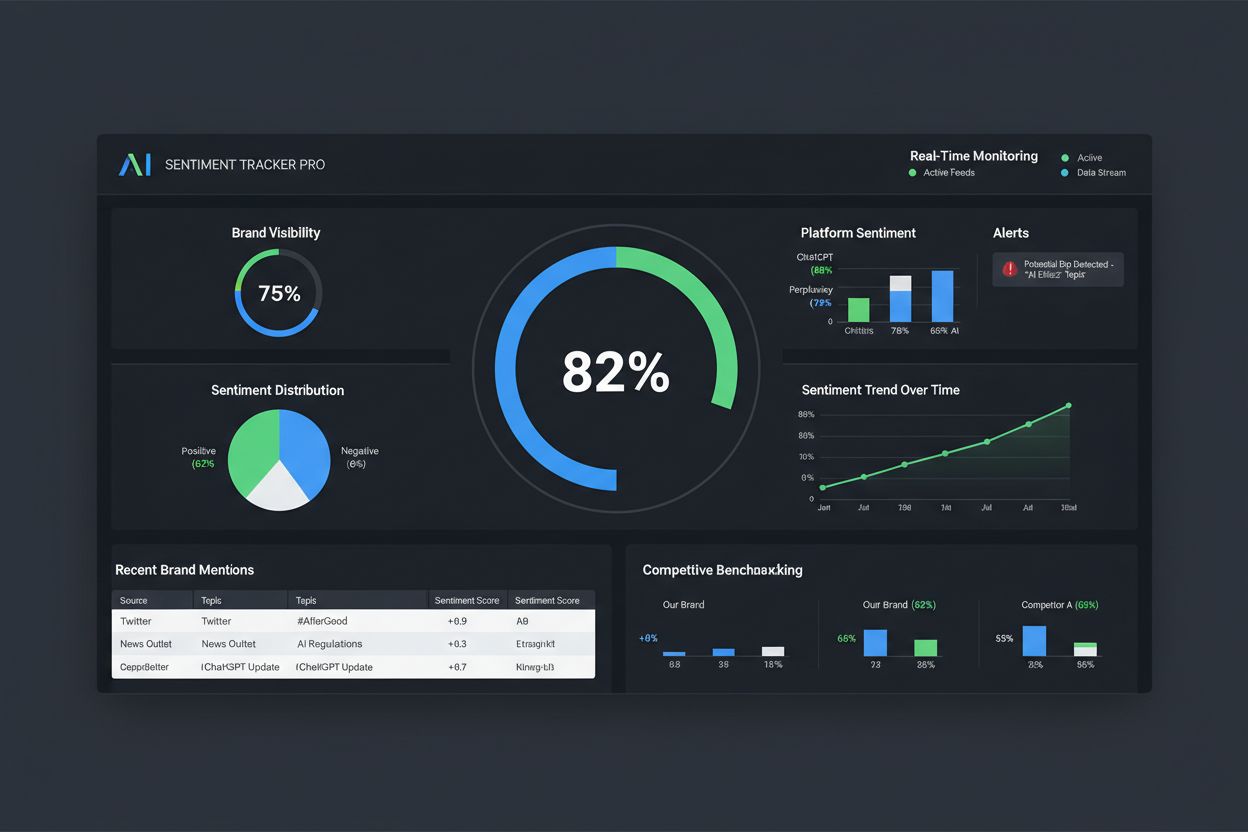
Track how AI chatbots mention your brand across ChatGPT, Perplexity, and other platforms.
Purpose-built tools — AmICited among them — automate the query-and-log loop: they run your prompt set across multiple AI platforms on a schedule, apply consistent sentiment analysis in the context of each mention, and roll results into dashboards and trend charts without anyone manually re-running queries.
Where it wins: Coverage and consistency at a scale manual tracking can’t sustain, built-in Visibility Score and sentiment trend history, competitive benchmarking against named rivals, and — critically — a maintained integration layer, so when a platform changes its interface or launches a new model, the vendor handles the update rather than your workflow silently breaking.
Where it falls short: Cost scales with prompt volume and platform coverage, and you’re trusting the vendor’s sentiment methodology rather than one you fully control. Some platforms are more transparent than others about why a given mention was scored the way it was — that transparency is worth explicitly checking for before you commit, not something to assume.
What to evaluate when comparing platforms:
Building your own means scripting queries against AI platforms (directly or via their APIs where available), running the responses through a sentiment scoring method — a cloud NLP API like AWS Comprehend or Google Cloud Natural Language, an open-source library, or a fine-tuned model — and storing the results yourself.
Where it wins: Full control over methodology, the ability to integrate directly with an existing data warehouse or BI stack, and no per-seat vendor pricing if volume is high enough that a custom pipeline’s marginal cost undercuts a subscription. This only makes sense if you have real engineering capacity to dedicate to it and a requirement a general-purpose tool genuinely can’t meet.
Where it falls short: Every AI platform without an accessible API means scraping — fragile, and prone to breaking whenever the platform changes its interface, which happens more often than most teams expect. Sentiment scoring accuracy depends entirely on the method chosen and how well it’s validated against human judgment, so the burden of accuracy validation shifts entirely onto your team. Citation Patterns — which sources a given platform pulls from and how consistently — also aren’t something a general NLP API tells you; you’d need to build that layer yourself on top of the raw sentiment score if it matters to your use case. And the ongoing maintenance cost is easy to underestimate: this isn’t a project you build once, it’s infrastructure you now own indefinitely, including every time a platform updates the model that decides how to represent your brand relative to competitors in its answers.
A rough cost comparison: a small team querying 30 prompts weekly across three platforms spends, in cloud NLP API calls alone, a few dollars a month — the real cost is engineering hours for the scraping layer, response parsing, and ongoing maintenance, which typically run into tens of engineering-hours per month once you account for platforms changing their markup or rate-limiting automated queries. Compare that fully-loaded cost, not just the API line item, against a platform subscription before deciding building is actually cheaper.
Get the latest insights on AI mentions, brand monitoring, and optimization strategies.
Match the approach to your actual stage, not your ambitions. Running a quick strengths-and-weaknesses pass on your own situation — closer to an AI SWOT Analysis than a vendor comparison spreadsheet — usually settles the question faster than reading another feature list:
None of these paths is permanent. Teams commonly start manual, move to a platform once the workflow proves itself, and occasionally supplement a platform with a small custom script for one specific need the platform doesn’t cover — the goal is matching effort to value at each stage, not picking one approach forever on day one.
Whichever direction you’re leaning, the internal pitch is stronger when it’s anchored to a decision rather than to the data itself. Nobody needs a sentiment dashboard for its own sake — they need it to catch a negative pattern before it affects the pipeline, or to prove a content and PR push actually shifted how AI recommendations characterize the brand.
A workable ROI case includes three things: the current cost (hours spent manually tracking, or the cost of not tracking at all and finding out about a sentiment problem from a lost deal instead), the cost of the option you’re proposing, and one concrete example — even a small one — of a sentiment signal that would have gone unnoticed without better tooling. If you don’t have that concrete example yet, that’s a sign to run a short manual pilot first and generate one, rather than buying or building on faith.
Whatever tool or process you land on, treat the underlying question the same way you would for any sentiment monitoring investment: does this change a decision, and is the cost of getting the answer faster or more reliably actually worth it. If the answer is yes, the specific approach — manual, platform, or custom — is a budget and capacity question, not a strategy question.
Viktor Zeman is a co-owner of QualityUnit. Even after 20 years of leading the company, he remains primarily a software engineer, specializing in AI, programmatic SEO, and backend development. He has contributed to numerous projects, including LiveAgent, PostAffiliatePro, FlowHunt, UrlsLab, and many others.

Compare the manual, build-it-yourself, and platform approaches for yourself. Am I Cited tracks sentiment across ChatGPT, Perplexity, and Gemini so you can see the difference a dedicated tool makes.
A practitioner's playbook for tracking AI brand sentiment: what to query, how often, how to categorize and log results, and how to build a repeatable workflow.

Community discussion on automating AI search monitoring. Real tools, processes, and workflows from teams who automated their brand tracking across ChatGPT, Perp...

Learn what AI sentiment monitoring is, why it matters for brand reputation, and how to track how ChatGPT, Perplexity, and Gemini characterize your brand. Essent...
Cookie Consent
We use cookies to enhance your browsing experience and analyze our traffic. See our privacy policy.