


Average Order Value and Order Mix Analysis
Order Mix is an average order value calculator that takes one window of orders and divides it seven ways — raw status classification, B2B vs B2C, first-vs-repeat sequence, how much margin is grounded in measured purchase cost, payment method, carrier, and a cancellation proxy — so the numbers other reports show can be audited, not just trusted.
Realized Order Classification Rules
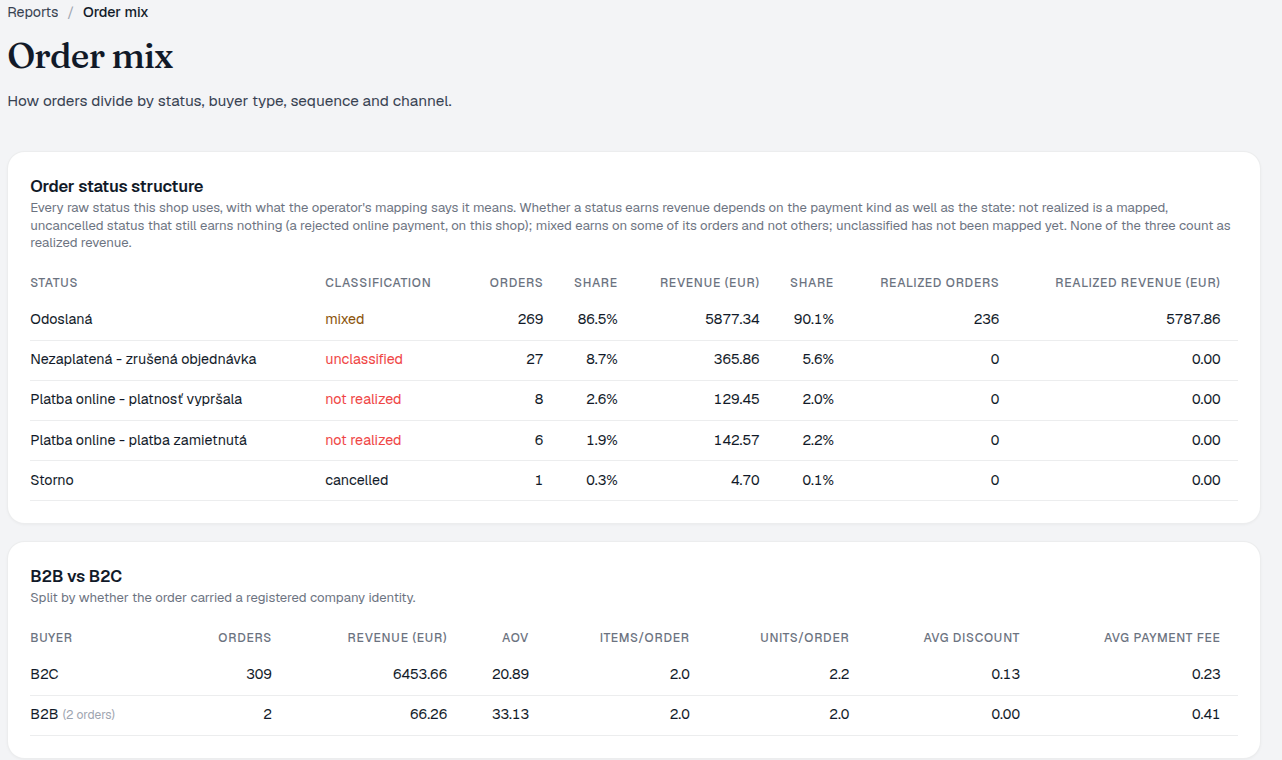
Orders by status: every raw shop status gets classified as realized, cancelled, not realized, mixed, or unclassified — and that classification depends on status and payment kind together, not status alone. A mapped, uncancelled order can still land as not realized if its online payment was rejected; a mixed status realizes only some of its payment combinations. Neither mixed nor unclassified counts as realized revenue by default.
- Five classifications, not two — realized, cancelled, not realized, mixed, unclassified; only realized counts as a sale.
- Status and payment kind together — a mapped, uncancelled order can still be not realized if its payment was rejected.
- Mixed statuses realize partially — some payment combinations under a mixed status count, others don’t.
- B2B vs B2C by registered identity — orders, net revenue, AOV, items/order, units/order, average discount, average payment fee.
- Small sides are marked, not dropped — a side under the minimum order threshold shows its count so its ratios are read cautiously, but the row stays.
Order History and Margin Confidence
Lifecycle Proxy labels each order by where it sits in that customer’s own order history — first, second, third, or fourth-and-later — showing orders, revenue and AOV per position. It’s order-history sequencing, not an acquisition cohort, so it says nothing about how the customer was acquired. Expense Source Mix is the closest thing this report has to a headline number: the measured purchase-cost share, followed by measured and assumed cost totals, with a monthly breakdown once more than one month is in range. It describes how much of the margin used by every other report in the product is grounded in an imported purchase price rather than a configured assumption.
- Four positions — first, second, third, fourth-and-later, each with orders, revenue and AOV.
- Sequencing, not acquisition — this is where an order sits in a customer’s own history, not a marketing-channel cohort.
- Measured purchase-cost share is the headline — how much of contribution margin elsewhere in the product rests on an actual imported cost, not an assumption.
- A monthly table when the range spans more than one month — measured cost, assumed cost, and measured share, month by month.
Order Mix Dimensions and Caveats
Payment Method Mix lists each raw method with orders, revenue and average acceptance fee — useful for spotting a method that’s quietly expensive. Carrier Mix lists carrier, orders, revenue and average reported shipment weight in grams; a missing weight stays an em dash rather than a false zero. Order-Status Refund Proxy tabulates monthly orders, cancelled orders and cancelled share — with a prominent notice that the platform exposes no credit notes, so this is a proxy built on cancellation status, not a measured refund rate. Rising cancelled share is adverse directionally, but can also reflect workflow or status behavior rather than money actually returned.
- Payment Method Mix — raw method, orders, revenue, average acceptance fee.
- Carrier Mix — carrier, orders, revenue, average reported weight in grams; missing weight shows as an em dash, never zero.
- Order-Status Refund Proxy — monthly orders, cancelled orders, cancelled share — built on cancellation status because the platform has no credit-note data.
- Cancelled is not automatically refunded — treat the share as a workflow signal to investigate, not a confirmed refund rate.
cards, one order set audited seven ways
Status classification, B2B/B2C, lifecycle sequence, measured cost share, payment method, carrier and a cancellation proxy — each one a check on what the other reports assume.
See GeographyValidate Sales Before Margin Analysis
Status classification, B2B/B2C, sequence, measured cost share, payment method, carrier and a cancellation proxy — seven cuts of the same order set.
Ready to see how your orders actually divide?
Free check · 7-day trial · card required