


- Composable commerce builds a store from separate services (catalog, cart, checkout, search, content) connected by APIs, so each one can be replaced without touching the others.
- Headless only separates the front end from one back-end platform. Composable splits the back end too, so headless is a precondition, not the same thing.
- It suits enterprises with complex catalogs or many channels. Smaller stores often spend more on integration work than they gain.
- Storefronts rendered with client-side JavaScript can hide products from crawlers, so render key pages on the server and test what AI crawlers see.
Where AmICited fits
AmICited’s AI Accessibility audit checks whether AI agents can read and move through your store: llms.txt, the accessibility tree, crawler access in robots.txt, sitemaps, WebMCP and agentic commerce protocols such as ACP and UCP.
See the AI accessibility audit
What Is Composable Commerce?
Composable commerce is a way of building an ecommerce system from independent services, each picked for one job and connected through APIs. Instead of running cart, catalog, search, checkout, content and promotions inside one platform, you choose a separate component for each and wire them together. If your search tool falls behind, you replace the search tool. The checkout keeps running.
The term was popularized by Gartner around 2020 and is closely tied to the MACH Alliance, a vendor group that promotes Microservices, API-first, Cloud-native and Headless architecture. You will mostly see composable commerce at enterprise retailers and fast-growing brands that have outgrown a monolithic platform, often built on vendors such as commercetools, Elastic Path or a headless CMS, with a custom front end on top. It sits one step beyond headless commerce, and it is often discussed together with unified commerce, since both try to break down silos between systems.
How Composable Commerce Works
A composable stack has three layers:
- Front ends (heads). The website, mobile app, in-store kiosk or marketplace connector. Each one calls the same back-end services.
- Orchestration or API layer. A gateway or middleware that routes requests, combines data from several services and handles authentication.
- Packaged business capabilities (PBCs). Self-contained services for catalog, pricing, inventory, cart, checkout, payments, search, promotions, content and order management.
When a shopper adds an item to the cart, the front end calls the cart service. The cart service asks the pricing service for the current price and the inventory service for stock. At checkout, the payment service takes over. Each service can be deployed, scaled and replaced without touching the others, because they agree only on the API contract between them.
Here is a simple example. A retailer runs 8 services. Its old search engine returns poor results for long product queries, so the team swaps in a new search vendor. In a monolith, that change might mean a platform upgrade or a custom plugin. In a composable setup, the team re-indexes the catalog into the new search service and points the front end’s search calls at it. The other 7 services don’t change.
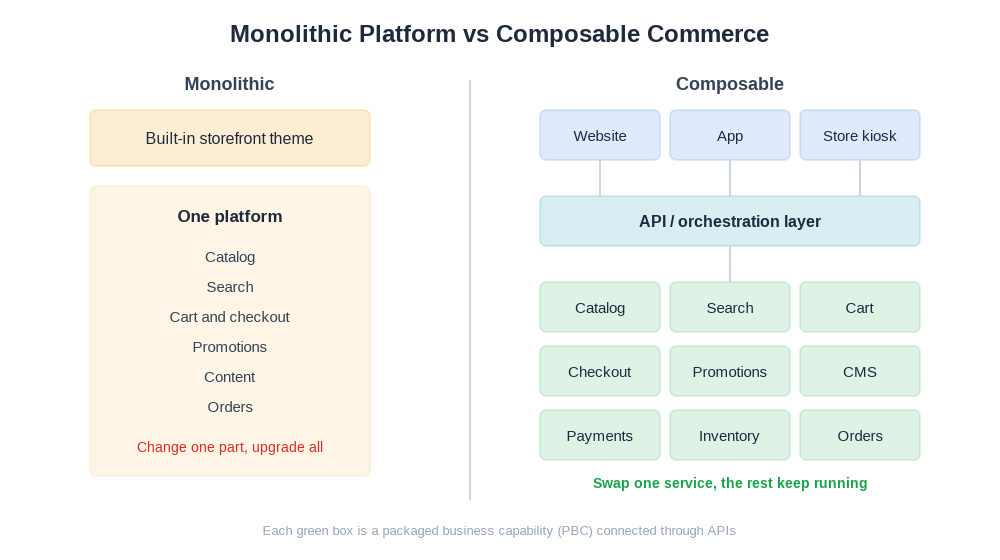
Monolithic vs Headless vs Composable Commerce
| Monolithic platform | Headless commerce | Composable commerce | |
|---|---|---|---|
| Front end | Built into the platform (themes) | Separate, custom front end | Separate, often several |
| Back end | One platform does everything | One platform, accessed by API | Many independent services |
| Swapping a capability | Hard, tied to platform roadmap | Hard on the back end | Replace one service at a time |
| Team needed | Merchandisers, light dev | Front-end developers | Developers and architects across services |
| Cost profile | One subscription, predictable | Platform plus front-end build | Several vendors plus integration work |
| Typical fit | Small to mid-size stores | Brands needing custom UX | Enterprises with complex catalogs or many channels |
Composable Commerce vs Headless Commerce
These two terms get used as synonyms, and they shouldn’t be. Headless commerce means the front end is decoupled from the back end. You might run Shopify as the back end and build your storefront in a JavaScript framework that reads products through the Storefront API. The back end is still one platform.
Composable commerce decouples the back end too. Search, cart, pricing and content are separate products, sometimes from separate vendors, and you can mix them. So headless is a precondition for composable, not the same thing. A useful test: if you can replace your promotions engine without migrating platforms, you are composable. If you can only redesign your storefront freely, you are headless.

Stay Updated on AI Visibility Trends
Get the latest insights on AI mentions, brand monitoring, and optimization strategies.
Composable Commerce and AI Search
AI engines and shopping agents don’t care what architecture sits behind your site. They care whether they can read your product data. Composable stacks can help here, because product information already lives in an API-first catalog or product information management system, which makes it easier to generate clean product feeds for AI, schema markup and agent-facing endpoints from one source.
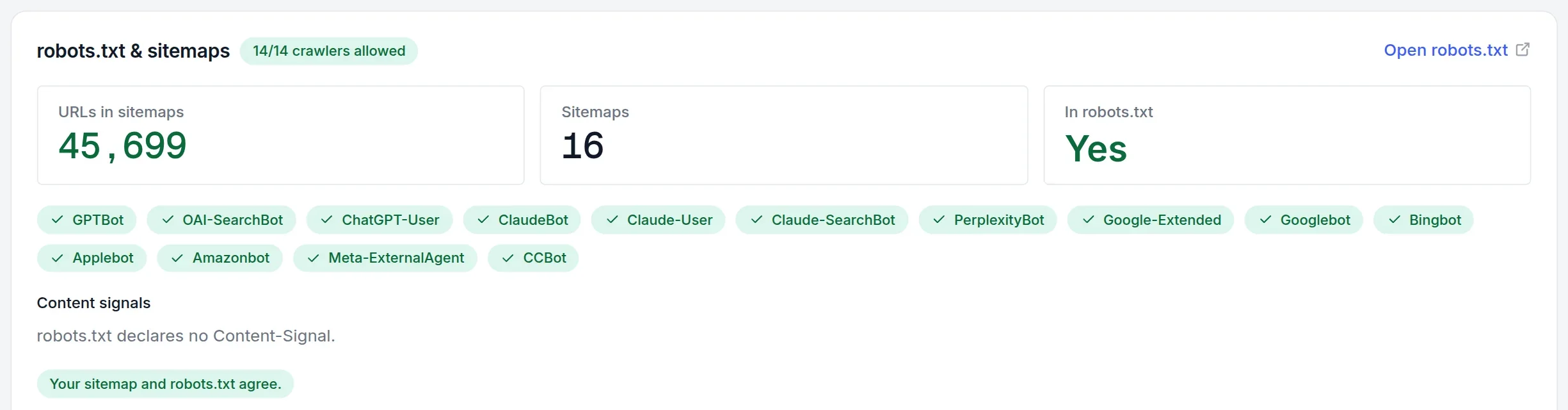
The risk runs the other way too. Custom front ends built on client-side JavaScript can hide content from crawlers that don’t render scripts. If you go composable, test what AI crawlers actually see. AmICited’s AI Accessibility audit checks whether AI agents can read pages, move through your site and complete purchases, including llms.txt and agentic commerce checks.
Best Practices for Composable Commerce
- Start with the capability that blocks you most (often search, content or checkout) and replace that first, instead of rebuilding everything at once.
- Keep one source of truth for product data. Feed every service and channel from the same catalog or PIM.
- Write down the API contracts between services and version them, so a vendor change doesn’t break other parts.
- Budget for integration and maintenance, not only licences. The glue code is where composable projects run over.
- Render key product content on the server or pre-render it, so search engines and AI crawlers see full pages.
- Assign an owner to each service, with monitoring and an incident process that spans vendors.
Common Composable Commerce Mistakes
The most common mistake is going composable because it sounds modern, not because a real limit exists. A store doing a few million a year on a stable platform rarely needs eight vendors, and the integration cost can wipe out any gain. Another is “composable in name only”: buying a set of MACH vendors but connecting them with brittle point-to-point code, which recreates a monolith that is harder to debug.
Teams also underestimate data consistency. When price, stock and content live in different services, they can drift apart, and shoppers (or AI agents) see a price on the product page that doesn’t match the cart. Finally, many projects launch a fast JavaScript storefront and only later find that crawlers see empty pages, which costs organic and AI visibility until it is fixed.