


- FBM (fulfilled by merchant) means you list and sell on Amazon but store and ship the orders yourself or through your own 3PL, instead of sending stock to Amazon’s warehouses.
- You avoid FBA fulfillment and storage fees, but you own shipping speed, customer service and returns, and standard FBM offers carry no Prime badge unless you qualify for Seller Fulfilled Prime.
- Large, heavy, slow-selling or made-to-order products often lean FBM; small, fast sellers in competitive categories often lean FBA. Many sellers use both.
- Compare the full cost per unit: your labor, packaging, storage rent and returns handling, not only the shipping label.
Where AmICited fits
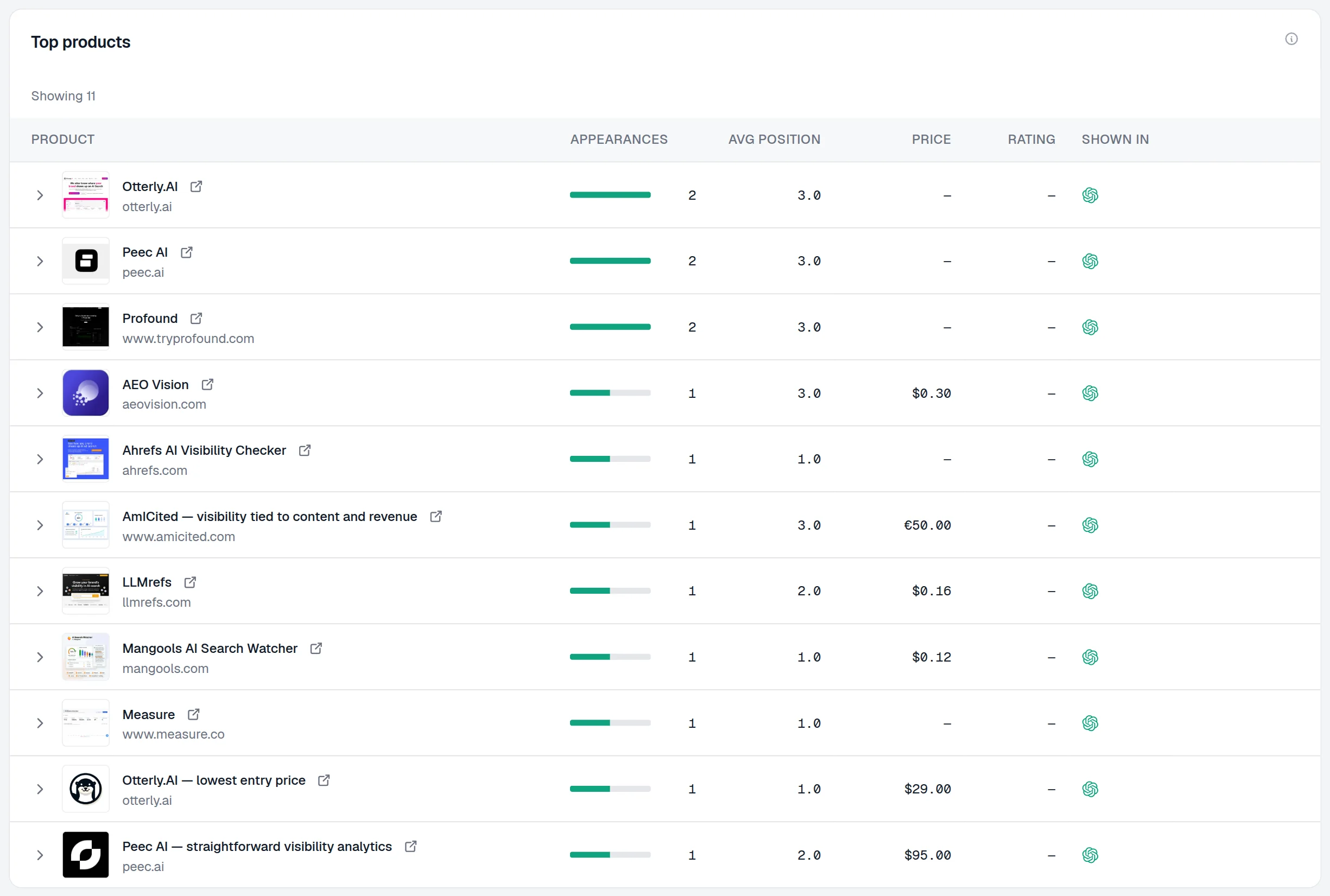
Shoppers also ask ChatGPT, Perplexity and Google AI Mode which product to buy. AmICited’s Shopping report shows which sellers and products appear on AI product cards for the prompts you track, and how often.
See AI visibility tracking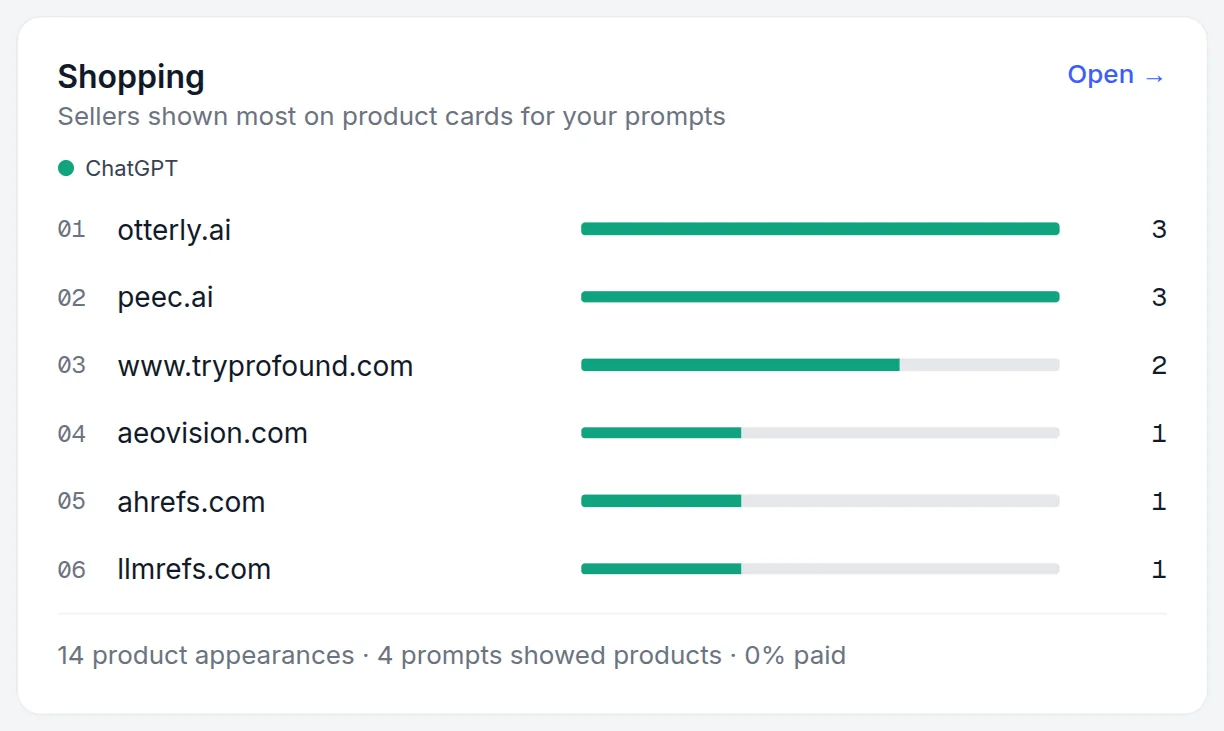
What Is FBM?
FBM (fulfilled by merchant) is the Amazon fulfillment option where you handle delivery yourself. Your products are listed on Amazon and customers buy them there, but the stock sits in your own warehouse, a shared space or a third-party logistics provider. When an order arrives in Seller Central, you pick, pack, label and ship it within the handling time you set, then upload the tracking number.
FBM is the alternative to Amazon FBA, where Amazon stores, ships and handles returns for you. Many sellers use both. FBM is common for oversized or heavy goods, slow movers, handmade or made-to-order items, high-value products and sellers who already fulfill orders for their own site and other marketplaces.
How FBM Works
- Create the offer. In Seller Central, list the product (or add an offer to an existing ASIN) and set fulfillment to “merchant fulfilled”.
- Set shipping templates. Define regions, rates and transit times. Your handling time plus transit time drives the delivery promise shown to buyers.
- Receive orders. Orders appear in Seller Central or sync to your order management system.
- Ship and confirm. Pick, pack, ship and confirm with tracking before the deadline. Amazon’s Buy Shipping can supply labels.
- Handle service and returns. You answer buyer messages and process returns under Amazon’s policies.
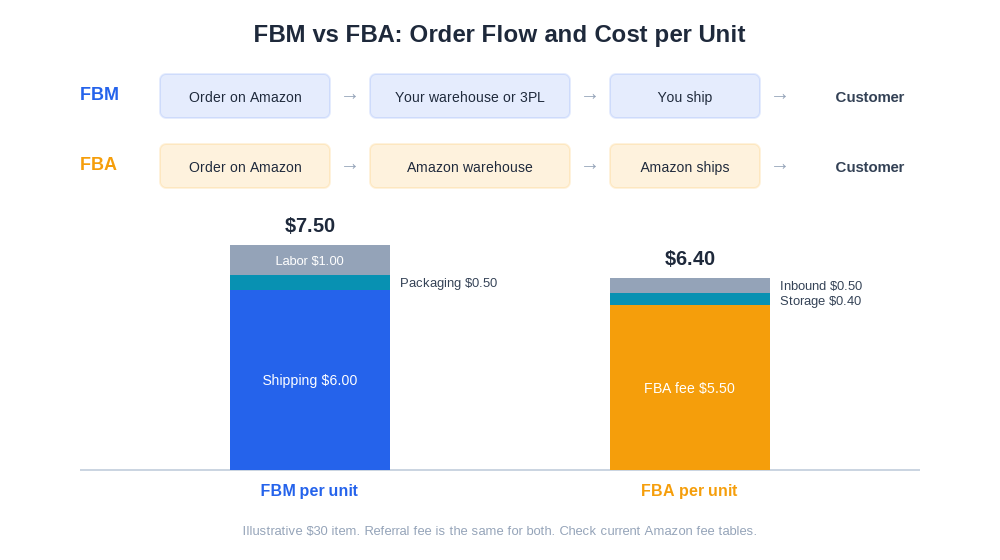
The cost decision is per unit. Here’s an illustrative comparison for a $30 item. The Amazon referral fee applies either way, so leave it out.
- FBM: shipping label $6.00 + packaging $0.50 + packing labor $1.00 = $7.50 per unit.
- FBA: fulfillment fee $5.50 + monthly storage share $0.40 + inbound shipping to Amazon $0.50 = $6.40 per unit.
In this example FBA is cheaper and adds the Prime badge. Change the product to a 25 lb bulky item that sells twice a month, and FBA fulfillment and long-term storage fees climb fast, while your own shipping cost rises more slowly. Amazon changes its fee tables regularly, so use the current FBA fee schedule and your real carrier rates.
FBA vs FBM vs Seller Fulfilled Prime
| FBM | FBA | Seller Fulfilled Prime | |
|---|---|---|---|
| Who stores stock | You or your 3PL | Amazon | You or your 3PL |
| Who ships | You | Amazon | You, to Prime delivery standards |
| Prime badge | No | Yes | Yes |
| Customer service and returns | You | Amazon | You, under Prime rules |
| Main costs | Shipping, packaging, labor, your storage | Fulfillment and storage fees, inbound shipping | Same as FBM, plus faster shipping costs |
| Best for | Bulky, slow, custom or high-value items | Small, fast-selling items | Experienced sellers with fast logistics |
| Main risk | Slower delivery, Buy Box disadvantage | Storage fees, inventory limits, stranded stock | Strict metrics, removal if missed |
FBM vs FBA: How to Choose
Start with three questions. How big and heavy is the product? How fast does it sell? How much does Prime matter in your category? Small, fast items in competitive categories lean FBA. Large, slow or custom items lean FBM. If you already ship well for your own direct-to-consumer site, FBM lets you use that same operation and keep inventory in one place.
You don’t have to choose once. A hybrid approach (FBA for bestsellers, FBM for the long tail and as a backup when FBA stock runs out) is common. It also protects you when Amazon limits FBA capacity.
Cost isn’t the only factor. FBA stock sits in Amazon’s network, so using it for orders from your own site means paying for Amazon’s Multi-Channel Fulfillment service. FBM stock is yours to ship anywhere, which makes it easier to run one inventory pool for Amazon, your own store and other marketplaces. On the other hand, FBA takes most of the customer service and returns work on Amazon orders off your plate, which matters if your team is small.

Stay Updated on AI Visibility Trends
Get the latest insights on AI mentions, brand monitoring, and optimization strategies.
FBM and AI Search
Fulfillment method doesn’t directly affect whether AI assistants mention your product. What does carry over is the outcome: delivery speed, stock availability and reviews. Amazon’s own assistant, Amazon Rufus, answers questions using listing data and reviews, and slow FBM shipping that leads to poor reviews can follow your product into those answers. Outside Amazon, AmICited’s AI visibility tracking shows whether ChatGPT, Perplexity, Gemini and Google’s AI answers mention your brand at all.
Best Practices for FBM
- Set handling times you can hit every day, including weekends and peak season.
- Use Amazon-integrated shipping or tracking that validates, so your valid tracking rate stays healthy.
- Watch late shipment rate, pre-fulfillment cancellation rate and order defect rate in Account Health weekly.
- Offer competitive shipping (free or low-cost) since the shipping charge is part of the price buyers compare.
- Keep FBM as a backup offer on FBA bestsellers to avoid stockouts during inbound delays.
- Compare FBM and FBA cost per unit with current fee tables at least twice a year.
Common FBM Mistakes
The most common FBM mistake is setting a handling time that looks fast in the listing but can’t be met on busy days. Late shipments damage account health and Buy Box eligibility quickly. Another is overselling because Amazon stock isn’t synced with stock sold on your own site and other channels.
Sellers also compare FBA and FBM on fulfillment fees alone, ignoring their own labor, packaging, storage rent and returns handling, which makes FBM look cheaper than it is. And many forget that FBM buyers still expect Amazon-level service, with fast replies to messages and easy returns.