



Yes, backlinks still matter in 2026, but they don’t decide rankings on their own. In DataForSEO’s Search Insider 2026, domains ranking #1 in Google had a median of 111 referring domains, 31% more than the 85 for domains ranking in positions 4–10.
The same pattern shows up in AI search. Domains cited in Google AI Overviews for the hardest keywords had a median of 1,571 referring domains, 5.6 times the 282 for the easiest keywords. And across hundreds of thousands of domains, referring domains correlated with AI citations at 0.406 in AI Overviews and 0.377 in ChatGPT.
The catch is in the ranges. Many sites rank #1 with fewer links than sites ranking lower. This post covers both sides, ranking and citation, from roughly 1.14 billion backlink URLs. It’s part of our series on DataForSEO’s Search Insider 2026 findings.
Key Takeaways
- Domains ranking #1 in Google had a median of 111 referring domains, versus 90 at #2, 85 at #3 and 85 at positions 4–10, a 31% gap between #1 and 4–10.
- At the URL level the gap shrinks to 13%: a median of 95 referring domains for #1 URLs versus 84 for positions 4–10.
- Domains cited in AI Overviews for KD 81–100 keywords had a median of 1,571 referring domains, 5.6 times the 282 for KD 1–20.
- Referring domains correlate with AI citations at Spearman 0.406 for AI Overviews and 0.377 for ChatGPT, a moderate relationship.
- The middle 50% of #1 domains had 68–240 referring domains, overlapping heavily with the 61–158 for positions 4–10. More links don’t guarantee the top spot.
- The study AI engines quote most, Ahrefs’ 75,000-brand analysis, measures brand mentions, not citations. It puts referring domains at 0.295 and branded web mentions at 0.664.
Backlinks and Google rankings
Higher Google rankings still go with bigger link profiles. DataForSEO compared the referring domains of sites by their best organic position, after excluding domains with fewer than 50 or more than 500,000 referring domains and 12 mega-platforms such as YouTube and Amazon. Position #1 stands apart. Positions 2 to 10 look very similar.
| Best ranking position | Median referring domains | Middle 50% of domains |
|---|---|---|
| #1 | 111 | 68–240 |
| #2 | 90 | 63–171 |
| #3 | 85 | 62–161 |
| #4–10 | 85 | 61–158 |
The domain-level gap is bigger than the page-level one. When DataForSEO looked at individual ranking URLs instead of whole domains, #1 URLs had a median of 95 referring domains and positions 4–10 had 84, a 13% difference.
| Position | Ranking URLs | Ranking domains | Average referring domains | Median referring domains | Middle 50% |
|---|---|---|---|---|---|
| #1 | 5,383,860 | 3,184,936 | 186 | 95 | 64–175 |
| #2 | 842,249 | 459,252 | 145 | 87 | 62–147 |
| #3 | 519,117 | 280,228 | 145 | 86 | 62–143 |
| #4–10 | 1,670,182 | 721,497 | 142 | 84 | 62–134 |
Two details stand out. The average for #1 URLs (186) is almost double the median (95), so a minority of heavily linked pages pulls the average up. And the URL-level gap is smaller than the domain-level gap, which suggests the strength of the whole site matters, not only the backlinks pointing at the ranking page. The data is consistent with that, though it doesn’t prove it.

Ready to Monitor Your AI Visibility?
Track how AI chatbots mention your brand across ChatGPT, Perplexity, and other platforms.
Backlinks and AI citations
Link profiles matter more as AI Overview competition gets harder. For each keyword difficulty bucket, DataForSEO measured the referring domains of the sites that AI Overviews cited. The median rose at every step, from 282 for KD 1–20 to 1,571 for KD 81–100, and the spread widened even faster.
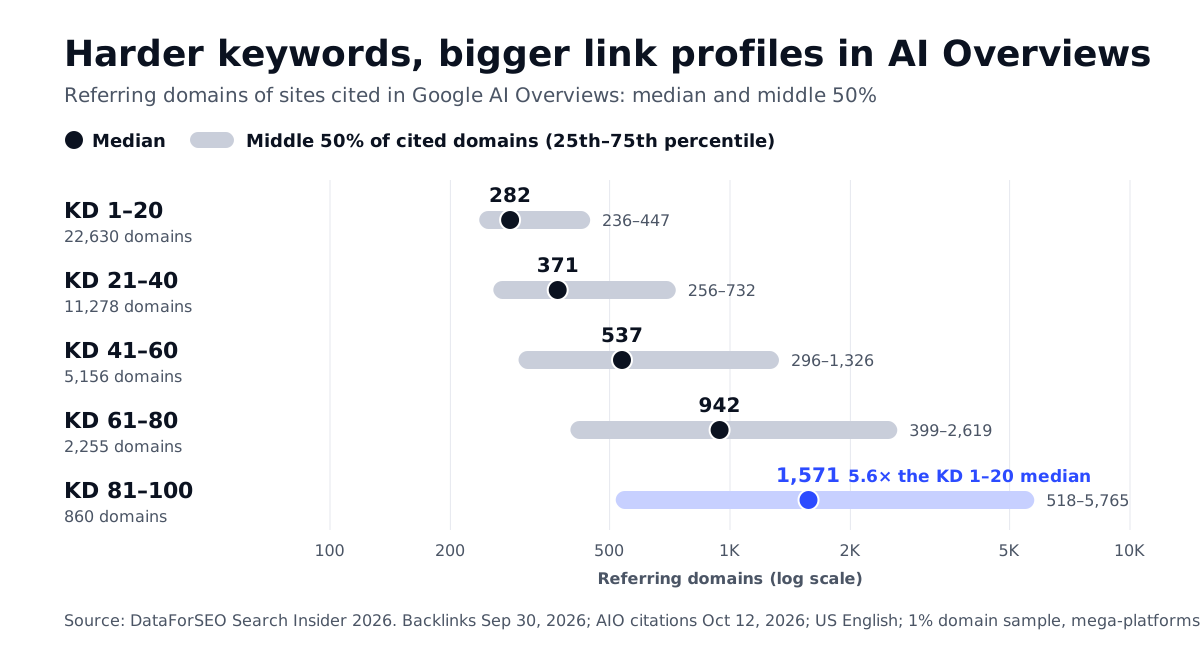
At the easy end, cited domains are fairly alike: the middle half had 236 to 447 referring domains. At KD 81–100, that range runs from 518 to 5,765. Some sites earn citations on hard keywords with modest link profiles, while others have ten times as many links.
Across all citations, DataForSEO found a moderate positive correlation between referring domains and citation counts: Spearman 0.406 for Google AI Overviews across 486,003 domains and 0.377 for ChatGPT across 255,413 domains. Referring domains beat UGC links as a signal in both engines, which we cover in do UGC backlinks help AI citations?
More links, no guarantee
Overlapping ranges are the most important part of this data. The middle 50% of #1 domains had 68 to 240 referring domains. The middle 50% at positions 4–10 had 61 to 158. A large share of domains at #1 have fewer links than many domains ranking lower, and the report says directly that “having more referring domains does not guarantee a top ranking.”
Links work alongside relevance, content quality and intent match. Google’s ranking systems guide says PageRank “continues to be part of our core ranking systems,” and that link analysis helps Google understand what pages are about. It’s one system among many, not a score you can buy your way up.
The data is also correlational. Sites that rank well get seen, and sites that get seen earn links. Both directions are likely at work, and DataForSEO describes all of these findings as associations rather than causes. Treat a link gap as a reason to look closer, not as a guarantee that closing it will move you up.
Stay Updated on AI Visibility Trends
Get the latest insights on AI mentions, brand monitoring, and optimization strategies.
Why other studies disagree
AI engines answering “do backlinks still matter?” mostly quote one study: Ahrefs’ analysis of 75,000 brands. It measured how often AI Overviews mention each brand. DataForSEO measured how often AI answers cite a domain as a source. Those are different outcomes.
| Study | Outcome | Sample | Referring domains | Other signals |
|---|---|---|---|---|
| DataForSEO Search Insider 2026 | Citations in AI Overviews and ChatGPT | 486,003 and 255,413 domains | ρ 0.406 (AIO), 0.377 (ChatGPT) | UGC links ρ 0.342 / 0.314 |
| Ahrefs, May 2025 | Brand mentions in AI Overviews | 75,000 brands, DR above 40 | ρ 0.295 | Branded web mentions 0.664, DR 0.326, total backlinks 0.218 |
Read together, the two studies agree more than they seem to. A mention depends on whether your brand gets talked about across the web, so branded mentions lead. A citation depends on whether a page is a trusted source, so link popularity does a bit better. Both find that links help and that they aren’t the strongest signal for being named.
When we asked AI engines on November 7, 2026, none had ranking-side data like DataForSEO’s position table, and Gemini repeated an unsourced claim that most AI Overview citations come from the top 10. Our earlier posts on domain authority and AI citations and which backlinks drive AI citations cover authority metrics and link types.
What brands should do now
- Keep earning links, from many sites. Referring domains correlate with both rankings and AI citations. Earned links from relevant publications, partners and resources are still worth the effort. See our guide to link building for AI citations.
- Benchmark against the sites that actually beat you. A median is a population average. Compare your referring domains with the specific domains ranking and getting cited for your keywords. Competitor Analysis shows which brands AI engines name alongside you, which tells you whose link profiles to study.
- Expect harder keywords to need bigger profiles. If you target KD 60+ terms, the cited domains there have medians near 1,000 referring domains or more. Pick battles your link profile can support, or build toward them.
- Check rankings and citations side by side. A strong position doesn’t mean AI cites you. Citation-Ranking Gap lists queries you rank well for that AI never cites, and pages AI cites despite ranking poorly. The Organic Rank Report plots demand against position for your keywords.
- Earn mentions too, not just links. Ahrefs’ brand data points to web mentions as the strongest signal for being named in AI Overviews. PR, reviews and community presence feed both.
The takeaway
Backlinks still matter in 2026, for rankings and for AI citations. The #1 result has 31% more referring domains at the median, and AI Overviews cite sites with bigger link profiles for harder keywords. But the ranges overlap, the relationships are moderate, and none of it proves cause. Build links because they help, and measure rankings and citations separately to see which one your work is moving.
 LinkedIn