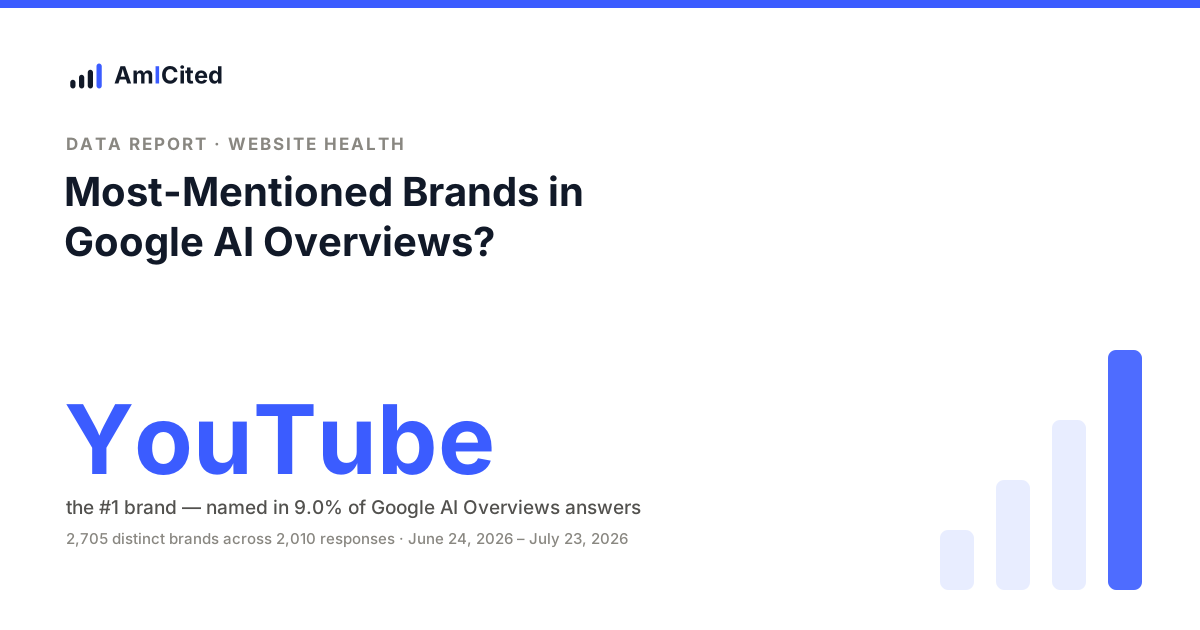
Across 2,010 Google AI Overviews responses to AmICited’s 1,905 tracked prompts, YouTube is the most-mentioned brand (9.0%), ahead of Google and Zendesk. Full top-20 with counts.
Google AI Overviews named 2,705 distinct brands across 2,010 responses to AmICited’s tracked prompts (June 24, 2026 – July 23, 2026, 2026). The most-mentioned was YouTube, appearing in 181 answers (9.0%), followed by Google and Zendesk. A “mention” counts whether or not the answer linked to the brand, and that distinction turns out to matter a lot (see below), because Google AI Overviews names brands far more often than it links them.
Key Takeaways
- YouTube leads at 9.0%, ahead of Google and Zendesk, a more fragmented top of leaderboard than other engines in this series.
- Mentions are the most concentrated of the engines covered here: the top 3 brands hold 6% and the top 10 hold 12%, while 1,855 brands were named only once.
- 67% of Google AI Overviews’ brand references carry no link, so most of its brand influence would be invisible to link-only tracking.
- The brand list reflects AmICited’s SaaS, e-commerce and customer-support prompt mix rather than the whole web.
Bottom line: With two-thirds of mentions unlinked, brands aiming for Google AI Overviews visibility need to track mentions, not just citations, which is exactly what AmICited’s own tracking data is built to do.
Google AI Overviews’s 20 most-mentioned brands
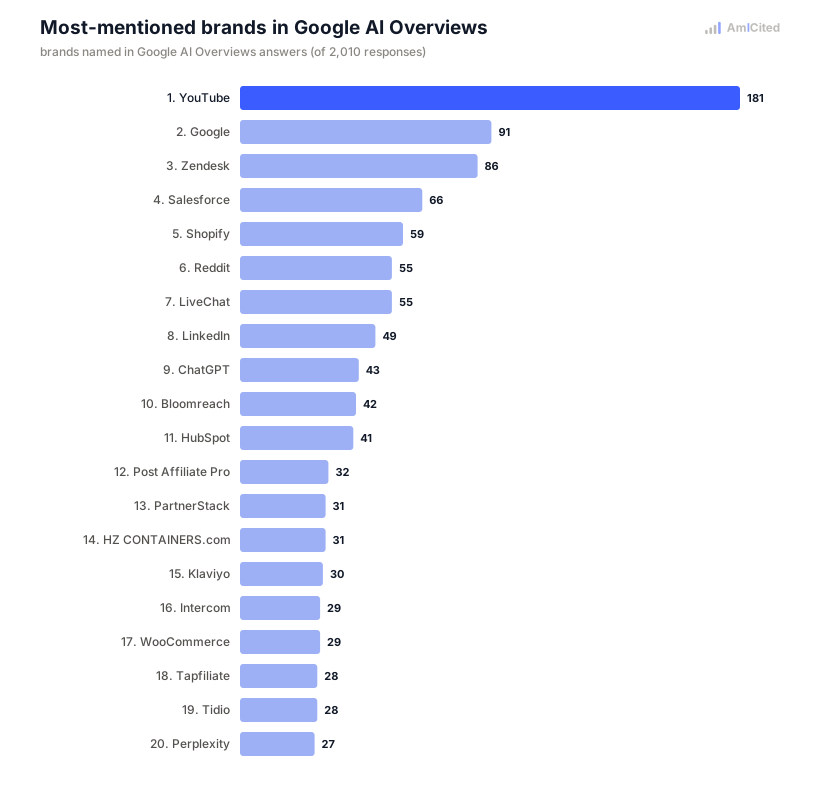
The ranking is dominated by SaaS, e-commerce and customer-support names, a direct reflection of AmICited’s tracked-prompt mix. YouTube leads the field; below it, Google and Zendesk anchor a familiar cluster of category incumbents. These are the brands Google AI Overviews reaches for by default when answering these topics.

Ready to Monitor Your AI Visibility?
Track how AI chatbots mention your brand across ChatGPT, Perplexity, and other platforms.
The raw brand-mention data
| Rank | Brand | Responses mentioning it | % of answers |
|---|---|---|---|
| 1 | YouTube | 181 | 9.0% |
| 2 | 91 | 4.5% | |
| 3 | Zendesk | 86 | 4.3% |
| 4 | Salesforce | 66 | 3.3% |
| 5 | Shopify | 59 | 2.9% |
| 6 | 55 | 2.7% | |
| 7 | LiveChat | 55 | 2.7% |
| 8 | 49 | 2.4% | |
| 9 | ChatGPT | 43 | 2.1% |
| 10 | Bloomreach | 42 | 2.1% |
| 11 | HubSpot | 41 | 2.0% |
| 12 | Post Affiliate Pro | 32 | 1.6% |
| 13 | PartnerStack | 31 | 1.5% |
| 14 | HZ CONTAINERS.com | 31 | 1.5% |
| 15 | Klaviyo | 30 | 1.5% |
| 16 | Intercom | 29 | 1.4% |
| 17 | WooCommerce | 29 | 1.4% |
| 18 | Tapfiliate | 28 | 1.4% |
| 19 | Tidio | 28 | 1.4% |
| 20 | Perplexity | 27 | 1.3% |
How concentrated is brand visibility in Google AI Overviews?
Brand visibility here is top-heavy: the three most-mentioned brands account for 6% of all brand mentions and the top 10 for 12%, while 1,855 brands were named just once, a very long tail of one-off mentions. In practice that means a handful of incumbents soak up most of Google AI Overviews’s brand real-estate, and breaking into that leading group is materially harder than earning an occasional mention. For a challenger brand, the realistic first goal is to move out of the single-mention tail and into the repeat-mention middle.
Stay Updated on AI Visibility Trends
Get the latest insights on AI mentions, brand monitoring, and optimization strategies.
Named vs linked: the visibility most tools miss
Of every brand reference Google AI Overviews made, 67% carried no link at all: the brand was named in the answer without a citation. That is the crux of AI-search visibility: an assistant can recommend a brand to a user, shaping their shortlist, without ever sending a click or leaving a trackable citation. Tools that measure only links (citations) therefore undercount real brand visibility badly; a mention-based view like this leaderboard captures the influence that link-tracking misses.
Why brand mentions matter
For AI-search visibility, being mentioned is the first and often decisive battle, ahead of being linked. A brand named in an AI answer enters the user’s consideration set even without a click, and repeated mentions across many prompts compound into share of voice. This leaderboard is the incumbent set for Google AI Overviews on these topics: if you compete with any of these names, their positions are your benchmarks, and the gap between rank #1 and the mid-table shows how much ground a challenger must make up. The practical playbook is to earn presence in the sources and discussions these engines synthesize (consistent, quotable, on-topic coverage) so your brand becomes one an assistant reaches for by default.
Competitive implications of the brand leaderboard
The brand mention leaderboard is not just a list: it is a map of the competitive landscape for AI visibility. The brands that appear in the top 20 are the brands that AI engines “think of” when answering questions in these categories. They are the default recommendations, the names that come to mind first.
For challenger brands, the leaderboard provides both a benchmark and a roadmap:
The top 3-5 brands are the incumbents. They have achieved a level of AI mindshare that is difficult to dislodge. Competing directly with them on broad, category-level queries is a long-term project.
The mid-table brands (positions 6-15) are the contenders. They have established a meaningful AI presence but are not yet dominant. This is where a well-executed AI visibility strategy can make the biggest difference.
The long tail (10,000+ brands mentioned only once) is the entry point. Earning a single mention is the first step. From there, the goal is to earn repeat mentions and move up the leaderboard.
How to improve your brand’s AI mention ranking
Improving your brand’s position on the AI mention leaderboard requires a systematic approach:
Identify the queries where your brand should be mentioned. Use AmICited to find the prompts where your competitors are mentioned but you are not. These are your immediate opportunities.
Create content that answers those queries. For each target query, create comprehensive, authoritative content that directly addresses the question. Publish it on your own domain and promote it on the platforms AI engines cite.
Build presence in the sources AI engines synthesize. AI engines cite content from the domains in their top-20 lists. Being present on those domains (through guest posts, partnerships, or community participation) increases your chances of being mentioned.
Track your progress over time. AI visibility is not a one-time achievement. Monitor your mention count, ranking, and share of voice monthly. Adjust your strategy based on what is working.
Methodology
Built from AmICited’s 1,905 tracked prompts (June 24, 2026 – July 23, 2026, 2026). For each brand we count how many Google AI Overviews responses mentioned it at least once (mentions with or without a link) using AmICited’s brand-detection on the response text; each response counts once per brand. Concentration figures use the full brand distribution (2,705 brands, 6,201 total mentions). The prompt set skews toward SaaS, e-commerce and customer-support topics, so the leaderboard reflects that mix rather than the whole web. No external links appear in this report.
 LinkedIn