



Annual Recurring Revenue (ARR)
Annual Recurring Revenue (ARR) is the value of subscription or recurring revenue a business expects to receive over a 12-month period, normalized to exclude one-time purchases. It's the standard metric for measuring the predictable, ongoing revenue base of a subscription business, including e-commerce brands with subscription or membership models.
Definition of Annual Recurring Revenue (ARR)
Annual Recurring Revenue (ARR) is the normalized value of subscription or recurring revenue a business expects to generate over a 12-month period. It’s a standard metric in subscription businesses of all kinds — software, media, and increasingly e-commerce brands that run subscription boxes, replenishment programs, or paid membership tiers. ARR deliberately excludes one-time purchases, setup fees, and other non-recurring revenue, because its purpose is to isolate the predictable, ongoing portion of the business — the revenue that doesn’t require winning a brand-new sale to materialize again next period.
How ARR Is Calculated
The most common way to calculate ARR is to start from Monthly Recurring Revenue (MRR) and annualize it:
ARR = MRR × 12
Alternatively, for a business with contracts or subscriptions of varying terms, ARR can be calculated directly by summing the annualized value of every active recurring contract:
ARR = Σ (Subscription Value Normalized to Annual Basis)
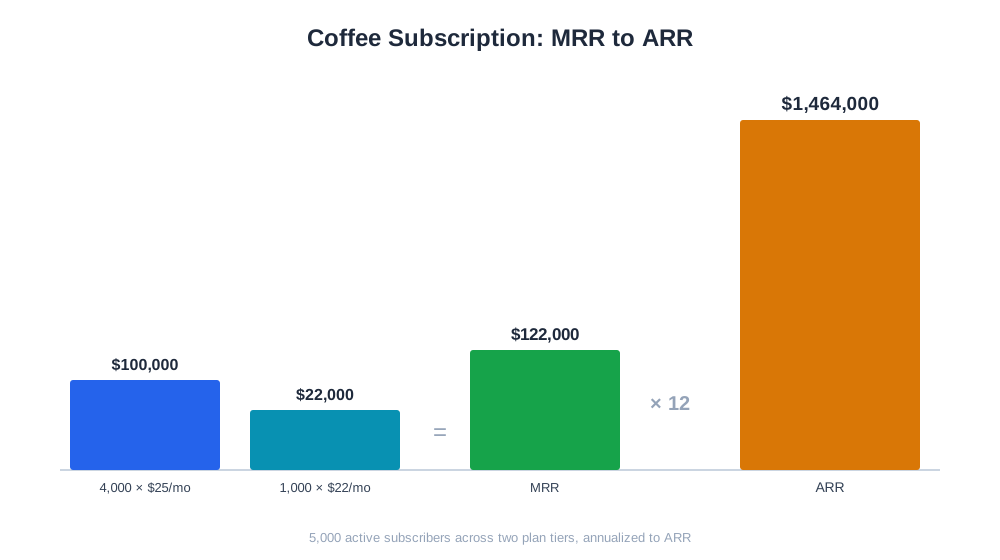
A worked example: a coffee subscription brand has 5,000 active subscribers. Of those, 4,000 pay $25/month and 1,000 pay a discounted annual plan equivalent to $22/month. Monthly recurring revenue is (4,000 × $25) + (1,000 × $22) = $100,000 + $22,000 = $122,000. Annualized, that’s $122,000 × 12 = $1,464,000 in ARR.
If that same brand adds 500 new subscribers at $25/month next quarter but loses 300 existing subscribers to churn, the net change in MRR is (500 × $25) − (300 × $25) = $5,000, which adds $60,000 to ARR — illustrating how new growth and churn both flow directly into the ARR figure.

Ready to Monitor Your AI Visibility?
Track how AI chatbots mention your brand across ChatGPT, Perplexity, and other platforms.
Why ARR Matters for E-commerce Brands
For e-commerce brands with a subscription or membership component, ARR provides a clearer picture of business health than total revenue alone, because it separates the predictable base from one-time, harder-to-forecast purchases. A brand with growing ARR has a compounding foundation: next year’s revenue starts from this year’s recurring base rather than from zero, which materially changes cash flow planning, inventory commitments, and fundraising conversations if the brand is seeking investment.
ARR also makes it easier to evaluate the health of a subscription program in isolation from the rest of the business. A DTC brand might have flat total revenue while its subscription ARR is actually growing steadily — a signal that the subscription offer is working even if one-time purchase volume is soft, or vice versa.
ARR vs. MRR vs. Total Revenue
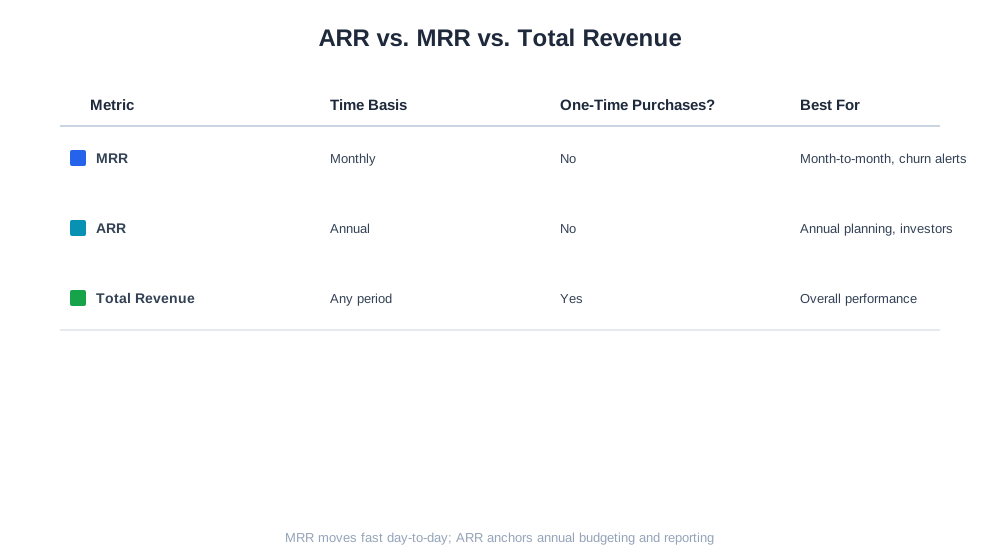
| Metric | Time Basis | Includes One-Time Purchases? | Best Used For |
|---|---|---|---|
| MRR | Monthly | No | Month-to-month tracking, early warning on churn |
| ARR | Annual | No | Annual planning, investor reporting, long-term goals |
| Total Revenue | Any period | Yes | Overall business performance |
MRR is generally the more actionable day-to-day metric since it surfaces changes faster, while ARR is better suited to annual budgeting and higher-level reporting.
Stay Updated on AI Visibility Trends
Get the latest insights on AI mentions, brand monitoring, and optimization strategies.
ARR and AI-Driven Commerce
Subscription and replenishment-model e-commerce brands are a natural fit for AI shopping assistants, which increasingly help customers find and re-subscribe to recurring products — an AI assistant recommending a supplement or coffee subscription is effectively driving new ARR the same way a paid ad would. Brands that track how often their subscription products are surfaced or cited by AI shopping tools can connect that visibility directly to new subscriber growth, closing the loop between AI-driven discovery and recurring revenue.
AmICited’s eshop_get_series tool tracks daily revenue trends for connected stores, which gives subscription and membership-driven merchants a data foundation for isolating and monitoring the recurring portion of their revenue alongside overall sales trends, rather than relying on a separate subscription platform’s reporting in isolation.
Best Practices for Managing ARR
- Track new ARR, expansion ARR (upgrades from existing subscribers), and churned ARR separately, rather than reporting a single net number that hides the underlying drivers.
- Exclude one-time purchases and setup fees from ARR calculations to keep the metric a clean measure of recurring revenue.
- Report ARR alongside churn rate and net revenue retention, since ARR growth alone doesn’t reveal whether the underlying subscriber base is healthy or shrinking beneath the surface.
- Reconcile ARR with actual cash collected periodically, especially for annual-plan subscribers, since ARR is a normalized projection, not a cash-in-hand figure.
- Set ARR growth targets that account for your subscription program’s maturity stage rather than benchmarking against much larger, more established programs.
Common ARR Mistakes
Including one-time purchases in the ARR calculation. Mixing in shipping fees, one-time upsells, or non-recurring add-ons inflates ARR and defeats its purpose as a measure of predictable revenue. Keep the recurring and non-recurring revenue streams reported separately.
Ignoring churn when reporting ARR growth. A headline “ARR grew 20% this year” can mask a business that added 35% in new ARR but lost 15% to churn — very different underlying health than a business that grew 20% with minimal churn. Always report churned and expansion ARR alongside the net figure.
Treating annual-plan subscribers inconsistently. A customer on an annual plan paid upfront still counts toward ARR at their normalized monthly-equivalent rate, not their full upfront payment recognized entirely in the month it was received. Mixing cash accounting with ARR reporting produces a distorted, spiky metric.
Forecasting ARR growth without segmenting by subscriber cohort. Different acquisition cohorts often have very different retention curves; blending them into a single average growth assumption can significantly overstate or understate future ARR.
Confusing ARR with total company valuation potential. ARR is a revenue metric, not a profitability metric — a subscription program can have strong, growing ARR while still being unprofitable once fulfillment costs, churn-driven acquisition spend, and overhead are accounted for.