



Yes, Google searches are getting longer, but slowly and mostly on desktop. In DataForSEO’s Search Insider 2026, queries of five or more words rose from 29.3% to 34.8% of unique desktop queries between September 2025 and August 2026. On mobile they grew from 29.6% to 31.9%.
Three- and four-word queries are still the most common length on both devices. They’re also the ones losing share. The change is real, but it’s far smaller than the “three times longer” figure that AI engines repeat, which describes Google AI Mode, not classic search.
This post breaks down the change by query length and device, explains why other numbers look so different, and covers what longer queries mean for AI Overviews and content. It’s part of our series on DataForSEO’s Search Insider 2026 findings.
Key Takeaways
- Queries of 5+ words rose from 29.3% to 34.8% of unique US desktop queries between September 2025 and August 2026, a gain of 5.53 percentage points.
- On mobile, the 5+ word share rose from 29.6% to 31.9%, a gain of 2.29 points, less than half the desktop change.
- Three-word queries lost the most share: −3.2 points on desktop and −1.8 on mobile. Four-word queries lost −2.8 and −1.6.
- Three- and four-word queries are still the most common, at 46.8% of desktop and 48.6% of mobile unique queries in August 2026.
- Google’s “AI Mode queries are 3× longer” applies to AI Mode only. It’s often repeated as if it described all Google searches.
- Longer queries are more likely to trigger AI Overviews: 46.4% of 7+ word queries versus 9.5% of one-word queries in Ahrefs’ 2025 data.
How query length changed
The share of longer queries grew at every length from five words up, on both devices, while three- and four-word queries shrank. DataForSEO measured this in organic search performance data from more than 2,000 websites, counting each unique query once and comparing September 2025 with August 2026 in the US.
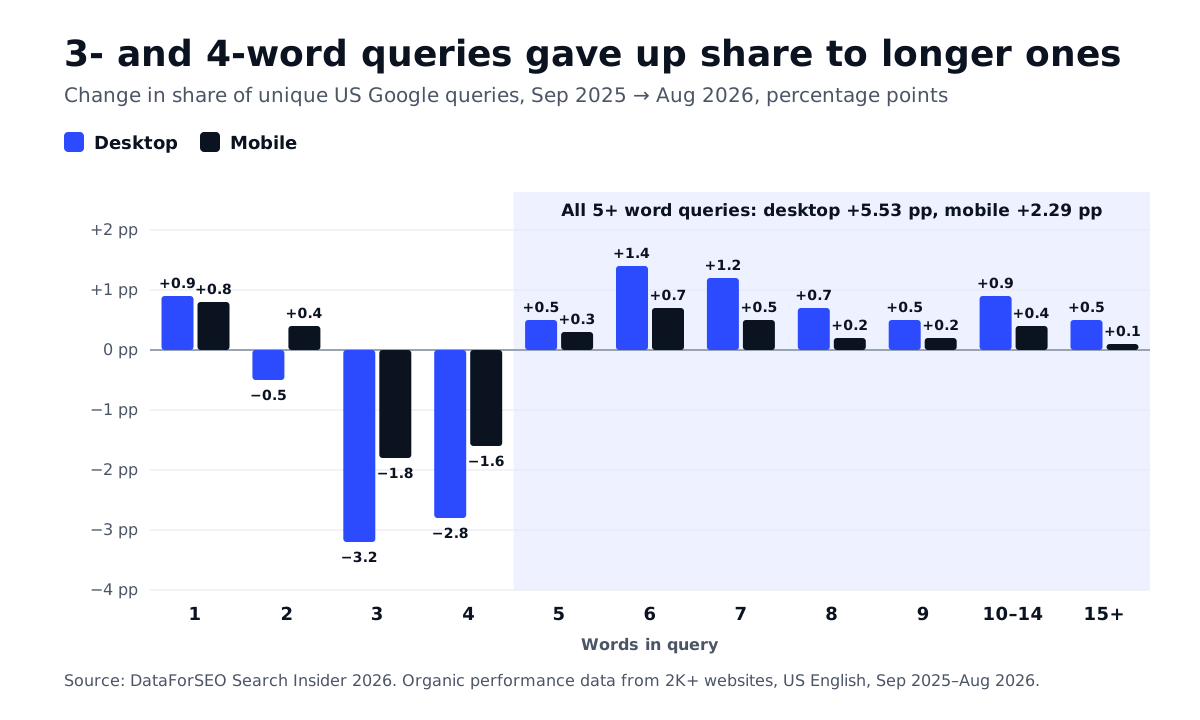
The middle of the distribution is shrinking, not just the short end. One-word queries actually gained a little share on both devices. The losses are concentrated in three- and four-word queries, and the gains spread across every length from five words to fifteen and beyond.
| Query length | Desktop Sep 2025 | Desktop Aug 2026 | Desktop change | Mobile Sep 2025 | Mobile Aug 2026 | Mobile change |
|---|---|---|---|---|---|---|
| 1 word | 3.09% | 3.99% | +0.90 | 3.11% | 3.92% | +0.80 |
| 2 words | 14.94% | 14.45% | −0.48 | 15.26% | 15.62% | +0.35 |
| 3 words | 28.00% | 24.83% | −3.18 | 27.23% | 25.39% | −1.85 |
| 4 words | 24.71% | 21.95% | −2.77 | 24.81% | 23.22% | −1.59 |
| 5 words | 14.37% | 14.82% | +0.46 | 15.00% | 15.25% | +0.25 |
| 6 words | 7.03% | 8.39% | +1.36 | 7.62% | 8.30% | +0.68 |
| 7 words | 3.42% | 4.62% | +1.20 | 3.62% | 4.09% | +0.47 |
| 8 words | 1.77% | 2.52% | +0.75 | 1.74% | 1.94% | +0.20 |
| 9 words | 1.04% | 1.50% | +0.47 | 0.88% | 1.04% | +0.16 |
| 10–14 words | 1.26% | 2.12% | +0.85 | 0.67% | 1.07% | +0.41 |
| 15+ words | 0.37% | 0.82% | +0.45 | 0.04% | 0.17% | +0.12 |
Changes are in percentage points and are calculated by DataForSEO from unrounded shares, so they may differ from the shown shares by 0.01.

Ready to Monitor Your AI Visibility?
Track how AI chatbots mention your brand across ChatGPT, Perplexity, and other platforms.
Desktop versus mobile
Desktop queries got longer more than twice as fast as mobile queries. The 5+ word share on desktop rose 5.53 points in a year, while mobile rose 2.29 points. The two devices started at nearly the same level, around 29.5%, and ended more than two points apart.
DataForSEO calls mobile search behavior “comparatively stable.” Mobile three-word queries fell 1.8 points against 3.2 on desktop, and mobile two-word queries even gained share.
The report doesn’t explain the difference, and we won’t invent one. What matters in practice is that a single sitewide query-length number hides the device split. If most of your audience searches on desktop, the long-tail shift affects you more than the average suggests. Device also changes what happens after the search: desktop CTR for top positions fell much faster than mobile over the same year, as our CTR by position breakdown shows.
Why other figures differ
When we asked AI engines on November 7, 2026 whether Google queries are getting longer, the most common answer was that Google says queries are three times longer. That figure is about AI Mode. According to PPC Land, its likeliest origin is Google’s May 19, 2026 AI Mode report, which put the average AI Mode query at about three times the length of a traditional query, based on US users.
Google repeated the “3×” claim on its Ads Decoded podcast on October 28, 2026. PPC Land found that the episode didn’t say which product the figure covered. Search Engine Journal noted that the statistic doesn’t define its baseline or time window. Neither supports applying it to Google Search as a whole.
Other numbers measure different things:
| Figure | What it measures | Why it differs |
|---|---|---|
| DataForSEO: 5+ word queries 29.3% → 34.8% (desktop) | Share of unique queries, classic Google, 2K+ sites, US | Each distinct query counts once, whatever its volume |
| Google: AI Mode queries ~3× longer | Average AI Mode query vs traditional query, US | Conversational AI Mode prompts, not classic search |
| Similarweb average of about 3.5 words (quoted by Perplexity) | Average words per search | Every search counts, so frequent short queries dominate |
| Datos and SparkToro: fastest US growth in 6–9 word searches (Q4 2025, via PPC Land) | Growth rate by length | A growth rate, not a share |
The unique-queries method matters. A long, specific query might be searched a handful of times, while a short head term is searched thousands of times. Counting unique queries gives the long tail more weight than a volume-weighted average does. That’s why DataForSEO can show a third of queries at five words or more while volume-based averages stay around three to four words.
One more caution. Grok told us that Google Ads data showed one- and two-word queries falling from 42% to 24% of impressions. We couldn’t find those figures in the articles it cited, so we left them out.
Stay Updated on AI Visibility Trends
Get the latest insights on AI mentions, brand monitoring, and optimization strategies.
Longer queries and AI answers
Longer queries are more likely to land on a results page with an AI answer. In Ahrefs’ study of 146 million desktop results from September 2025, AI Overviews appeared on 9.5% of one-word queries, 27.6% of five-word queries and 46.4% of queries with seven or more words.
That makes the length shift and the AI Overview boom part of the same story. AI Overviews now appear on 61% of the results DataForSEO tracks, as covered in our post on how often AI Overviews appear. As queries get longer, more of them meet one.
AI search also turns one long question into many short ones. Google AI Mode and ChatGPT use query fan-out to split a prompt into several sub-searches, then combine the results. Our explainer on how LLMs run multiple searches shows how this works. A page that answers one specific sub-question clearly can be cited even when the original prompt was much longer.
What brands should do now
- Pull your long queries from Search Console. Google Search Queries shows clicks, impressions, CTR and position for each query. Filter by device to see whether your long-tail growth matches the desktop pattern.
- Group them into themes. N-Grams counts recurring one- to five-word phrases across your queries, with the clicks and impressions behind each. Recurring phrases inside long queries point to the sub-topics your pages should cover.
- Account for hidden queries. Google withholds some low-volume query rows, and many long queries are low-volume. Query Coverage shows how much of your organic traffic can be tied to named queries, page by page.
- Write answer-first sections for specific questions. Keep targeting your core three- and four-word keywords, and add sections that answer the longer questions directly in their first sentences. That format also suits AI answers and fan-out sub-queries.
- Track your longest questions as AI prompts. Long queries are where AI Overviews appear most often. Promote the important ones into prompt tracking to see whether ChatGPT, AI Overviews and AI Mode cite you for them.
The takeaway
Google queries are getting longer, but gradually: 5+ word queries gained 5.53 points of share on desktop and 2.29 on mobile in a year. That’s a shift worth planning for, not a revolution. The bigger change is that longer queries are the ones most likely to get an AI answer. Keep your core keywords, answer the specific questions around them, and measure whether those answers earn citations.
 LinkedIn