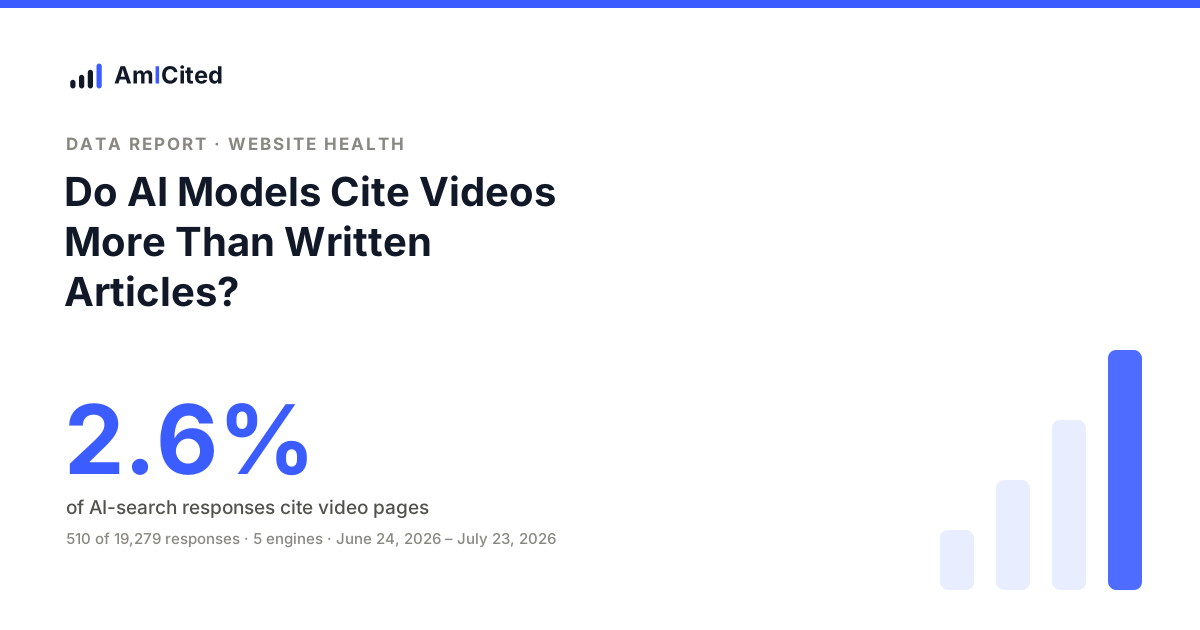
Across the five AI engines, just 2.6% of responses cite video pages ( YouTube, Vimeo, Dailymotion); the overwhelming majority of citations point to ordinary written web pages.
Only 510 of 19,279 responses (2.6%) across the five tracked AI engines cite video pages (YouTube, Vimeo, Dailymotion). Written, HTML web pages account for essentially all of the rest, so the answer to whether AI models prefer video content over articles is a clear no, at least for this prompt set.
Key Takeaways
- Only 2.6% of AI-search responses cite video pages (YouTube, Vimeo, Dailymotion); written HTML pages account for nearly all the rest.
- Google AI Mode leans on video the most (8.1%), still far below what would make video a primary citation format.
- ChatGPT almost never cites video (0.2%), a 38x gap versus Google AI Mode.
- Virtually all video citations point to YouTube; Vimeo and Dailymotion barely register.
- The pattern is stable over time rather than a temporary dip, which points to how AI engines process content rather than a quirk of this dataset.
Bottom line: If AI citations are the goal, invest in written HTML pages first and treat video as a brand-building complement rather than a primary citation vehicle, and use AmICited’s own citation tracking to see which format is actually earning you citations.
Video pages citation rate by AI engine
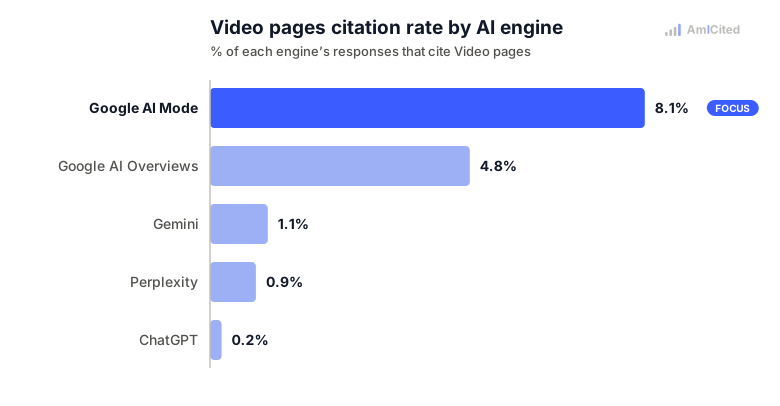
Google AI Mode cites video pages most (8.1%) and ChatGPT least (0.2%), a 38× spread, but even the leader stays in low single digits. Video content is a niche citation source, not a mainstream one, in every engine tracked. The engine that leans on it most (Google AI Mode) is worth noting if video is central to your content, but no engine treats it as a primary format.

Ready to Monitor Your AI Visibility?
Track how AI chatbots mention your brand across ChatGPT, Perplexity, and other platforms.
The underlying numbers
| AI engine | Responses | Citing video pages | Rate |
|---|---|---|---|
| Google AI Mode | 3,975 | 321 | 8.1% |
| Google AI Overviews | 2,010 | 97 | 4.8% |
| Gemini | 5,123 | 55 | 1.1% |
| Perplexity | 3,052 | 26 | 0.9% |
| ChatGPT | 5,119 | 11 | 0.2% |
What actually gets cited instead
Almost all of that thin slice is YouTube: 100% of the video citations point to youtube.com, with Vimeo and Dailymotion barely registering. So “video in AI search” effectively means “a YouTube link,” and even that is rare outside explicitly how-to or product-demo queries.
Stay Updated on AI Visibility Trends
Get the latest insights on AI mentions, brand monitoring, and optimization strategies.
Video pages citations over time
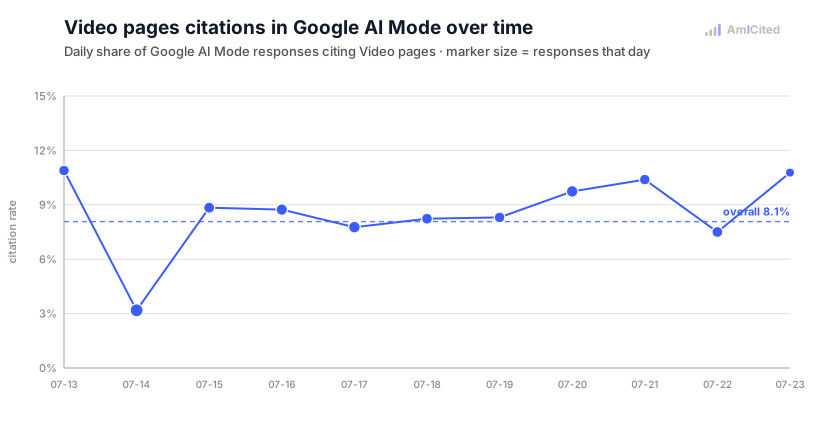
Tracked daily in Google AI Mode (its strongest engine), the video citation rate stays low and flat across the window: this is a stable structural preference for written pages, not a temporary dip.
What this means for content strategy
If your goal is AI-search citations, written HTML pages remain the workhorse format: video pages (YouTube, Vimeo, Dailymotion) are cited far too rarely to build a strategy around. Video can support brand presence and may be surfaced for explicitly visual or how-to questions, and a YouTube video can itself rank, but engines quote text. Put the substance of anything you want cited into an indexable HTML page, and treat video as a complement rather than the citable asset.
Why AI engines overwhelmingly prefer written content
The 2.6% video citation rate is one of the clearest signals in the entire dataset. AI engines are text-first systems. They extract, process, and synthesize written content. Video, as a format, is fundamentally harder for them to work with:
Video content is not directly parseable as text. While AI engines can access video transcripts (especially on YouTube), the transcript is a secondary artifact: it may be incomplete, poorly timed, or auto-generated with errors. The written page is the primary artifact.
Video content is high-bandwidth. Fetching and processing a full video file is orders of magnitude more expensive than fetching an HTML page. AI engines optimize for efficiency, and text is the most efficient format.
Video content is harder to quote. An AI engine that wants to cite a specific claim or statistic from a video must first locate the relevant timestamp, extract the transcript, and verify accuracy. From a written page, it can quote directly from the text.
The 8.1% citation rate in Google AI Mode is the exception that proves the rule. Google AI Mode has direct access to YouTube’s infrastructure and transcript data, a structural advantage that no other engine shares. Even with that advantage, video citations stay in the single digits. For every other engine, video is a rounding error.
What this means for content strategy
The practical implication for content teams is clear: if you want AI citations, write HTML pages. This does not mean you should abandon video. Video is a powerful format for brand building, user engagement, and social distribution. But it should not be your primary vehicle for earning AI citations.
A pragmatic approach is to create both: publish a video on YouTube for reach and engagement, and publish a written companion article on your site for AI citation potential. The written article can embed the video, reference it, and provide the text-based content that AI engines can extract and cite. This gives you the best of both formats.
The data also has implications for how you structure your content investment. If you are choosing between producing a high-quality video and producing a high-quality written guide, and your primary goal is AI citations, the written guide is the better investment. The 2.6% video citation rate means that for every 100 AI responses, fewer than 3 will cite a video, and those 3 are almost all YouTube links.
The YouTube monopoly within video citations
A secondary but important finding: of the 510 video citations in our dataset, essentially 100% are YouTube links. Vimeo and Dailymotion are effectively invisible. This means that “video in AI search” is synonymous with “YouTube in AI search.” If you are publishing video content anywhere other than YouTube, your AI citation potential from that content is near zero.
This is a structural outcome: YouTube is the dominant video platform, it has the most comprehensive transcript infrastructure, and Google (which owns YouTube) has built direct integration between YouTube and its AI products. Competitors cannot match this integration. If video citations matter to you, YouTube is the only platform that matters.
Practical recommendations
Publish written content first. For any topic you want to earn AI citations on, create a comprehensive written HTML page. This is the format AI engines actually cite.
Use video as a complement, not a replacement. Create a video version of your written content and publish it on YouTube. Embed the video in your written article. The written article earns the citation; the video earns engagement.
Optimize YouTube transcripts. If you publish on YouTube, ensure your video has an accurate, manually reviewed transcript. Auto-generated transcripts are better than nothing, but manual transcripts are more likely to be correctly extracted.
Prioritize Google AI Mode if video is core to your strategy. At 8.1%, it is the only engine where video citations are frequent enough to be worth deliberate optimization.
Methodology
Computed from AmICited’s 1,905 tracked prompts (June 24, 2026 – July 23, 2026, 2026). A response counts as citing video if it cites youtube.com, vimeo.com or dailymotion.com. Rates are citing-responses over total responses per engine; the format label is derived entirely from the cited URLs in the data; no page fetching. Copilot is tracked but returned no citation data. No external links appear in this report.
 LinkedIn