


- Ecommerce fulfillment is everything between an order being placed and the parcel being delivered: receiving stock, storage, picking, packing, shipping and processing returns.
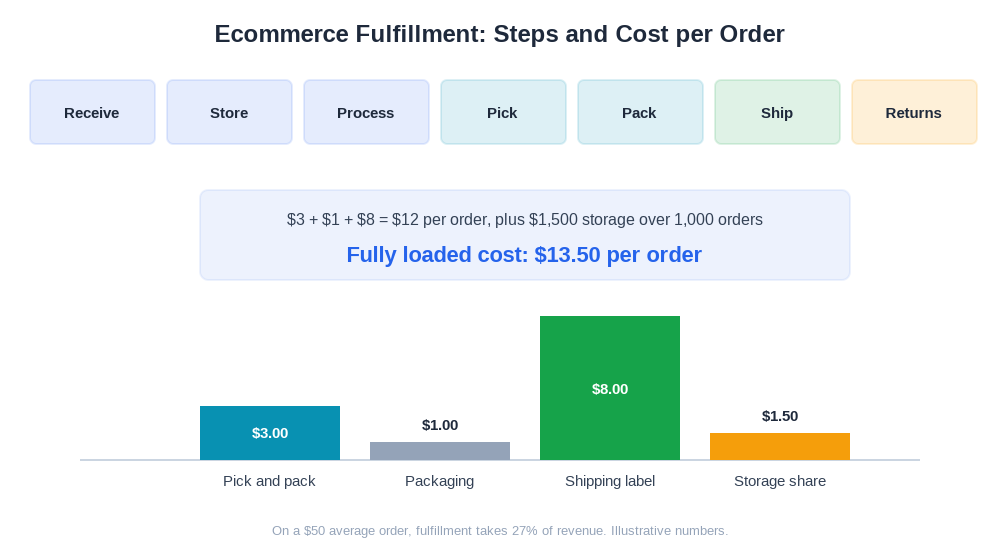
- Work out your cost per order. With $3 pick and pack, $1 packaging, an $8 label and $1,500 of storage across 1,000 orders, fulfillment costs $13.50 an order, 27% of a $50 order.
- Stores do it in-house, through a 3PL, with Amazon FBA, by dropshipping or with a mix. Compare 3PLs on total cost per order, not headline pick fees.
- Shipping is only one step. Delivery speed is often decided earlier, by cut-off times, pick and pack time and where your stock sits.
Where AmICited fits
AmICited’s Order mix report splits a connected shop’s orders by carrier, payment, status and cost share, and its Economics report subtracts packaging and shipping on the way from revenue to profit, so fulfillment cost per order is visible instead of buried in overhead.
See Order mix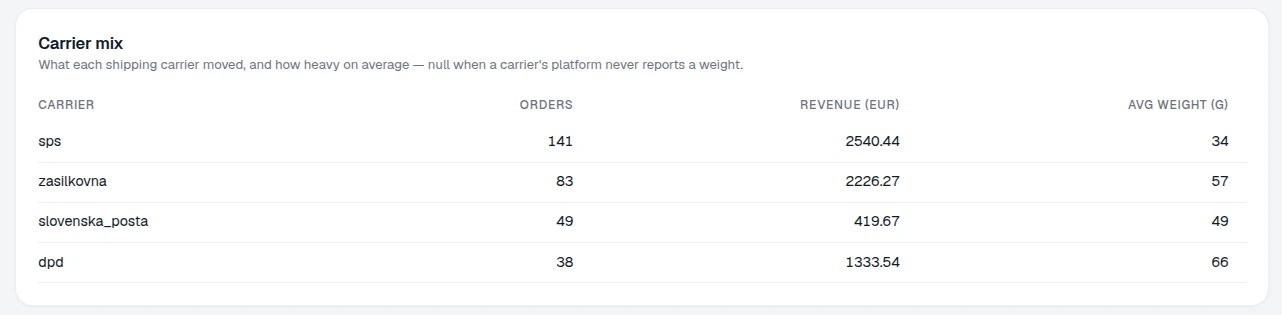
What Is Ecommerce Fulfillment?
Ecommerce fulfillment is everything that happens between “order placed” and “parcel delivered”, plus the steps that make it possible and the returns that follow. It covers receiving inventory from suppliers, storing it, picking the right items for each order, packing them, shipping with a carrier and processing returns.
Every online store does fulfillment somehow. Early on, it’s often the founder packing boxes in a spare room. As volume grows, stores move to a warehouse, a third-party logistics provider (3PL), a marketplace program such as Amazon FBA, or a mix. The software side usually involves an order management system and, at scale, a warehouse management system. For a narrower look at the order-level steps, see order fulfillment.
How the Ecommerce Fulfillment Process Works
- Receiving. Inbound stock is counted, checked against the purchase order and logged into inventory.
- Storage. Items get bin locations so they can be found fast. Fast movers go near packing stations.
- Order processing. Orders flow in from the store and marketplaces, are checked for payment and fraud, and released to the warehouse.
- Picking. Staff or robots collect the items. Batch picking groups several orders into one walk.
- Packing. Items are packed in the right-size box with protective material, inserts and a shipping label.
- Shipping. Carriers collect parcels. Tracking is sent to the customer.
- Returns. Returned items are received, inspected and restocked or written off.
To know what fulfillment costs you, work it out per order. Say pick and pack costs $3.00, packaging $1.00 and the average shipping label $8.00. That’s $12.00 per order. At 1,000 orders a month, that’s $12,000, plus storage. If storage is $1,500 a month, the true cost is ($12,000 + $1,500) ÷ 1,000 = $13.50 per order. On a $50 average order, fulfillment is 27% of revenue. That number decides whether free shipping thresholds, box sizes and 3PL quotes make sense.

Ecommerce Fulfillment Models Compared
| Model | How it works | Pros | Cons | Fits |
|---|---|---|---|---|
| In-house | You store and ship from your own space | Full control, custom packaging, no fees to a partner | Rent, staff, carrier rates at small volume | Early stage, custom or fragile products |
| 3PL | A logistics partner stores and ships for you | Scales with volume, better carrier rates, multiple warehouses | Less control, receiving and storage fees, minimums | Growing brands, multichannel sellers |
| Amazon FBA | Amazon stores and ships, mostly Amazon orders | Prime badge, Amazon handles service | Fees, storage limits, Amazon-first | Amazon-heavy sellers |
| Dropshipping | Supplier ships direct to customer | No inventory to hold | Thin margins, little control over quality and speed | Testing products, wide catalogs |
| Hybrid | Mix of the above by channel or product | Right model per product | More systems to manage | Larger, multichannel brands |
Ecommerce Fulfillment vs Shipping
People often say “shipping” when they mean fulfillment. Shipping is one step: the carrier moving a parcel to the customer, including last-mile delivery. Fulfillment is the system around it. A fast carrier can’t fix an order that sat unpicked for two days, and a perfect pick-and-pack operation can’t make up for a slow carrier. When delivery times disappoint, look at the whole chain: order cut-off times, pick and pack time, carrier handoff and transit.
Much of delivery speed is decided before the parcel leaves. A store that ships the same day for orders placed before 2 p.m. and uses ground shipping can often beat a store that takes two days to pack and then pays for express. Where your stock sits matters too: one warehouse on the East Coast means long transit times to customers in California. Brands with national demand often split inventory across two or more locations, either through a 3PL network or a second warehouse.

Stay Updated on AI Visibility Trends
Get the latest insights on AI mentions, brand monitoring, and optimization strategies.
Ecommerce Fulfillment and AI Search
AI assistants don’t see inside your warehouse, but they see the results. Reviews mentioning “arrived in two days” or “took three weeks” feed into how ChatGPT, Perplexity and Google’s AI answers describe a store. Google’s shopping surfaces also show shipping speed and cost pulled from Merchant Center data, so accurate shipping settings in your feed matter.
On the cost side, AmICited’s Economics report shows contribution margin as a revenue-to-profit bridge, and Order Mix splits orders by carrier and cost share. Both make fulfillment cost per order visible instead of buried in overhead.
Best Practices for Ecommerce Fulfillment
- Know your fully loaded cost per order (labor, packaging, shipping, storage, returns) and review it monthly.
- Set a daily order cut-off time and publish it, so delivery promises are realistic.
- Right-size boxes. Carriers charge by dimensional weight, so empty space costs money.
- Place fast-moving items near packing stations and batch-pick small orders.
- Get quotes from at least two 3PLs before outsourcing, and compare on cost per order, not headline rates.
- Track order accuracy, dock-to-stock time and on-time shipment rate.
- Keep inventory synced across every channel to avoid overselling.
Common Ecommerce Fulfillment Mistakes
A frequent mistake is offering free shipping without knowing the real cost per order, so every sale under a certain basket loses money. Another is choosing a 3PL on the lowest pick fee while ignoring receiving, storage, account management and minimum monthly charges, which can double the real cost.
Stores also outgrow their setup without noticing. Order errors creep up, packing delays push shipments to the next day, and reviews start mentioning slow delivery. Others use oversized boxes for everything and pay for air on every parcel. And many leave returns out of the fulfillment plan entirely, so returned items pile up uninspected.