


- Minimum order quantity (MOQ) is the fewest units a supplier will sell you in one order. It can apply per product, per variant, per order, or as a minimum order value.
- Suppliers set MOQs to cover the fixed costs of each production run, such as machine setup, molds and minimum material lots.
- For a buyer the key number is months of cover: MOQ divided by monthly sales. A 500-unit MOQ at 100 sales a month is five months of stock paid up front.
- Weigh the lower unit price against holding cost, tied-up cash and the risk that stock never sells. Ask the supplier for a price ladder.
Where AmICited fits
AmICited’s Purchase costs report puts what each product cost to buy next to the revenue it brought in and the units sold, from your connected shop. That sales rate is the number to check before you accept a supplier’s minimum.
See purchase costs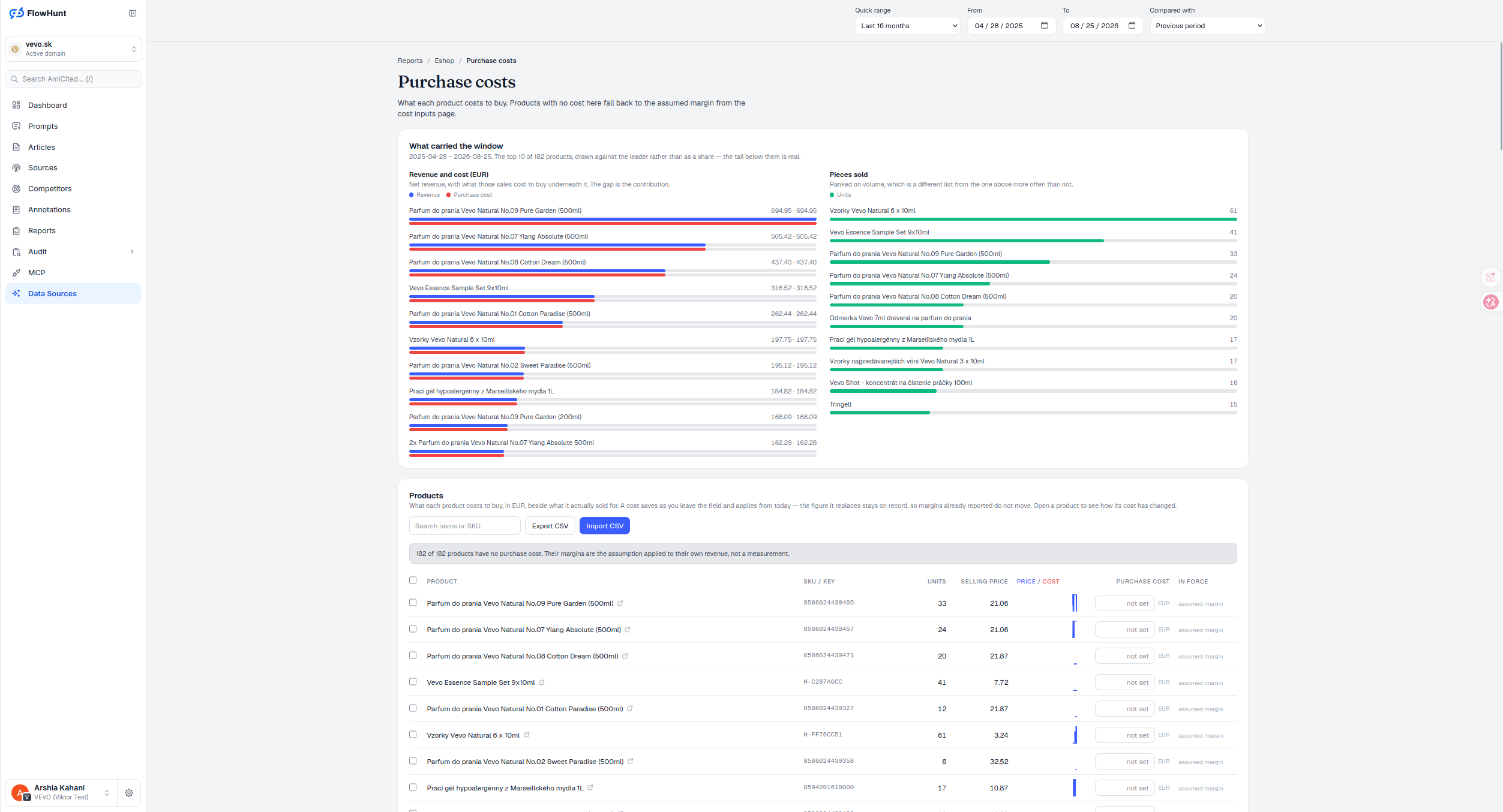
What Is Minimum Order Quantity?
Minimum order quantity (MOQ) is the smallest number of units a supplier will sell you in one order. If a factory’s MOQ is 500 units, you can’t order 200, or you can only do so at a higher price. MOQs can apply per product, per color or size, per order, or as a minimum order value in dollars.
You’ll meet MOQs whenever you buy from manufacturers and wholesalers: on Alibaba listings, in factory quotes for private label products, and in distributor terms. If you run a wholesale ecommerce business, you probably set them yourself. For brands, MOQs are one of the biggest drivers of how much cash goes into inventory, and one of the most common causes of over-stocking.
How Minimum Order Quantity Works
Suppliers set MOQs because every production run has fixed costs: setting up machines, making molds or printing plates, buying raw materials in minimum lots, and processing the order. A simple supplier-side view:
Break-even MOQ = Fixed cost per production run ÷ Profit per unit
With $1,500 of setup costs and $3 profit per unit, a supplier needs at least 500 units just to cover setup.
For the buyer, the MOQ matters because of what it does to your stock. The key calculation is how many months the minimum order lasts:
Months of cover = MOQ ÷ Monthly sales
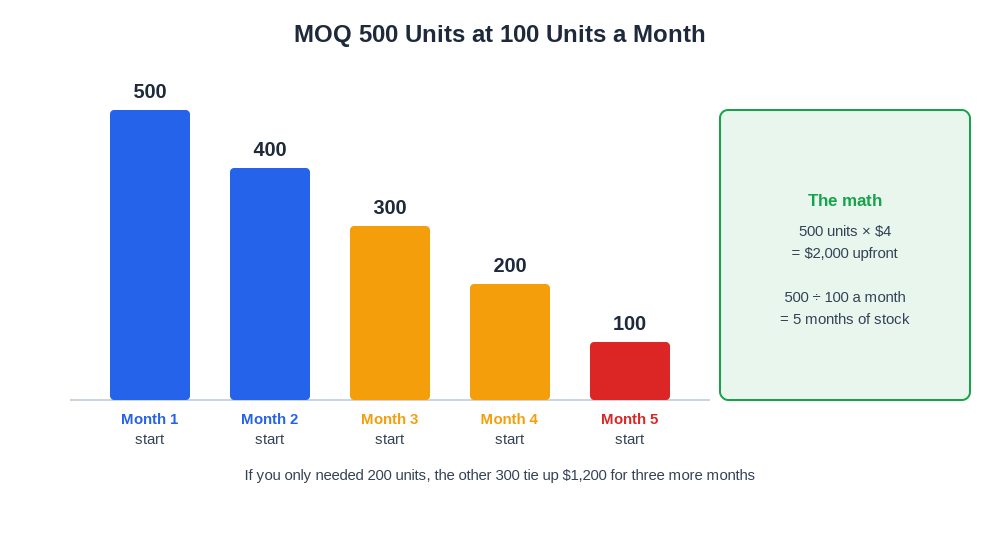
Say a supplier’s MOQ is 500 units at $4 each, so the minimum order costs $2,000. You sell about 100 units a month. That order is 500 ÷ 100 = 5 months of stock, which you pay for up front. If you only needed 200 units to cover the next two months plus a buffer, the other 300 units tie up $1,200 for three extra months, and they carry storage and holding costs while they wait.
That’s not automatically bad. The larger order may come with a lower unit price, fewer shipments and fewer stockouts. The question is whether the savings beat the holding cost and the risk that some of the stock never sells. For trendy or seasonal items, the risk of ending up with dead stock is often the deciding factor.
A price ladder makes the trade-off concrete. Suppose the supplier offers 500 units at $4.00 or, as an exception, 250 units at $4.60. The smaller order costs $1,150 instead of $2,000, so you pay a $150 premium ($0.60 × 250) but keep $850 in cash and hold 2.5 months of stock instead of 5. On holding cost alone the larger order still wins: the extra 250 units are $1,000 of stock, and at around 25% a year, holding them for the extra 2.5 months costs roughly $50. The case for the smaller order is cash and risk. If the product sells slower than planned, you’re stuck with 250 units instead of 500. For a new or unproven product, that risk usually outweighs the $150 premium.
MOQ vs EOQ vs MOV vs Reorder Point
| Term | Set by | What it means | Used for |
|---|---|---|---|
| Minimum order quantity (MOQ) | Supplier | Fewest units accepted per order | Supplier’s floor on order size |
| Economic order quantity (EOQ) | You | Order size that minimizes your ordering plus holding costs | Your ideal order size |
| Minimum order value (MOV) | Supplier | Smallest order in money terms, e.g. $1,000 | Floor on order size across mixed products |
| Reorder point | You | Stock level that triggers a new order | When to order |
| Safety stock | You | Extra buffer for demand or lead-time surprises | How much buffer to hold |
In practice: the reorder point tells you when to order, EOQ tells you how much you’d like to order, and the MOQ tells you the least you’re allowed to order. You order the larger of EOQ and MOQ, unless the MOQ is so high that it isn’t worth it.
Minimum Order Quantity and AI Search
Buyers increasingly ask AI assistants things like “manufacturers with low MOQ for custom mugs” or “which suppliers have no minimum order”. If you’re a supplier or wholesaler, stating your MOQ clearly on your site gives AI tools something concrete to quote. Vague phrasing like “flexible minimums” is hard for an AI answer to repeat.
For brands buying stock, the connection to AI search is weak. MOQ is a sourcing decision, and its effect shows up later in inventory and margin, not in AI answers.

Stay Updated on AI Visibility Trends
Get the latest insights on AI mentions, brand monitoring, and optimization strategies.
Best Practices for Minimum Order Quantities
- Calculate months of cover for every MOQ before you accept it, using realistic sales, not launch hopes.
- Include the full cost. Add shipping, duties and storage to the unit price to get your landed cost, then compare scenarios.
- Ask for a price ladder. Get quotes at the MOQ, half the MOQ and double it to see how much the minimum is really worth.
- Combine variants. Many suppliers will accept an MOQ split across colors or sizes of the same product.
- Start with stock items. Off-the-shelf products with your branding often have lower MOQs than fully custom ones.
- Negotiate with commitment. A signed plan for repeat orders can lower the first MOQ.
Common Minimum Order Quantity Mistakes
The most common mistake is accepting a high MOQ to get a lower unit price, without counting the cost of holding the extra stock or the chance it doesn’t sell. A 10% lower unit price doesn’t help if a third of the order ends up discounted or written off. Another is meeting the MOQ by ordering several variants in equal amounts, when sales history shows one color or size sells far more than the others.
Buyers also forget cash flow. Paying for six months of stock up front can leave too little cash for marketing to actually sell it. Finally, many never revisit MOQs after the first order. Once you have a sales track record, suppliers are often willing to change terms, but only if you ask.