



Which keywords trigger AI Overviews? In 2026, nearly every kind. DataForSEO’s Search Insider 2026 found trigger rates between 42.63% and 65.32% across every search volume, keyword difficulty and CPC bucket it measured in US Google results in mid-2026.
That breaks a rule many SEO teams still use: target easy, low-volume keywords because AI Overviews mostly hit the big, competitive ones. Keywords with a difficulty of 1–20 triggered AI Overviews 60.64% of the time. Keywords with 201–300 monthly searches triggered them 58.59% of the time, more than keywords with 601+ searches.
This post is part of our series on the Search Insider 2026 findings. It covers the numbers by metric, why older studies taught the opposite, and how to fold AI Overview presence into keyword prioritization.
Key Takeaways
- No keyword metric makes a keyword AIO-proof. Every bucket of search volume, keyword difficulty and CPC in DataForSEO’s latest 2026 data had an AI Overview trigger rate of 42% or more.
- Easy keywords (KD 1–20) triggered AI Overviews 60.64% of the time. The hardest keywords (KD 81–100) were lowest, at 53.76%.
- In Q3 2026, keywords with 201–300 monthly searches had the highest rate (58.59%) and 601+ the lowest (48.62%). In Q4 2025 every volume bucket sat between 29% and 33%.
- CPC follows a shallow U: $0–0.25 keywords at 50.54%, $5+ at 49.55%, and the low point at $0.51–1.00 with 42.63%.
- Older advice came from 2024–2025 studies; Ahrefs’ 2025 sample found AI Overviews on about one SERP in five. The 2026 base rate is more than double that.
What the data shows
AI Overview trigger rates in the latest 2026 data sit between about 43% and 65% whatever the keyword’s volume, difficulty or cost per click. The differences between buckets are real but small: about 10 points across volume, 12 across difficulty and 8 across CPC. None of them separates keywords that get AI Overviews from keywords that don’t.
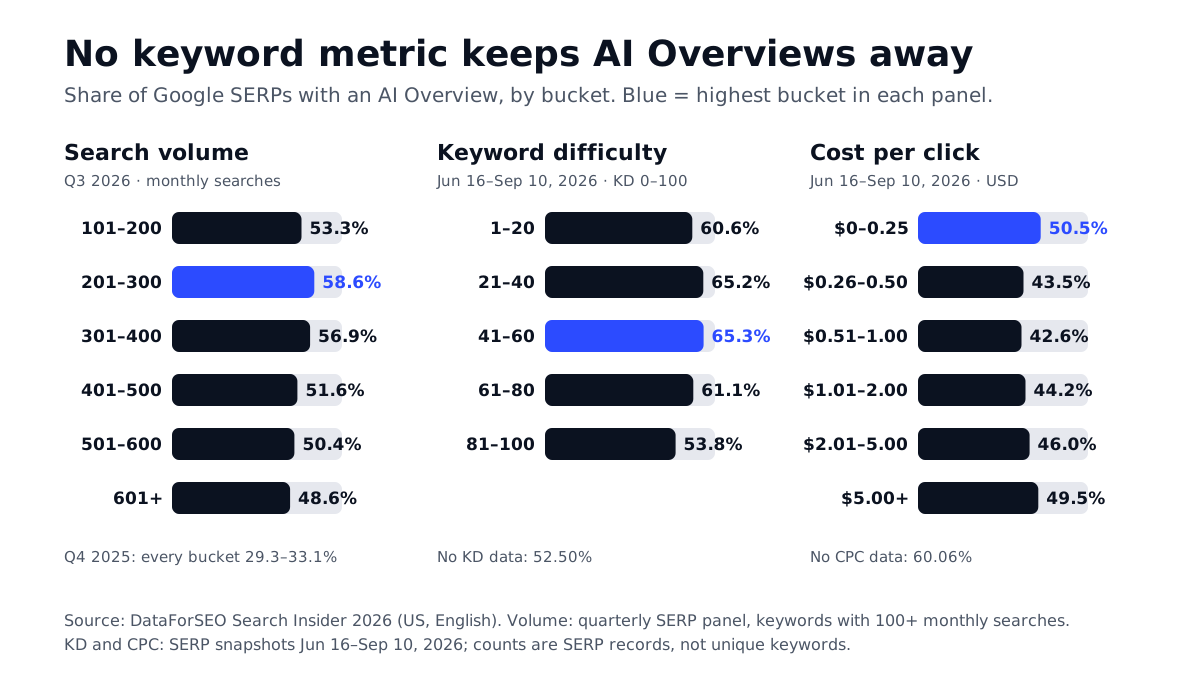
Here are all the buckets in one table. Search volume comes from DataForSEO’s quarterly panel (keywords with 100+ monthly searches, Q3 2026 = July 1 to September 14). Keyword difficulty and CPC come from a separate snapshot of SERPs collected June 16 to September 10, 2026.
| Metric | Bucket | AI Overview trigger rate | SERPs |
|---|---|---|---|
| Monthly searches (Q3 2026) | 101–200 | 53.33% | 7.5M |
| Monthly searches (Q3 2026) | 201–300 | 58.59% | 3.5M |
| Monthly searches (Q3 2026) | 301–400 | 56.88% | 2.5M |
| Monthly searches (Q3 2026) | 401–500 | 51.62% | 1.0M |
| Monthly searches (Q3 2026) | 501–600 | 50.40% | 0.8M |
| Monthly searches (Q3 2026) | 601+ | 48.62% | 4.7M |
| Keyword difficulty | 1–20 | 60.64% | 63.6M |
| Keyword difficulty | 21–40 | 65.20% | 14.6M |
| Keyword difficulty | 41–60 | 65.32% | 4.0M |
| Keyword difficulty | 61–80 | 61.08% | 1.1M |
| Keyword difficulty | 81–100 | 53.76% | 0.4M |
| Keyword difficulty | No KD data | 52.50% | 116.9M |
| Cost per click | $0–0.25 | 50.54% | 23.6M |
| Cost per click | $0.26–0.50 | 43.45% | 17.5M |
| Cost per click | $0.51–1.00 | 42.63% | 20.8M |
| Cost per click | $1.01–2.00 | 44.25% | 18.9M |
| Cost per click | $2.01–5.00 | 45.95% | 18.9M |
| Cost per click | $5.00+ | 49.55% | 14.5M |
| Cost per click | No CPC data | 60.06% | 136.6M |

Ready to Monitor Your AI Visibility?
Track how AI chatbots mention your brand across ChatGPT, Perplexity, and other platforms.
Volume and difficulty don’t protect you
Search volume and keyword difficulty both lean slightly the opposite way from the old advice. Lower-volume keywords triggered AI Overviews a little more often than high-volume ones in Q3 2026, and easy keywords triggered them more often than the hardest ones. The safe-looking end of a keyword list is not the AI-free end.
Volume tells a growth story too. In Q4 2025, every volume bucket sat between 29.29% and 33.13%. By Q3 2026, every bucket had gained between 18 and 26 points. The 201–300 bucket gained most, from 33.10% to 58.59%. Popular keywords weren’t the ones that changed most; everything changed.
Difficulty peaks in the middle. Keywords with KD 21–40 and 41–60 triggered AI Overviews about 65% of the time, KD 1–20 at 60.64%, and KD 81–100 at 53.76%. Easy keywords are also by far the largest group with a difficulty score, 63.6M SERPs, so they hold most of the AI Overviews among scored keywords.
That matters for long-tail keyword strategies. A low-competition keyword you can rank for in weeks may still put an AI summary above your result. You win the ranking and share the clicks.
CPC follows a shallow U
Cost per click reflects what advertisers will pay for a keyword, so it’s often used as a stand-in for commercial value. In DataForSEO’s data, the cheapest keywords ($0–0.25) triggered AI Overviews 50.54% of the time and the most expensive ($5+) 49.55%. The low point was $0.51–1.00 at 42.63%. Expensive keywords are not AIO-proof.
This is where AI engines disagree most when asked. When we asked AI engines about it with AmICited on November 7, 2026 (one US prompt, one run per engine), Perplexity said keywords above roughly $2 CPC are less represented in AI Overviews, while ChatGPT cited a Semrush finding that the highest CPC tier triggers them most. The 2026 data supports neither slope. The highest and lowest CPC buckets are within a point of each other.
Keywords without any CPC data had a higher rate than any CPC bucket, 60.06%, across 136.6M SERPs. DataForSEO doesn’t explain why. A plausible reading is that keywords nobody bids on lean informational, and informational searches trigger AI Overviews most often. Treat that as a hypothesis, not a finding.
Stay Updated on AI Visibility Trends
Get the latest insights on AI mentions, brand monitoring, and optimization strategies.
Why older studies said the opposite
The advice that AI Overviews favour easy, low-volume, cheap keywords came from studies run when AI Overviews were rare. In Ahrefs’ 2025 sample they appeared on about one SERP in five, so small differences between keyword types looked large. With trigger rates now above 50% in most buckets, those differences have mostly closed.
Ahrefs’ October 2024 study compared 150,000 keywords with an AI Overview to 150,000 without. The AI Overview group had a median keyword difficulty of 12 against 33, a median volume of 500 against 29,000, and a median CPC of 0.35 against 0.45. That sample was built from top keywords picked by AI Overview status, so it compares two groups rather than measuring how often each type triggers one.
Ahrefs’ November 2025 study of 146 million desktop SERPs from September 2025 found AI Overviews on 20.5% of them. Its CPC buckets ran from 27.6% for $0–0.10 to 15.8% for $20+, with what Ahrefs called little obvious correlation.
Semrush’s AI Overviews study, updated in December 2025, reported that nearly 60% of keywords triggering an AI Overview had 100 or fewer monthly searches and nearly 60% fell in KD 21–60. Those figures describe what the AI Overview keywords look like, not how likely a keyword is to get one. Most keywords in any database are low volume, so most AI Overview keywords will be too.
That composition-versus-rate mix-up runs through a lot of AI answers on this topic. “Most AI Overview keywords are low volume” and “low-volume keywords are more likely to get an AI Overview” are different claims. The 2026 data shows the second is only slightly true, and only for volume.
Use AIO presence when you prioritize
If no metric predicts AI Overviews, track the SERP itself. Add “AI Overview present” to your keyword list next to volume, difficulty and CPC, and lower your expected clicks where one appears. DataForSEO estimates the top organic result’s share of clicks falls from 33–38% to 21–24% on SERPs with an AI Overview, across all four search intents.
A simple adjustment: on a commercial keyword, the top result’s estimated click share drops from 33.8% to 21.1% with an AI Overview, about 38% less. On an informational keyword, it drops from 37.1% to 20.7%, about 44% less. Apply that cut to your forecast for the keywords where you’ve confirmed an AI Overview, rather than to the whole list. Our post on AI Overview citations’ share of clicks has the full table, and organic CTR by position covers how CTR itself has shifted.
Then flip the question. When an AI Overview is present, its cited sources collectively take an estimated 42–45% of clicks, about twice the top organic result’s 21–24%. That makes the keywords with an AI Overview a citation target, not just a traffic risk.
What brands should do now
- Add an “AI Overview present” column. Check the live SERP for your priority keywords, or pull the SERP-feature flag from your SEO tool, and record it next to volume, difficulty and CPC. Re-check quarterly: the rates moved 18–26 points in under a year.
- Discount forecasts only where an AI Overview appears. Apply the 38–44% top-result cut to confirmed keywords, not the whole list. Pages in Striking Distance are ranked by modelled upside from a click-through curve, so adjust that upside down for queries you know carry an AI Overview.
- Re-read your demand map with AI Overviews in mind. Quadrant plots each keyword or page by impressions against position. A high-demand, weakly ranked query with an AI Overview may be worth more as a citation target than as a ranking push.
- Keep organic and paid in one view. If expensive keywords show AI Overviews as often as cheap ones, paid and organic face the same summary. Unified Keywords puts organic clicks and position beside ad spend and conversions per keyword.
- Track the questions behind your top keywords. Add them to prompt tracking to see whether Google’s AI Overview names and cites you, and who it cites instead.
The takeaway
The 2026 data retires an easy shortcut. Low difficulty, low volume and high CPC don’t keep AI Overviews away; every bucket DataForSEO measured sits between about 43% and 65%. Treat AI Overview presence as its own keyword attribute, check it on the SERP, and plan for both outcomes on those keywords: fewer clicks from ranking, and a real prize for being cited. For the same shift by search intent, see how AI Overviews nearly doubled on commercial searches.
 LinkedIn