



When an AI Overview appears on Google, the links cited inside it take an estimated 42–45% of clicks. The top organic result’s share falls from 33–38% to 21–24%. Those figures come from DataForSEO’s Search Insider 2026, which modelled click distribution across 188.86M US keywords with a September 7, 2026 snapshot of Google results.
You may have seen a very different number: Pew Research found people clicked a link inside an AI summary in just 1% of visits. Both figures can be right, because they divide by different things. This post breaks the click shift down by search intent and explains how the two studies fit together.
It’s part of our series on the Search Insider 2026 findings.
Key Takeaways
- On US Google results pages with an AI Overview, links cited in the Overview take an estimated 42.2% to 44.8% of clicks, across all four search intents.
- The top organic result’s click share falls from 33.4–37.6% without an AI Overview to 20.7–24.1% with one.
- Position 1 loses about 16 percentage points on informational and transactional searches, 12.7 on commercial and 9.3 on navigational searches.
- Positions 2–10 combined lose about 36–42% of their click share when an AI Overview appears.
- Pew’s “1% clicked an AI summary link” counts all visits, including ones with no click, in March 2025. DataForSEO’s 42–45% counts only searches that got a click, in September 2026.
Where clicks go with an AI Overview
On Google results pages with an AI Overview, the links inside the Overview are the single biggest click destination. DataForSEO estimates they get 42.2% to 44.8% of clicks, depending on intent. The top organic result gets 20.7% to 24.1%, roughly half as much. These are modelled estimates that exclude searches with no click.
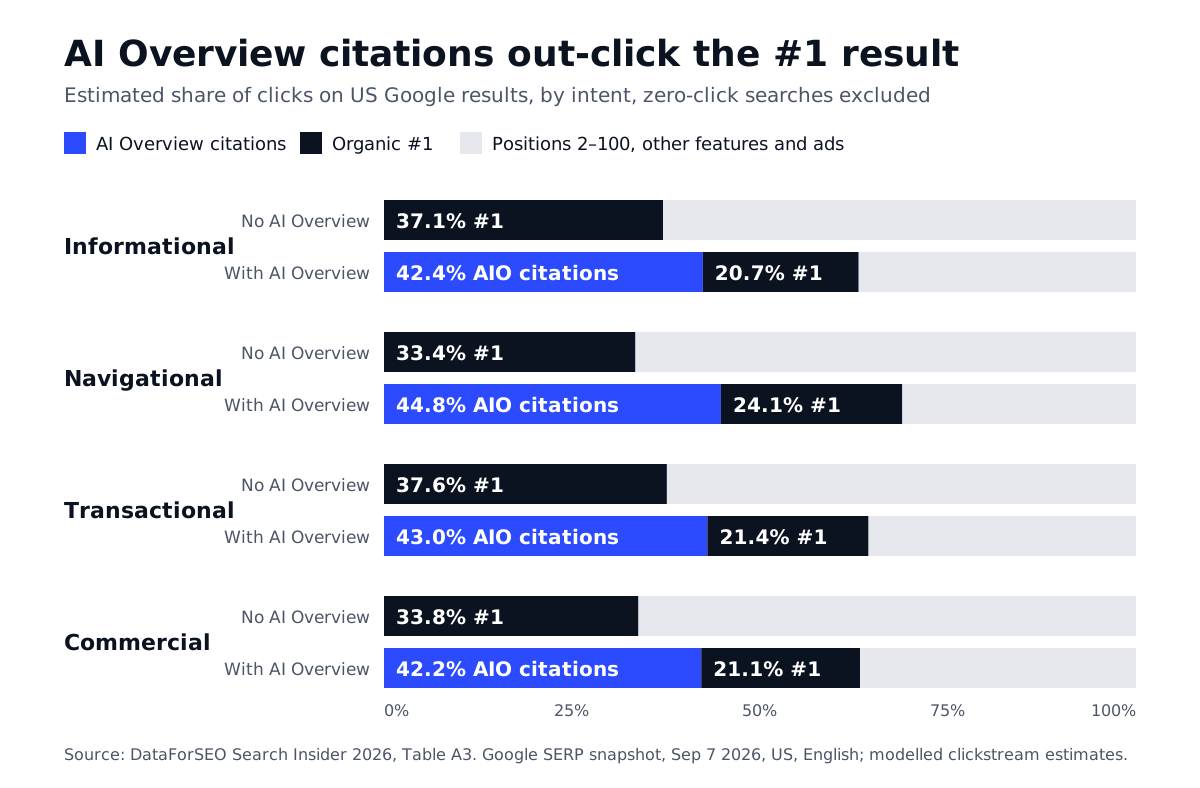
The most striking part is how little the AI Overview’s share varies. Whether someone is researching, looking for a site, comparing products or ready to buy, the citations take between 42% and 45% of clicks. The report reads this as AI Overviews taking over across the whole search journey.

Ready to Monitor Your AI Visibility?
Track how AI chatbots mention your brand across ChatGPT, Perplexity, and other platforms.
How each search intent changes
The top organic result loses click share on every intent, but not equally. Position 1 loses about 16 percentage points on informational and transactional searches, 12.7 on commercial and 9.3 on navigational searches. The rest of page one loses too: positions 2–10 combined give up about 36–42% of their click share.
Percentage points of estimated click share, US Google snapshot of September 7, 2026, zero-click searches excluded.
Here is the full Table A3. Each row shows where an estimated 100% of clicks go for that intent:
| Intent | AI Overview | AIO citations | #1 | #2 | #3 | #4–10 | #11–100 | Other features & ads |
|---|---|---|---|---|---|---|---|---|
| Informational | No | — | 37.1% | 18.2% | 10.6% | 22.9% | 9.2% | 2.0% |
| Informational | Yes | 42.4% | 20.7% | 10.5% | 6.2% | 13.3% | 6.5% | 0.4% |
| Navigational | No | — | 33.4% | 13.6% | 8.6% | 18.0% | 5.3% | 21.1% |
| Navigational | Yes | 44.8% | 24.1% | 8.7% | 5.1% | 11.8% | 4.8% | 0.9% |
| Transactional | No | — | 37.6% | 17.1% | 10.4% | 22.3% | 9.1% | 3.4% |
| Transactional | Yes | 43.0% | 21.4% | 10.2% | 6.1% | 13.0% | 5.7% | 0.7% |
| Commercial | No | — | 33.8% | 15.7% | 9.2% | 20.3% | 9.3% | 11.8% |
| Commercial | Yes | 42.2% | 21.1% | 10.0% | 6.0% | 13.0% | 6.5% | 1.3% |
Navigational searches show the smallest loss for position 1, which makes sense: people searching for a specific site still click it. They also show the biggest shift away from other features and ads, from 21.1% of clicks to 0.9%. Commercial searches follow the same pattern, from 11.8% to 1.3%. In the model, AI Overviews take clicks from local packs, featured snippets and ads as well as from organic results.
For informational searches, the drop runs down the whole page. Position 2 falls from 18.2% to 10.5%, and positions 4–10 combined from 22.9% to 13.3%. On an informational query with an AI Overview, the seven results in positions 4–10 share about 13% of clicks between them.
Cited versus ranked first
Being cited in an AI Overview is now a bigger click source than ranking first used to be. With an AI Overview, citations take 42–45% of clicks. Without one, position 1 took 33–38%. There’s an important catch, though: the 42–45% is shared among every link the Overview cites, not given to one page.
An AI Overview usually cites several sources. In our own tracking, one AI Overview for the prompt “ai search tracker” cited seven pages on October 31, 2026. DataForSEO’s table doesn’t say how clicks split among the cited links, so a single citation’s share is unknown. It’s likely well below 42%, especially for a source lower in the list.
So is it better to rank first or to be cited? On a results page with an AI Overview, the best position is both. Ranking still feeds citations: AI Overviews draw many of their sources from top-ranking pages, though an Ahrefs study we covered found that share falling from 76% to 38%. On those pages, position 1 gets about a fifth of the clicks. A page that is cited but doesn’t rank depends entirely on the AI answer.
One more caution: the table compares results pages with and without an AI Overview, not the same queries before and after one appeared. Queries that trigger AI Overviews may differ in other ways, so treat the gap as an estimate of the shift, not a controlled experiment.
Stay Updated on AI Visibility Trends
Get the latest insights on AI mentions, brand monitoring, and optimization strategies.
Why Pew says 1%
Pew and DataForSEO answer different questions. Pew counted all visits to a Google results page, including visits where nobody clicked anything. DataForSEO counts only the clicks that happen and asks where they go. A small share of all visits can still be a large share of clicks. The two studies are also 18 months apart.
Pew Research tracked the browsing of 900 US adults in March 2025, covering 68,879 Google searches, 12,593 of which showed an AI summary. On those pages, people clicked a traditional result in 8% of visits, compared with 15% on pages without a summary. They clicked a link inside the AI summary in 1% of visits. And 26% of visits ended the browsing session, against 16% without a summary.
| Pew Research | DataForSEO | |
|---|---|---|
| What it measures | Share of all visits to a results page | Share of clicks among searches that get a click |
| Zero-click searches | Included | Excluded |
| Method | Observed browsing, 900 US adults | Clickstream-based model, 188.86M keywords |
| Date | March 2025 | September 7, 2026 |
| AI summary link clicks | 1% of visits | 42–45% of clicks |
The denominator explains part of the gap, not all of it. In Pew’s data, there was roughly one click on an AI summary link for every eight clicks on traditional results. That’s still far below DataForSEO’s estimate. The rest likely comes from the 18 months between the studies, when AI Overviews spread from a minority of searches to most results pages, and from comparing observed behaviour with a model. Neither study settles it alone.
Both agree on the direction. Organic results get fewer clicks when an AI summary appears, and more searches end with no click at all. That’s the zero-click search pattern, and our earlier post on AI Overviews and organic CTR decline covers the 2025 studies that first measured it. For the device-level trend in 2026, see our organic CTR by position breakdown.
How to track the shift
You can’t see AI Overview clicks directly. Google says traffic from its AI features is counted in the overall Web search traffic in Search Console, according to its AI features documentation. The generative AI report adds impressions, not clicks. So you measure the shift indirectly: whether you’re cited, and what happens to clicks on queries with an AI Overview.
Our guide to tracking Google AI Overviews covers the setup. In short: track the queries that matter in AI Overviews and AI Mode separately, record which pages each answer cites, and compare that list against your clicks in Search Console for the same queries.
What brands should do now
- Track citations for your money queries. Run your priority queries as prompts in AI Overviews and AI Mode with an AI rank tracker, and record whether you’re cited and in what position.
- Find the pages that rank but aren’t cited. The Citation-Ranking Gap report lists queries where you rank near the top and AI answers cite someone else. Those pages get the smaller share of clicks on the page.
- Study who does get cited. Source & Citation Intelligence shows which domains and URLs each engine cites for your prompts. Compare their structure with yours.
- Watch clicks per query, not just totals. The CTR Gap report flags queries earning fewer clicks than your own curve predicts at that position. Check the live results page for an AI Overview before rewriting the title.
- Report citations as their own KPI. A citation can bring clicks even when your ranking slips, and it puts your brand in the answer when nobody clicks. Track AI visibility next to organic traffic.
The takeaway
When an AI Overview appears, the links inside it take more clicks than the top organic result, across every search intent. The top spot still matters, but on those pages it gets 28–44% less click share. Track whether you’re cited for the queries that matter, and treat a ranking without a citation as an unfinished job.
 LinkedIn