



AI Overviews now appear on 51.35% of commercial Google searches, up from 26.30% in Q4 2025. That’s one of the clearest shifts in DataForSEO’s Search Insider 2026, which tracked AI Overview trigger rates by search intent across a quarterly panel of US English keywords.
Informational searches still lead at 70.44%. The bigger story is everywhere else: navigational searches doubled to 34.03%, and transactional searches rose from 10.82% to 28.64%. Product, pricing and comparison searches are no longer a safe zone.
This post is part of our series on the Search Insider 2026 findings. It covers what changed by intent, why the 88% figure you may have seen measures something narrower, and what it means for the pages that sell.
Key Takeaways
- AI Overviews appeared on 51.35% of commercial Google SERPs in Q3 2026, up from 26.30% in Q4 2025, according to DataForSEO.
- Navigational SERPs with an AI Overview doubled, from 17.04% to 34.03%. Almost no published analysis mentions it.
- Transactional SERPs with an AI Overview rose from 10.82% to 28.64%. The sample is small (about 59,000 SERPs in Q3), but the rate rose every quarter.
- Semrush’s widely quoted 88% comes from a 400-keyword panel of “best”, review, “vs” and alternatives queries. It describes those phrasings, not commercial search as a whole.
- When an AI Overview appears, its citations take an estimated 42–45% of clicks on every intent, including commercial (42.2%) and transactional (43.0%).
What the data shows
AI Overview trigger rates rose for all four search intents between Q4 2025 and Q3 2026. Informational searches went from 48.42% to 70.44%, commercial from 26.30% to 51.35%, navigational from 17.04% to 34.03% and transactional from 10.82% to 28.64%. Commercial gained the most points; transactional grew the most relative to its start.
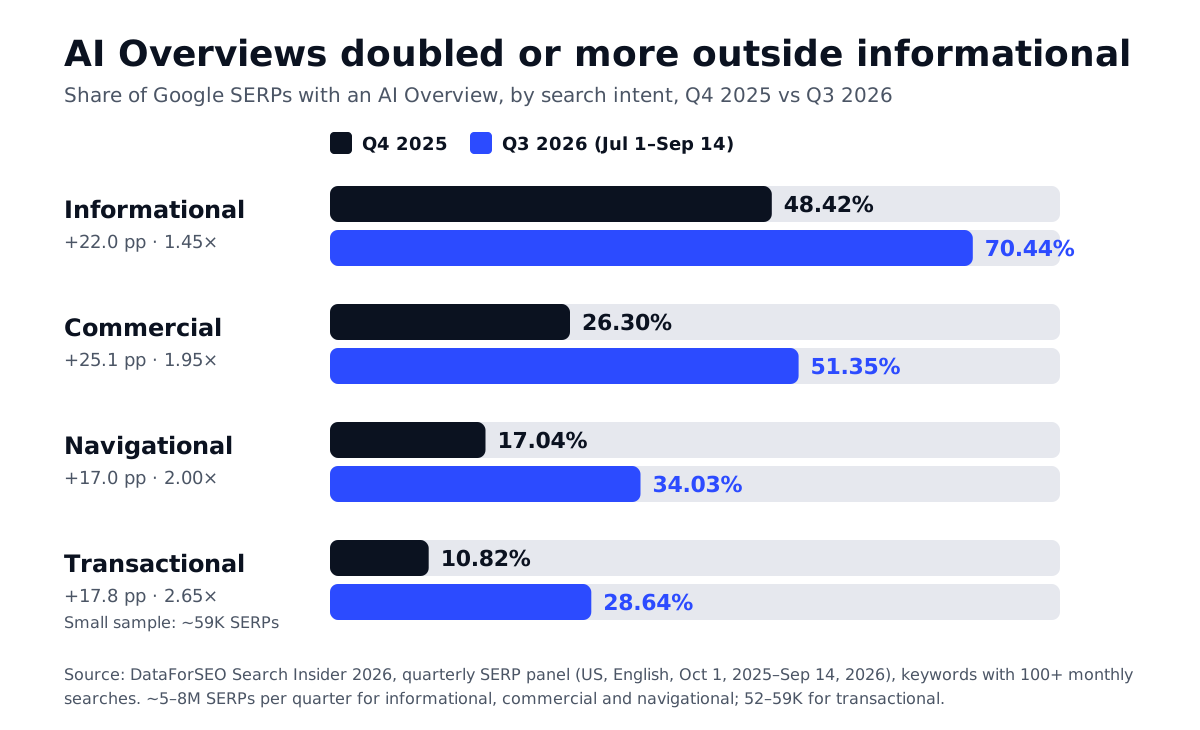
Most of the change happened in one quarter. Commercial rose about 3 points a quarter through Q2 2026, then jumped 18.4 points in Q3. Every other intent followed the same pattern. Q3 here runs from July 1 to September 14, 2026, so it’s a partial quarter.
| Quarter | Informational | Commercial | Navigational | Transactional |
|---|---|---|---|---|
| Q4 2025 | 48.42% | 26.30% | 17.04% | 10.82% |
| Q1 2026 | 50.30% | 29.33% | 17.67% | 12.13% |
| Q2 2026 | 56.14% | 32.94% | 19.87% | 14.89% |
| Q3 2026 (to Sep 14) | 70.44% | 51.35% | 34.03% | 28.64% |
| SERPs in Q3 2026 | 7,958,388 | 5,635,141 | 6,337,782 | 58,663 |
That Q3 jump matches the report’s monthly panel, which shows AI Overviews on 61.43% of all tracked SERPs by August 2026. If you planned your 2026 content around last year’s numbers, the ground moved under you this summer.

Ready to Monitor Your AI Visibility?
Track how AI chatbots mention your brand across ChatGPT, Perplexity, and other platforms.
Navigational searches doubled too
Navigational searches are queries where someone is looking for a specific site or brand. DataForSEO found AI Overviews on 34.03% of them in Q3 2026, up from 17.04% in Q4 2025. That’s the largest relative rise after transactional, and it barely appears in the AI answers or articles that cover this topic.
It matters because navigational intent is the query type brands assume they own. If someone searches for your brand and Google writes a summary first, the summary frames you before your own link does. It may cite review sites, forums or competitors’ comparison pages.
The click data makes it sharper. On navigational SERPs with an AI Overview, its citations take an estimated 44.8% of clicks, the highest share of any intent. The top organic result’s share drops from 33.4% to 24.1%. Your brand result still gets clicked, but less of the journey starts on your site.
Transactional is rising, not falling
Transactional searches, where someone is ready to buy or act, had the lowest trigger rate in every quarter. They also grew fastest relative to their start: 10.82% in Q4 2025, 12.13%, 14.89%, then 28.64% in Q3 2026, a 2.65× increase.
Two caveats. First, the transactional sample is small: 53,627 SERPs in Q4 2025 and 58,663 in Q3 2026, against millions for the other intents. That reflects how the panel’s classifier labels intent, and it makes the exact rate less stable. Second, the direction contradicts a claim AI engines repeat, that AI Overviews are retreating from transactional queries.
That claim traces back to a Semrush study of 600,000 keywords (November 2025 to April 2026), which found the average share of transactional SERPs with an AI Overview fell 5% while commercial grew 71%. Both can be true. Semrush measured an average across industries over a six-month window that ended before the summer jump; DataForSEO’s panel shows a steady rise and then a sharp one in Q3.
Stay Updated on AI Visibility Trends
Get the latest insights on AI mentions, brand monitoring, and optimization strategies.
Why other studies disagree
Published figures for AI Overviews on commercial searches range from about 4% to 88%. The spread comes from what each study samples: a small panel of high-intent phrasings, a broad set of all commercial keywords, or older data from 2025. None of them is wrong. They answer different questions.
| Study | Sample | Commercial figure | What it measures |
|---|---|---|---|
| Semrush, commercial modifiers | 400 keywords, banking, software, ecommerce, US desktop, Aug 2026 | 88% (keyword-weighted) | “Best X for Y”, reviews, brand vs brand, alternatives, price |
| DataForSEO Search Insider 2026 | Millions of SERPs a quarter, US English, 100+ searches, Q3 2026 | 51.35% | All keywords classified as commercial |
| Semrush, AI Overviews study | 10M+ keywords, Jan–Nov 2025 | 8.15% → 18.57% | Commercial keywords since Oct 2024 |
| Ahrefs | 146M desktop SERPs, Sep 2025 | 4.3% | Commercial SERPs showing an AI Overview, 2025 |
The Semrush modifier panel is the extreme case. “Best X for Y” queries hit 96.12% by August 2026, reviews nearly 90%, brand vs brand over 86% and alternatives over 82%. Those are the phrasings that sit closest to the AI Overview’s job of comparing options. Commercial search as a whole also includes product names, category terms and specification lookups, which trigger less often.
The Ahrefs and older Semrush figures are from 2025, when Ahrefs found AI Overviews on roughly one SERP in five in its keyword sample. They’re useful history, but they’re not this year’s base rate. Our post on which keywords trigger AI Overviews shows the same jump by search volume, plus how rates vary by difficulty and CPC.
Where the clicks go
DataForSEO also modelled where clicks land on SERPs with and without an AI Overview, using a September 7, 2026 snapshot and clickstream data. With an AI Overview present, its citations take an estimated 42–45% of clicks on all four intents. On commercial SERPs, the top organic result’s share falls from 33.8% to 21.1%.
SERPs with an AI Overview, US English, September 7, 2026 snapshot. Clickstream-based estimates; zero-click searches excluded.
Put the two findings together. A commercial keyword now has about even odds of showing an AI Overview, and when one appears, the cited sources collect over two-fifths of the clicks. For a comparison or pricing page, ranking first and being cited are now separate goals. Our breakdown of AI Overview citations’ share of clicks covers the full table.
What brands should do now
- Re-check your money keywords by intent. Assume about half of your commercial-intent keywords now show an AI Overview, and confirm the ones that drive revenue by looking at the live SERP. Start from the queries you already get impressions for in Google Search Queries.
- Track the buyer questions as prompts. “Best X for Y”, “X vs Y”, “X pricing” and “X alternatives” are where AI Overviews appear most. Add them to prompt tracking and run them in AI Overviews and AI Mode separately, as our guide to tracking Google AI Overviews explains.
- Read who gets cited for your category. Source & Citation Intelligence shows which domains and pages each engine cites for your prompts, and competitor analysis shows which brands appear next to yours.
- Watch CTR on product, pricing and comparison pages. The CTR Gap report flags queries earning fewer clicks than your own curve predicts. It can’t tell an AI Overview apart from a weak snippet, so check the live SERP before rewriting.
- Make those pages easy to quote. Put prices, plan limits, specs and comparison tables in plain text near the top. Our AI Overviews optimization guide covers page structure in more depth.
The takeaway
AI Overviews are no longer an informational-only feature. In DataForSEO’s 2026 data they appear on half of commercial searches, a third of navigational searches and more than a quarter of transactional ones, and they rose on all four in the same quarter. Plan for an AI summary in front of your product pages, track whether it names and cites you, and treat the 88% headline as a figure about “best” and “vs” queries, not about commercial search as a whole.
 LinkedIn