


- ACoS (advertising cost of sales) is ad spend divided by the sales those ads produced, as a percentage. It is the default efficiency metric in Amazon Ads.
- Compare it with your break-even ACoS, the margin before ad costs. Below break-even, ad-attributed sales make money.
- ROAS is the inverse of ACoS. TACoS divides ad spend by total sales and shows how much a product leans on ads.
- There is no universal good ACoS. Set a target per campaign goal: profit, launch or brand defense.
Where AmICited fits
AmICited does not read Amazon Ads data. Its Shopping report shows which products ChatGPT and other AI engines put on product cards for the prompts you track, with position and price, and its Google Ads and Bing Ads reports cover paid spend, clicks and conversions.
See the ChatGPT visibility tracker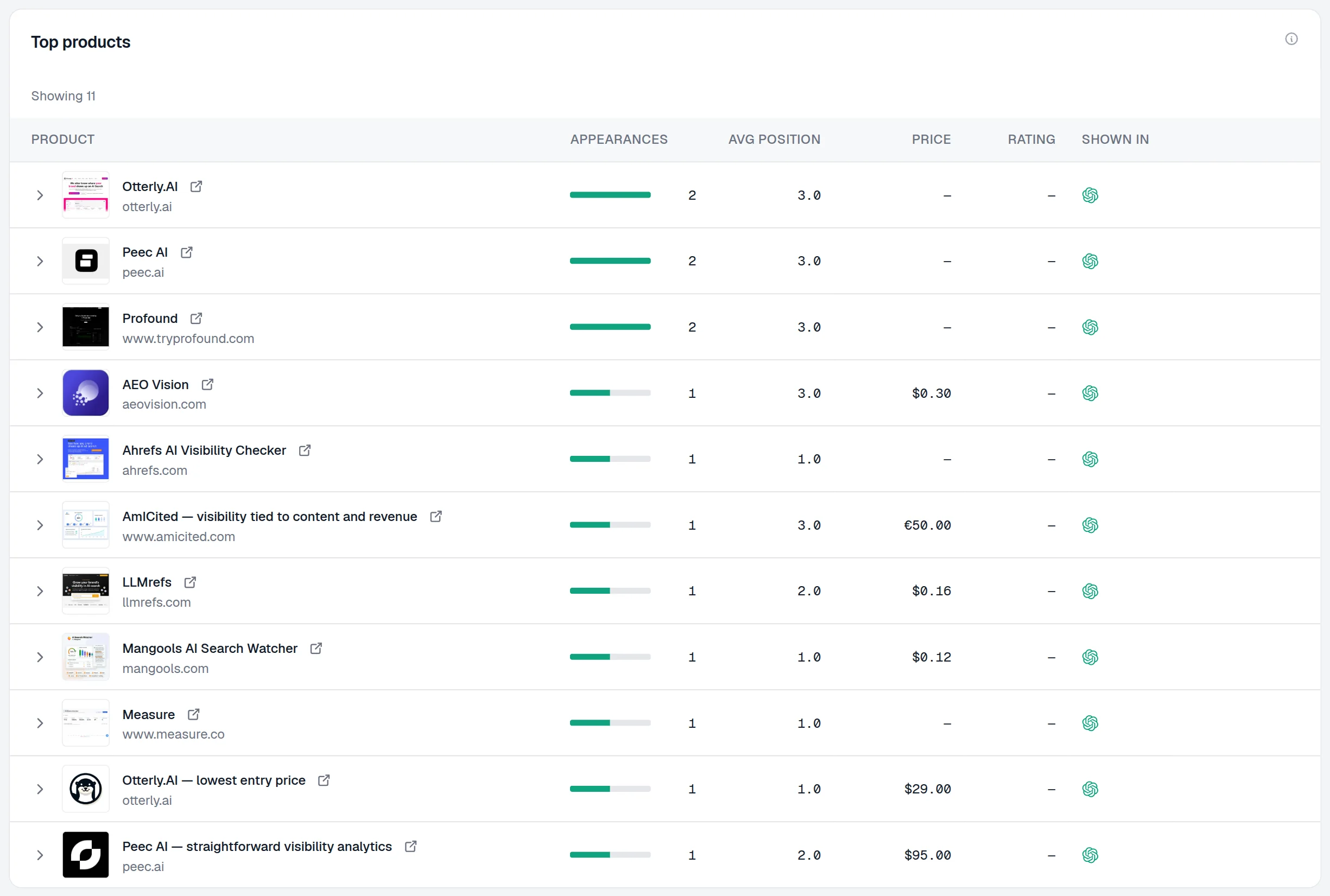
What Is ACoS?
ACoS, or advertising cost of sales, is the share of ad-attributed revenue you spent on advertising to get it. If you spent $25 on ads and those ads produced $100 in sales, your ACoS is 25%. It is the default efficiency metric in Amazon Ads for Sponsored Products, Sponsored Brands and Sponsored Display, and you will see it in Seller Central and Vendor Central campaign reports.
Walmart Connect and other retail media networks report the same metric, sometimes under a different label. Sellers like ACoS because it compares directly with profit margin: if your ACoS is lower than your margin, attributed ad sales are profitable.
How ACoS Is Calculated
ACoS = Ad spend ÷ Attributed sales × 100
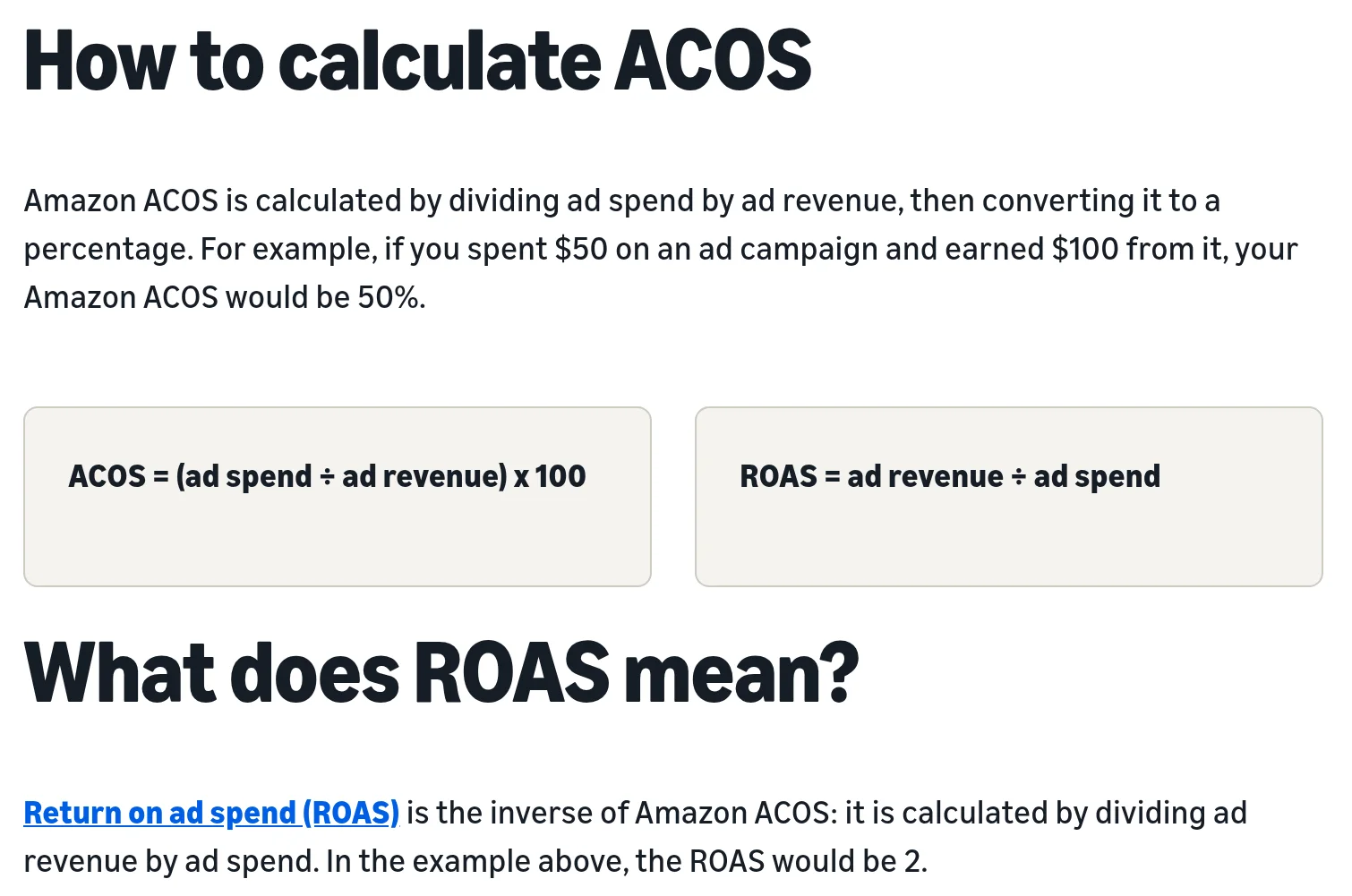
Worked example for one product over a month:
- Ad spend: $500
- Sales attributed to ads: $2,000
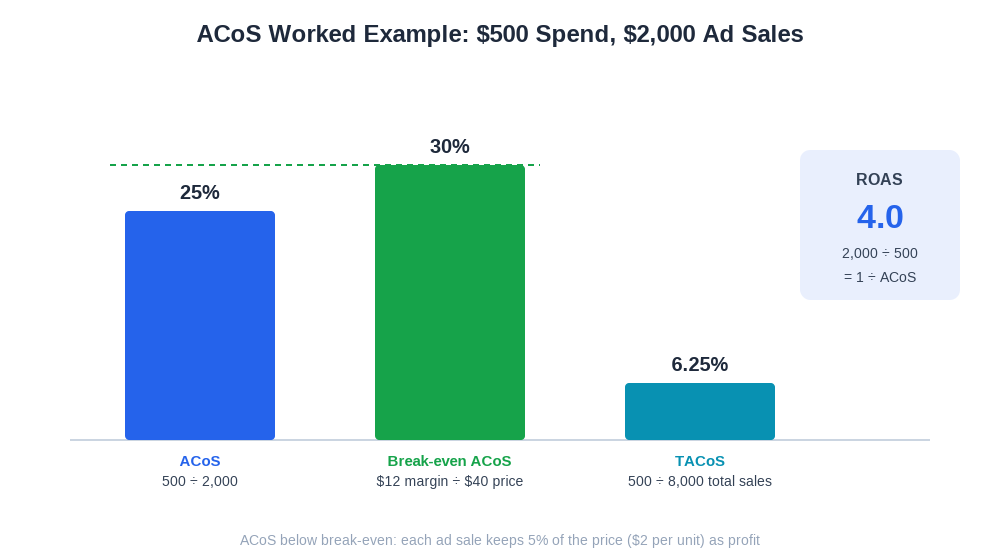
- ACoS: 500 ÷ 2,000 × 100 = 25%
To know whether 25% is good, compare it with your break-even ACoS, which is your profit margin before ad costs:
Break-even ACoS = (Price − all costs except ads) ÷ Price × 100
Say the product sells for $40. After cost of goods, Amazon referral fee, FBA fulfillment fees and other costs, $12 is left before advertising. Break-even ACoS is 12 ÷ 40 = 30%. At 25% ACoS, each ad sale makes 5% of the price, or $2 per unit, in profit. At 35% ACoS, each ad sale loses $2.
Now add total sales. If this product sold $8,000 in total that month, organic plus ads, then TACoS = 500 ÷ 8,000 = 6.25%. TACoS shows how heavily the whole product leans on ads.
ACoS vs ROAS vs TACoS
These three metrics use the same inputs but answer different questions.
| Metric | Formula | Example (from above) | Answers |
|---|---|---|---|
| ACoS | Ad spend ÷ ad sales | 500 ÷ 2,000 = 25% | Are attributed ad sales profitable? |
| ROAS | Ad sales ÷ ad spend | 2,000 ÷ 500 = 4.0 | How many dollars of sales per ad dollar? |
| TACoS | Ad spend ÷ total sales | 500 ÷ 8,000 = 6.25% | How dependent is the business on ads? |
| Break-even ACoS | Pre-ad margin ÷ price | 12 ÷ 40 = 30% | What is the most ACoS can be and still profit? |
ROAS is the inverse of ACoS: ROAS = 1 ÷ ACoS. Google Ads and Meta report ROAS, while Amazon leads with ACoS, so sellers who run all three often convert one to the other. Neither tells you whether the sales were incremental. For that, see true ROAS and incrementality.
What Is a Good ACoS?
There is no universal benchmark, because margin varies so much by category. A useful way to set targets:
- Profit campaigns: target ACoS below break-even, for example 20% when break-even is 30%.
- Launch and ranking campaigns: accept ACoS at or above break-even for a set period to build sales history and reviews.
- Brand defense: branded keywords usually have a low ACoS, so do not let them pull the account average down and hide weak generic campaigns.
Many sellers land somewhere in the 15–35% range overall, but your own break-even matters far more than any average.
A quick way to set bids from ACoS: target bid = target ACoS × average order value × conversion rate. With a 20% target ACoS, a $40 order value and a 10% conversion rate, the most you can pay per click is 0.20 × 40 × 0.10 = $0.80. If a keyword’s conversion rate falls to 5%, the same target allows only $0.40. This is why conversion rate and ACoS move together: improve the listing, and you can afford more per click without raising ACoS.

Stay Updated on AI Visibility Trends
Get the latest insights on AI mentions, brand monitoring, and optimization strategies.
ACoS and AI Search
ACoS only measures paid traffic inside a marketplace. More product research now starts in AI assistants, such as Amazon Rufus, ChatGPT and Perplexity, which recommend products based on listings, reviews and third-party content rather than ad bids. A product that AI answers recommend may need less paid support to sell, which shows up as falling TACoS over time.
Best Practices for ACoS
- Calculate break-even ACoS per product from real costs, including fees, shipping and returns.
- Set target ACoS per campaign goal: profit, launch or brand defense.
- Review the search term report weekly and add negatives for terms that spend without selling.
- Judge ACoS on data at least 7–14 days old, after delayed attributed sales arrive.
- Track TACoS next to ACoS to see whether ads are lifting organic sales.
- Fix listing conversion (images, price, reviews) before cutting bids on good keywords.
Common ACoS Mistakes
The most common mistake is chasing the lowest possible ACoS. Cutting bids until ACoS is tiny usually means you only win clicks on your own brand name, and total sales shrink. A low ACoS with falling total sales is worse than a moderate ACoS with growing sales.
Sellers also use a single target ACoS for the whole catalog, even though margins differ by product. Others ignore fees and returns when they work out break-even, so campaigns that look profitable lose money. Finally, many treat attributed sales as fully caused by ads. Some of those shoppers would have bought anyway, especially on branded searches.