


Payment Gateway
A payment gateway is the technology layer that securely captures, encrypts, and transmits a customer's payment information from an online store to the payment processor and card networks for authorization. It is what allows a shopper to enter a card number or select a wallet at checkout and have that payment approved or declined within seconds.
Definition of Payment Gateway
A payment gateway is the technical infrastructure that securely captures a customer’s payment details at checkout and transmits them, encrypted, to the appropriate payment processor and card network for authorization. It functions as the digital equivalent of a physical card terminal: when a shopper enters a card number or selects a digital wallet, the gateway encrypts that data, sends an authorization request through the banking network, and returns an approved or declined response within seconds. Gateways are a required piece of infrastructure for any store that accepts online payments, and most modern ecommerce platforms (Shopify, WooCommerce, BigCommerce, and custom-built stores alike) integrate with one or more gateway providers such as Stripe, PayPal, Adyen, Braintree, or Authorize.net.
How a Payment Gateway Works
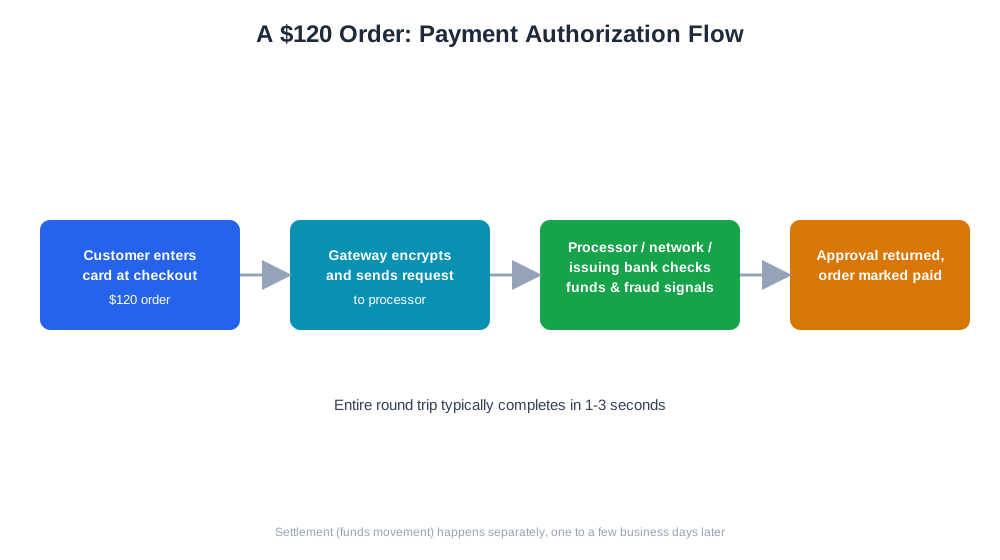
The payment flow through a gateway generally follows a consistent sequence, regardless of which provider is used. First, a customer submits payment details at checkout, which the gateway encrypts before it ever touches the merchant’s own servers — this is central to reducing PCI DSS compliance burden, since raw card data ideally never passes through systems the merchant directly controls. Second, the gateway forwards the encrypted request to the payment processor, which routes it to the relevant card network (Visa, Mastercard, etc.) and ultimately the customer’s issuing bank. Third, the issuing bank checks the account for sufficient funds and fraud signals, then returns an approve or decline decision. Fourth, that decision travels back through the same chain to the gateway, which relays it to the store’s checkout page, typically within one to three seconds end to end.
A concrete example: a customer buys a $120 order and enters their card at checkout. The gateway encrypts the card data and sends an authorization request through the processor to the card network and issuing bank. The bank confirms sufficient funds and no fraud flags, returns an approval, and the gateway tells the store to mark the order as paid — all before the customer’s next page load. Settlement, the actual movement of funds into the merchant’s bank account, usually happens in a batch process one to a few business days later, separate from the real-time authorization step.

Ready to Monitor Your AI Visibility?
Track how AI chatbots mention your brand across ChatGPT, Perplexity, and other platforms.
Why Payment Gateway Choice Matters for E-commerce Brands
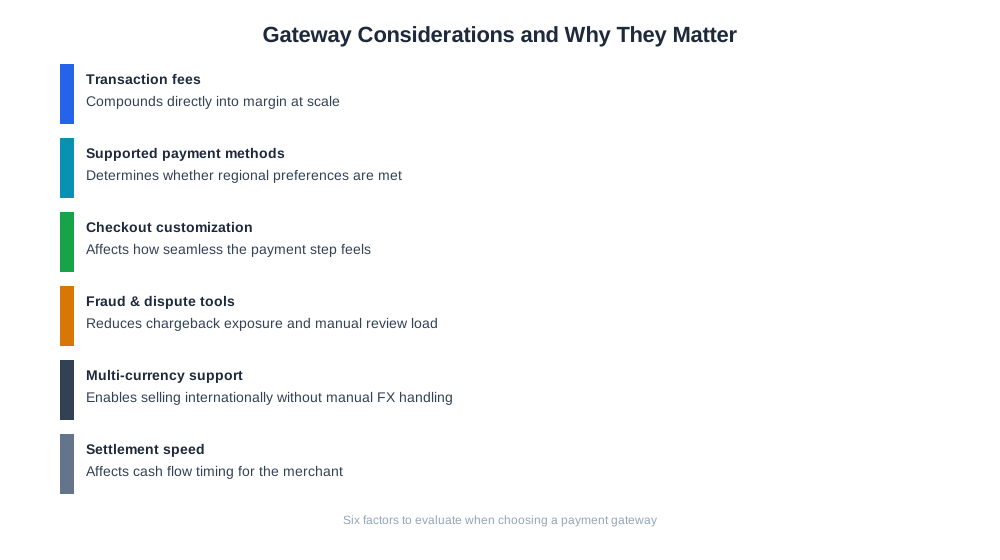
The payment gateway a store uses affects far more than whether transactions clear. Transaction fees compound at scale, so a percentage-point difference in gateway fees can meaningfully change margin on high-volume stores. Supported payment methods determine whether a store can offer the wallets, buy-now-pay-later options, or local payment preferences that a given market expects — a gateway with weak support for a region’s preferred payment method can quietly suppress conversion there even if everything else about the store is well optimized. Checkout speed and reliability also matter directly: a gateway with frequent timeouts or slow authorization responses introduces exactly the kind of last-second friction that causes cart abandonment.
| Consideration | Why It Matters |
|---|---|
| Transaction fees | Compounds directly into margin at scale |
| Supported payment methods | Determines whether local/regional preferences are met |
| Checkout customization | Affects how seamless the payment step feels |
| Fraud and dispute tools | Reduces chargeback exposure and manual review load |
| Multi-currency support | Enables selling internationally without manual FX handling |
| Settlement speed | Affects cash flow timing for the merchant |
Payment Gateway and AI-Driven Commerce
As AI shopping and checkout features like ChatGPT Instant Checkout and agentic commerce flows mature, payment gateways are increasingly being asked to authorize transactions initiated by an AI agent acting on a shopper’s behalf rather than a human manually typing card details into a form. This raises the bar for gateway reliability and API responsiveness, since an AI-mediated purchase flow has less tolerance for a slow or unclear authorization step than a human does. On the reporting side, AmICited’s eshop_list_payment_map tool addresses a more everyday problem: every store platform records payment methods using its own internal strings, which makes it hard to compare payment method mix across stores or over time. By mapping those raw strings into a consistent set of payment kinds, it gives merchants a clean, unified view of how customers actually pay, which is a prerequisite for any deeper analysis of payment method performance or fraud patterns.
Stay Updated on AI Visibility Trends
Get the latest insights on AI mentions, brand monitoring, and optimization strategies.
Best Practices for Payment Gateway Selection
- Compare total cost including per-transaction fees, monthly fees, and any currency conversion markup
- Confirm the gateway supports the payment methods your target markets actually prefer, not just cards
- Test checkout latency under realistic conditions, since a slow authorization response directly costs conversions
- Verify the gateway’s PCI DSS compliance handling to minimize your own compliance burden
- Evaluate built-in fraud detection and dispute management tools rather than building that logic separately
- Consider a secondary gateway for redundancy only once transaction volume justifies the added complexity
Common Payment Gateway Mistakes
A frequent mistake is choosing a gateway based on the lowest advertised transaction fee without checking whether it supports the payment methods a store’s actual customer base prefers, which can suppress conversion in specific regions even as the headline fee looks attractive. Another common issue is under-testing the checkout flow across devices and browsers before launch, only to discover a gateway’s hosted checkout page renders poorly on mobile or times out on slower connections. Some merchants also fail to reconcile gateway settlement reports against their own order records regularly, which delays the discovery of missing payments, duplicate charges, or unexpected fee changes. Relying on a single gateway with no fallback is a real risk at scale — a gateway outage during a peak sales period can halt checkout entirely, which is why larger merchants often maintain a secondary provider even if it adds reconciliation overhead. Finally, treating payment method data as an afterthought rather than an analytics input means many merchants can’t easily answer basic questions about which payment methods their customers actually use, which is exactly the gap tools like AmICited’s payment mapping are built to close.