


Top Brands Mentioned for an AI Prompt
Use the Brand Mentions leaderboard to compare which brands AI engines name for a prompt and their citation share.

For any single prompt, the Brand mentions leaderboard shows exactly who AI engines name when they answer it, and how you stack up against them. It’s the clearest view of your competition for one specific question.
Quick Steps
- The Brand mentions leaderboard ranks every brand named in answers to one prompt, by share and average position.
- Find it in the right-hand panel of the prompt detail page.
- avg #N shows how early a brand typically gets named; a lower number means more prominent placement.
- Find your row, study who ranks above you, and cross-reference with the actual responses for context.
- Track it over time to see whether your position and share are moving after you publish new content.
What is a brand mention leaderboard?
When someone asks ChatGPT, Perplexity, Gemini, or Google AI Overviews a question, the engine doesn’t return ten blue links, it writes an answer, and inside that answer it names specific companies, products, or people. Each time your brand (or a competitor’s) shows up by name in one of those generated answers, that’s a brand mention . A brand mention leaderboard is simply a ranked list of every brand that got named in answers to one specific prompt, ordered by how often each one appears.
This matters because AI answers are not static. The same prompt asked on different days, on different engines, or with slightly different phrasing can surface a different mix of brands. A leaderboard built from many real answers to the same prompt smooths out that noise and reveals a pattern: which companies the AI treats as the default, trustworthy answer to that specific question. That pattern is a proxy for AI search visibility: not just whether you’re mentioned at all, but how you rank against the field for a question that actually matters to your buyers.
Two numbers make a leaderboard useful rather than just a list of names. The first is share: what percentage of all mentions for this prompt belong to each brand. This is a prompt-scoped version of share of voice , the metric used across generative engine optimization to describe how much of the conversation a brand owns relative to its competitors. The second is average citation position: where in the answer a brand typically gets named. Citation position matters because AI answers, like search results, aren’t read with equal attention top to bottom: a brand mentioned first or in the opening sentence is doing more work for that brand than one buried in a closing list of “other options.”
Together, share and position turn a vague sense of “we come up sometimes” into a concrete competitive scoreboard for one question. That’s a very different exercise from watching your overall AI visibility trend, which blends performance across your whole prompt set. A prompt-level leaderboard isolates a single moment of truth: one query, one competitive set, one chance to be the brand the AI recommends.
Where to find it
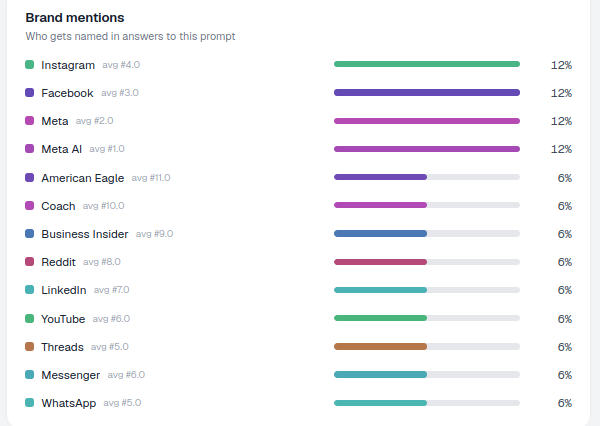
It’s the right-hand panel in the middle of the prompt detail page, headed “Brand mentions: who gets named in answers to this prompt.” You get there from your prompt list or from a chart drill-down: click into any tracked prompt and the leaderboard renders alongside the rest of that prompt’s detail data, scoped only to answers for that exact question.
What it shows
Each row is a brand that appeared in answers to this prompt:
- The brand name, with your own flagged you so it’s easy to spot without hunting through the list.
- avg #N: the brand’s average citation position across the answers it appears in. A brand with avg #1 is consistently named first or foremost when it shows up; a brand with avg #4 is typically an also-mentioned option further down the answer.
- A bar and percentage: how often that brand is named, as a share of all mentions for this prompt. This is calculated across every tracked response to that prompt, not a single snapshot, so it reflects a pattern rather than a one-off result.
The list is ranked by share, so the brands at the top are the ones dominating the AI conversation for this question. Because the leaderboard is prompt-specific, it will look different from one prompt to the next. A brand that dominates “best project management software for startups” might not appear at all on “enterprise resource planning software comparison,” even within the same industry. That’s expected: AI engines match brands to the specific intent behind each question, not to a category as a whole. If you want the mechanics behind how that overall percentage is calculated across a whole prompt set , it’s worth reading alongside this page, since the leaderboard is really that same calculation narrowed to one question.
What it measures
The leaderboard is answering a narrow but high-value question: for this exact prompt, who wins? It isn’t a measure of overall brand strength or general market share. A company can dominate broad, well-known category questions and still lose a specific, high-intent prompt to a narrower competitor who’s better matched to that phrasing. That’s precisely why prompt-level data is worth tracking separately from your aggregate metrics: it shows you where the fight for a particular customer question is actually being won or lost, which is where you can act.
The avg #position figure also does something an overall percentage can’t: it tells you about the quality of a brand’s mentions, not just the quantity. A competitor mentioned in 80% of answers but almost always as the third or fourth name listed is vulnerable; they haven’t secured the top spot the AI reaches for first. A brand mentioned in only 40% of answers but always first is punching above its mention rate. Reading share and position together, rather than either alone, is what turns this table into a genuine competitive read, the same reasoning brand teams use when they want to own how AI describes their company rather than just show up as one name among many.
How to use it
- Find your row. How far down the list is your brand, and what’s the gap to the leaders? If you’re not in the list at all, that prompt is a clean visibility gap: a real question your buyers are asking that AI engines currently answer without you.
- Study who’s above you. These are the brands AI engines currently trust for this question, worth understanding what content, structure, or third-party coverage makes them citable. Their citation pattern for this specific prompt is a reasonable proxy for what “correct” looks like in the AI’s eyes for that query.
- Cross-reference with the responses. Scroll to Latest responses by provider to read the actual answers and see the context in which the top brands get named: the surrounding sentence, the comparison being drawn, and whether the mention is a recommendation, a passing reference, or a warning.
- Track it over time. A leaderboard captured once is a snapshot; the same panel checked weekly becomes a trend. Watching your position and share move (or stay flat) after you publish new content or earn new coverage tells you whether your GEO work for that specific question is actually landing.
- Prioritize by prompt value, not just gap size. A prompt where you’re absent but that reflects low buying intent is worth less than one where you’re a distant fourth on a question your ideal customer asks right before they buy. Weigh the leaderboard against how commercially important the underlying prompt is before deciding where to invest.
This prompt-level view complements the site-wide Brand voice chart: use Brand voice to see the overall landscape, and this leaderboard to win specific, high-value questions. If you’re not yet sure which prompts are worth building leaderboards for in the first place, it helps to work backwards from your existing prompt set and figure out which prompts actually trigger a brand mention for you today, versus which ones are pure blind spots.
Where to go next
Once you’ve read a handful of these leaderboards, a pattern usually emerges: the same three or four competitors keep showing up at the top across your most important prompts, often with tighter avg #position numbers than you’d expect. That’s worth investigating properly rather than prompt by prompt. A broader look at how to track competitor AI mentions across your whole prompt set will tell you whether a rival’s strength is concentrated in one topic or spread evenly across your category. From there, the practical next step is deciding which of the gaps this leaderboard exposes are worth closing first, and pairing that prioritization with AmICited’s AI rank tracker so you can watch your citation position move on the prompts that matter most, not just check in on them manually every so often.
Frequently asked questions
It's a ranked list, in the right-hand panel of a prompt's detail page, of every brand named in answers to that one specific question, ordered by share of mentions. Each row shows the brand's average citation position (avg #N) alongside its share, scoped only to that prompt rather than your whole account.
Avg #N is a brand's average citation position across the answers it appears in: how early it typically gets named. A brand at avg #1 is consistently named first or foremost, while avg #4 means it's usually an also-mentioned option further down. A lower number means more prominent placement, which can matter more than raw mention share.
Share is what percentage of all mentions for this prompt belong to each brand, showing how often they're named. Average position shows where in the answer they typically appear. A competitor named in most answers but usually third or fourth is more vulnerable than a brand named less often but consistently first, so read both together, not either alone.
Absence means that prompt is a clean visibility gap: a real question your buyers ask that AI engines currently answer without you. Study the brands ranked above you to see what content or third-party coverage makes them citable, then weigh how commercially important that specific prompt is before prioritizing it for content or GEO work.
More tutorials in this section
 How to Use the Fan-Out Queries Heatmap
Explore related fan-out queries for a prompt and see how well cited pages match them in AmICited’s heatmap.
Read guide →
How to Use the Fan-Out Queries Heatmap
Explore related fan-out queries for a prompt and see how well cited pages match them in AmICited’s heatmap.
Read guide →
 How to Use the Semantic Scatter Map
Explore the AI semantic scatter map to compare prompts, fan-out queries, cited URLs and your page content.
Read guide →
How to Use the Semantic Scatter Map
Explore the AI semantic scatter map to compare prompts, fan-out queries, cited URLs and your page content.
Read guide →
 Read AI Responses to a Tracked Prompt
Read the latest AI response for a tracked prompt, including the brands and sources detected by AmICited.
Read guide →
Read AI Responses to a Tracked Prompt
Read the latest AI response for a tracked prompt, including the brands and sources detected by AmICited.
Read guide →Ready to put it into practice?
Free check · 7-day trial · card required