


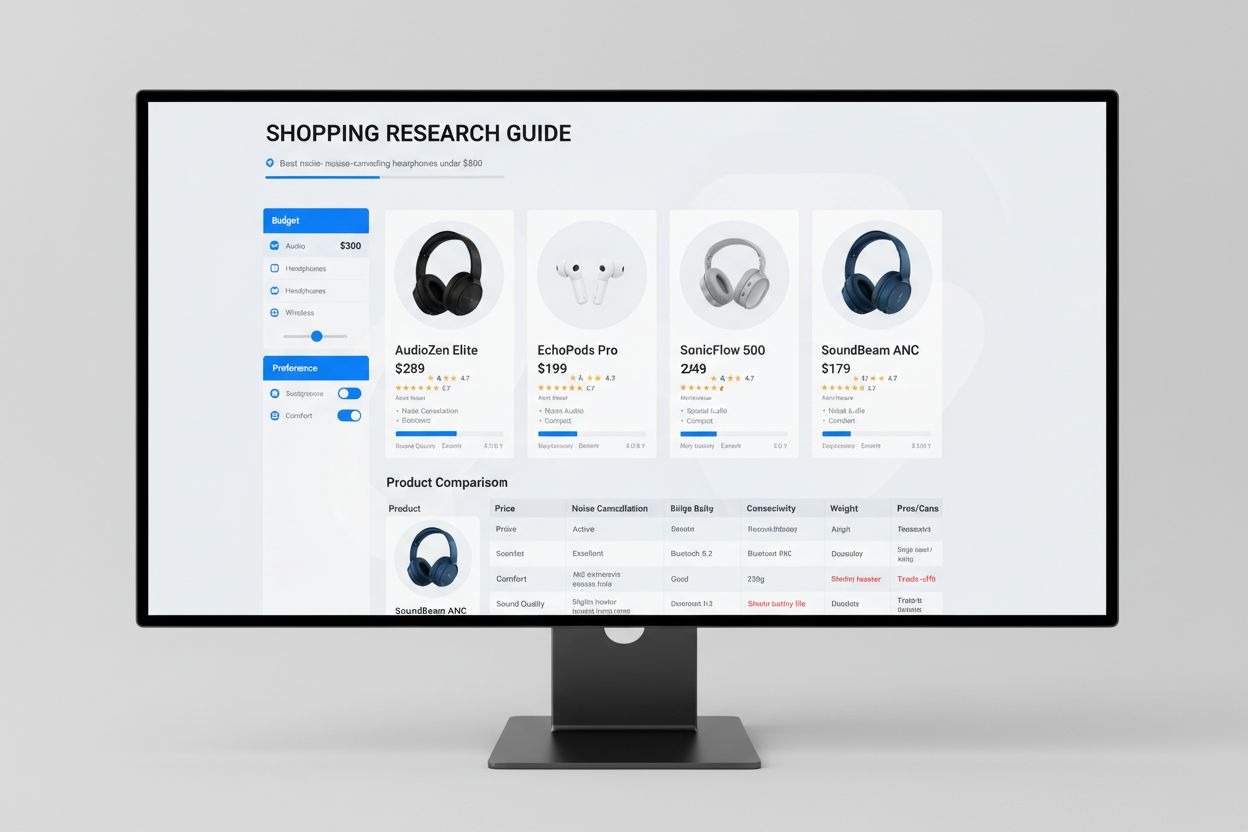
ChatGPT Shopping Research
Learn how ChatGPT Shopping Research helps you compare products, find deals, and make smarter purchase decisions with AI-powered recommendations and instant chec...
8 min read
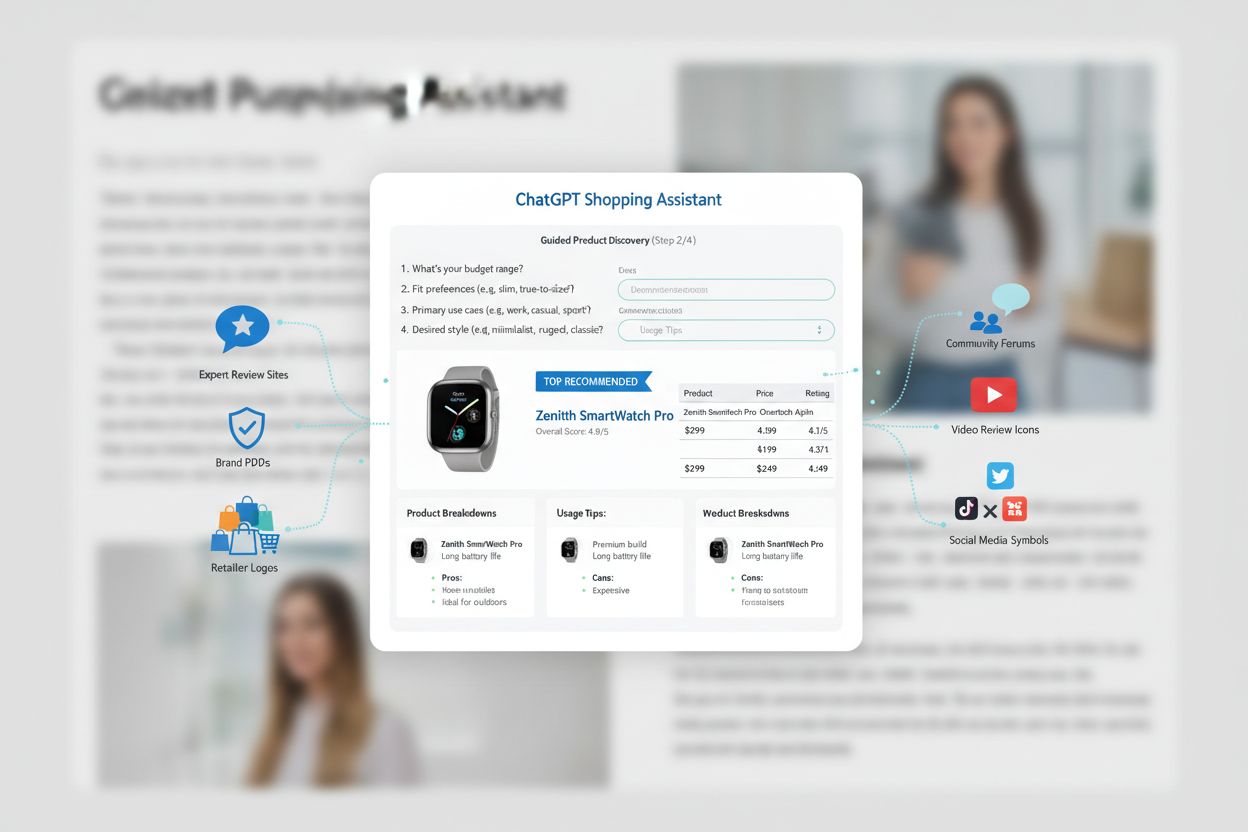
ChatGPT’s Shopping Research wizard asks guided questions, cites 100+ sources, and uses memory to personalize results. Learn how it works and what brands must change to stay visible.
ChatGPT’s new Shopping Research experience fundamentally transforms how consumers discover and evaluate products online. Unlike traditional search engines that return a list of links, ChatGPT now pulls shoppers into a guided, wizard-style discovery flow that gathers parameters before showing any recommendations. This isn’t casual chatting with an AI—it’s a structured, visual shopping analyst that asks clarifying questions about fit, use case, budget, support level, and style before delivering personalized results. The result is a dramatic long-tail expansion, expanded citation graphs, and a highly personalized product universe shaped by memory, persona, and context. This guide assumes ChatGPT can already find and crawl your product pages — if you still need to cover that ground, our technical guide to getting featured in ChatGPT’s buyer’s guides walks through crawler access, schema markup, and trust signals. Here, we focus specifically on what changes once the guided wizard itself enters the picture.
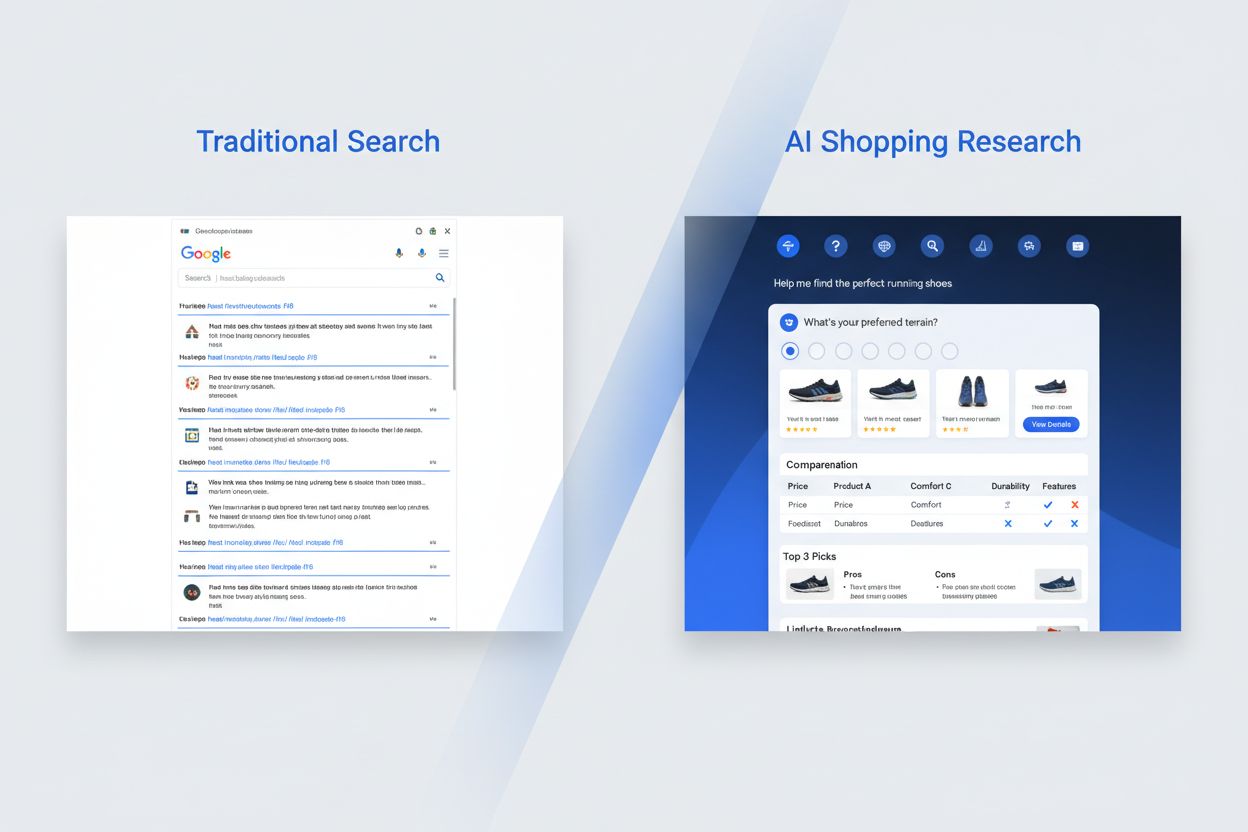
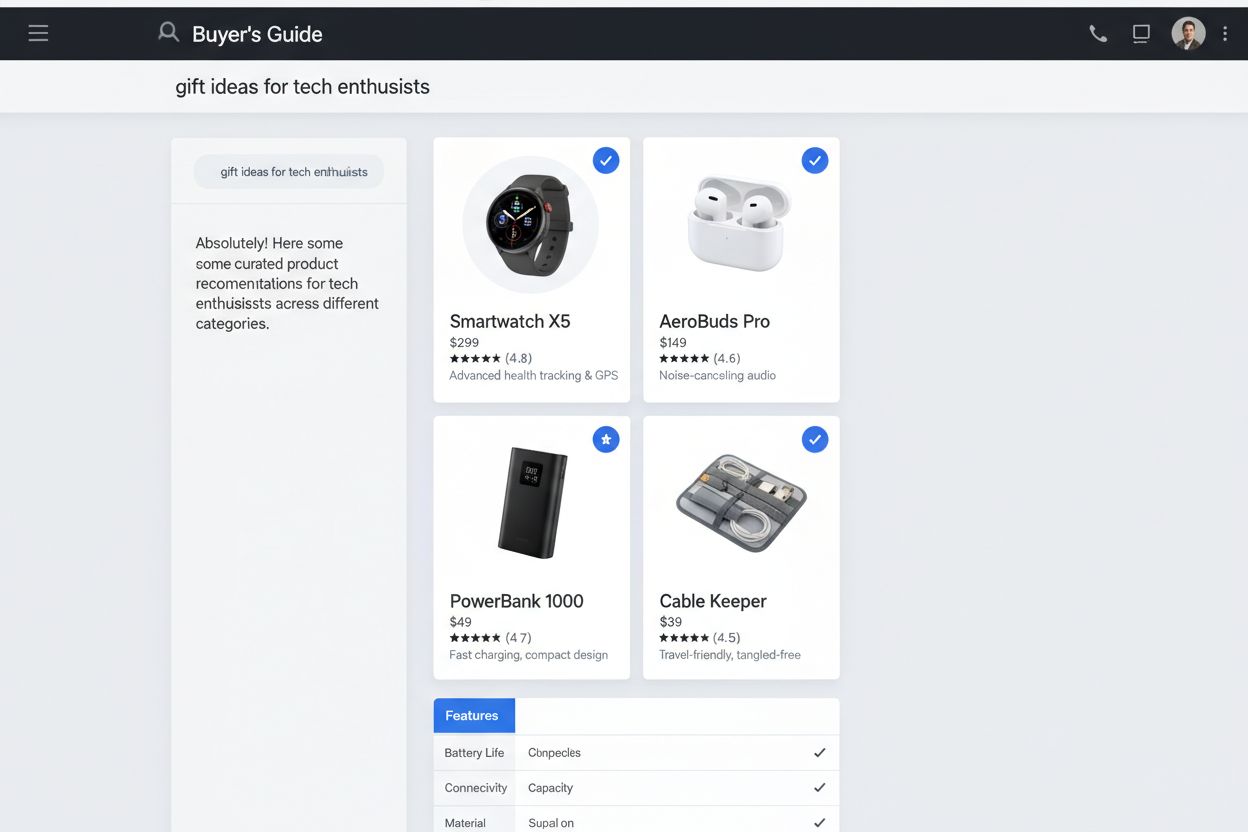
The Shopping Research experience operates through a structured, multi-stage process that fundamentally differs from how ChatGPT handles regular product questions. When a shopper asks a product-related question, the interface transforms into a questionnaire that guides them through fit, use case, budget, support level, and style preferences—essentially acting like a trained shopping specialist. Once parameters are collected, ChatGPT delivers results in a unified research environment that includes a hero image of the top recommended product, a comprehensive comparison table showing the entire recommended lineup side-by-side, and listicle-style product breakdowns with pros, cons, usage tips, and citations. Each recommendation is evidence-backed, drawing from expert testers, brand product pages, editorial reviews, forums, long-form video reviews, and community discussions. The comparison table makes tradeoffs explicit, helping shoppers understand why one product might be better for their specific needs than another. This structured approach creates a dramatically different product universe than traditional ChatGPT responses, as demonstrated in testing where the same question generated entirely different recommendations across three modes.
| Feature | Traditional ChatGPT | Shopping Research | Parameter-Rich Prompt |
|---|---|---|---|
| Recommendations | ~8 broad models | ~6 targeted options | ~10 niche models |
| Citations | 8-12 sources | 100+ sources | ~38 sources |
| Personalization | Minimal | High (guided) | Medium (parameter-based) |
| Product Universe | Generalist | Stability-focused | Performance-testing focused |
| User Experience | Free-form chat | Structured wizard | Parameter-driven |

Track how AI chatbots mention your brand across ChatGPT, Perplexity, and other platforms.
One of the most significant changes in ChatGPT’s Shopping Research is the dramatic expansion in citation sources—jumping from approximately 10-12 sources in traditional ChatGPT to over 100 sources in the Shopping Research mode. This citation explosion fundamentally reshapes how brands are discovered and described within AI systems. ChatGPT now draws from a vastly broader ecosystem of voices:
With this expanded citation footprint, brands gain more paths to appear in recommendations, but the narratives become more fragmented and harder to control. Your brand’s story is no longer anchored to your product page or a handful of authoritative reviews—it’s now distributed across an entire network of external domains. This means off-site content quality becomes critical. If expert reviewers, community forums, and social media creators are describing your product inconsistently or inaccurately, ChatGPT synthesizes these conflicting narratives into its recommendations. Brands without visibility into how they’re being described across these diverse sources are essentially flying blind.
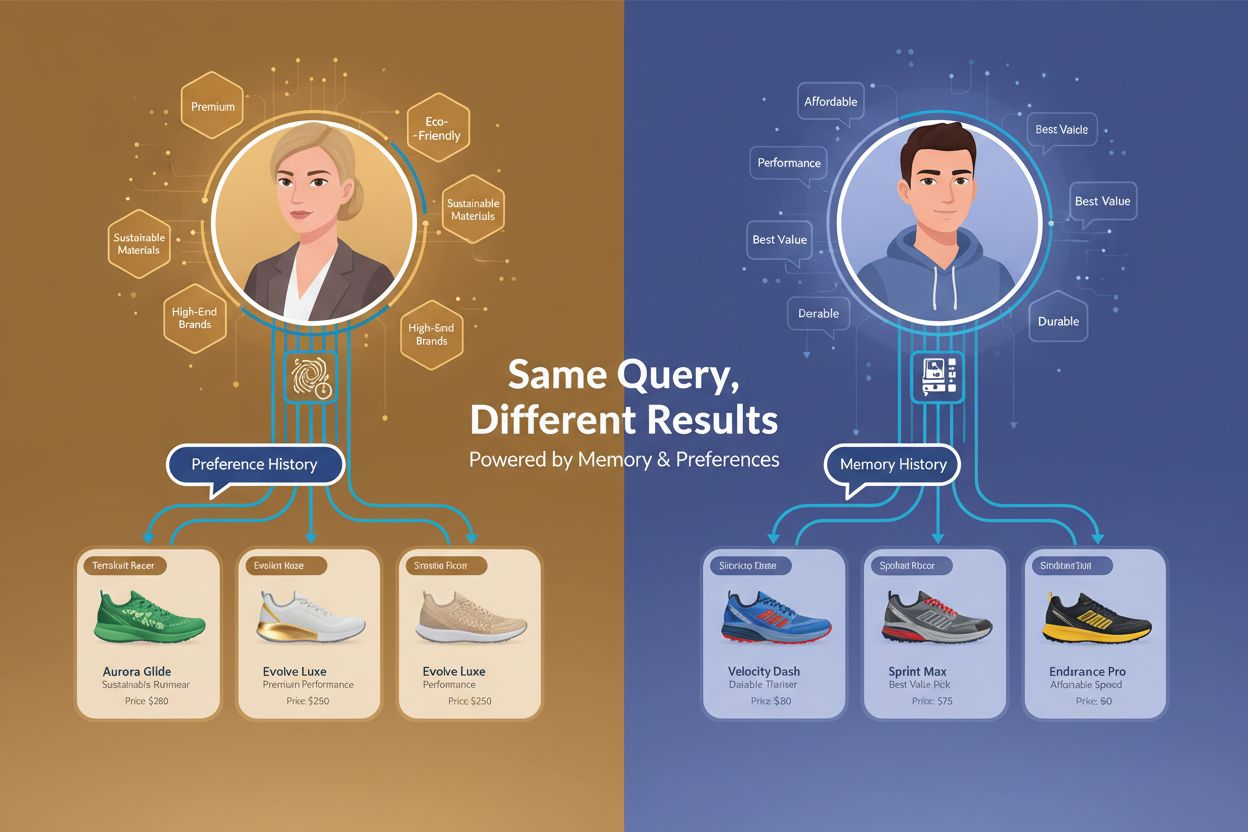
ChatGPT’s memory feature introduces a new class of ranking factor that traditional search engines don’t have: persistent personal preference. When a shopper enables memory, ChatGPT remembers their preferences from previous conversations and uses that history to shape future recommendations. In testing, when a user previously indicated a preference for pink basketball shoes, ChatGPT’s Shopping Research mode immediately asked whether color matters in a subsequent session—without the user mentioning it—and recommended a pink model first. This demonstrates that memory influences which questions are asked and which attributes are prioritized before any results are shown. Two shoppers with identical queries can receive fundamentally different recommendations, not due to intent or parameters, but due to their personal history stored in ChatGPT’s memory. This creates what we might call individualized visibility—your brand may be highly present for one memory profile and completely absent for another.
Get the latest insights on AI mentions, brand monitoring, and optimization strategies.
ChatGPT’s Shopping Research actively guides shoppers into long-tail questions in ways that traditional search never did. Historically, long-tail visibility depended on whether users naturally knew how to ask detailed questions or whether ChatGPT prompted clarifying questions after showing initial results. The new Shopping Research flow flips this entirely—the assistant now collects long-tail parameters before showing any results, structuring the decision space upfront and prompting shoppers into deeper, narrower needs by default. This has the strongest impact at the top-of-funnel discovery phase, where shoppers are exploring rather than deciding. For brands, this represents a powerful opportunity: if your product excels in specific attributes like ankle stability, cushioning profile, foot shape compatibility, or surface suitability, you can win dozens of micro-intents the shopper may not have articulated on their own. The long tail becomes not just a discovery surface, but a guided path shaped by ChatGPT itself. Brands that align their product attributes, descriptions, and content with the specific parameters ChatGPT asks about will see dramatically increased visibility. However, brands without AEO visibility tools have no way to track or influence these new surfaces—they’re essentially operating without data about which micro-intents are emerging or how their products are being positioned.
Winning in ChatGPT’s Shopping Research requires a fundamentally different optimization approach than getting crawled in the first place. First, align your product attributes with what the wizard asks about. If the assistant asks about fit, cushioning, material, surface compatibility, and style, your product data should explicitly address each of these attributes, not just describe the product in general terms. Second, ensure your product data is complete and accurate across all channels—your website, product feeds, retailer listings, and any other platforms where your products appear. Inconsistencies between these sources confuse the wizard and reduce your visibility. Third, build authority on the sources Shopping Research actually cites—expert testers, editorial publications, community forums, and video reviews. Since recommendations now draw from 100+ sources instead of your product page alone, being well-documented off-site matters as much as your own content. Fourth, focus on specific product attributes and benefits rather than generic marketing language; Shopping Research is attribute-driven, so detailed specifications, materials, dimensions, and use-case suitability matter more than brand storytelling. Finally, maintain consistent messaging across all sources—your PDP, retailer listings, reviews, and social content should tell a coherent story about what your product is and who it’s for. (For the underlying technical work of making sure ChatGPT can access and parse your pages at all — robots.txt, schema markup, review generation — see our guide to getting featured in ChatGPT’s buyer’s guides .) Tools like AmICited.com help brands monitor exactly how ChatGPT, Perplexity, and Google AI Overviews are perceiving and recommending their products, providing the visibility needed to optimize strategically.
OpenAI’s Agentic Commerce Protocol (ACP) represents a fundamental shift in how AI systems discover and rank products. Unlike Google, which relies on crawling, links, and page-level signals, ChatGPT takes a different approach: the feed isn’t just another signal—it’s a primary authority on your brand and products. Price, stock, and product attributes supplied by you directly shape visibility. Your data is now both the input and the signal of differentiation. The ChatGPT Product Feed Specification requires merchants to supply structured product data via TSV, CSV, XML, or JSON files, refreshed as often as every 15 minutes. Required attributes include product ID, title, description, price, availability, and weight—without these, your products may be disqualified from search or checkout. Beyond the basics, optional fields create differentiation opportunities: performance signals like popularity score, return rate, and review count; rich media including video and 3D models; custom variants that go beyond color and size to match intent-heavy queries like “mahogany desk, 48 inches wide”; and geo-targeting for region-specific pricing and availability. Feed freshness is critical—stale pricing or stock information will hurt visibility. Consistency across your feed, website, and policies is required; discrepancies signal unreliability to ChatGPT’s ranking systems. Treat your product feed as a strategic marketing asset, not just a technical requirement. Success depends on how completely and clearly your data reflects what buyers ask for in natural conversation with ChatGPT.
The challenge with ChatGPT’s Shopping Research is that brands need insight into exactly what AI thinks of their brand, but AI models are inherently unpredictable. The same prompt can generate different recommendations depending on memory profile, session context, and model updates. This unpredictability makes monitoring essential — not traffic monitoring, but perception monitoring: understanding which specific product attributes drive recommendations, where you fall short against competitors, and how your positioning changes over time. Source authority matters significantly—ChatGPT draws from what it considers “high-quality sources” to build shopping guides, meaning brands must ensure their content appears on the influential domains and URLs that the wizard prioritizes. Comprehensive monitoring reveals patterns in how AI systems think about your brand versus competitors. Rather than guessing what matters, brands can see exactly which gaps exist between their positioning and what AI models value most. Tools like AmICited.com run 1 million+ monthly prompts per brand across all major AI models—ChatGPT, Claude, Gemini, and Google AI Overviews—to establish statistical significance and reveal how AI perception shifts over time. This data-driven approach transforms AI visibility from a guessing game into a measurable, optimizable channel.
Taking action now positions your brand ahead of competitors who are still waiting to see if they’re being recommended. Start by auditing your current product data to identify missing attributes, inconsistencies, and gaps. Determine what attributes may be missing, such as material, sizes, variants, and specific use-case details. Create rich media beyond static images—plan for product videos and 3D files that help shoppers visualize products in the Shopping Research interface. Organize and collect product reviews so you can supply review counts and ratings to your product feed; review velocity and sentiment will carry weight in ChatGPT’s ranking systems. Write thorough titles and descriptions that think like a user asking ChatGPT, not like traditional SEO. Include the specific attributes and use cases that matter to your target buyers. Align feed data with your website schema to ensure consistency; structured markup on your site should match the data you supply to ChatGPT’s feed. Finally, plan refresh cycles for pricing and stock information—out-of-date data will hurt visibility and customer trust. These aren’t just tasks for developers; SEO and marketing teams should own the story of how products are described, categorized, and trusted in conversational search.
ChatGPT’s Shopping Research marks one of the largest shifts in AI-assisted product discovery since ChatGPT launched. AI visibility directly impacts revenue, not just awareness—the platforms consumers trust for recommendations are increasingly AI-powered, and those AI models are learning from the content brands publish, the reviews customers write, and the sources they consider authoritative. Visibility is no longer anchored to a single product page or a single answer; it’s shaped by guided long-tail questions, personalized memory profiles, expanded citation surfaces, and the evolving context of each conversation. This combinatorial nature is precisely what makes modern Generative Engine Optimization (GEO) fundamentally different from traditional SEO. Brands that act now—auditing their data, optimizing their feeds, building authority on influential sources, and monitoring their AI visibility—will be best positioned as AI systems become the starting point for shopping. The discipline of AEO becomes the practice that helps brands understand and shape their presence across this new landscape of fluid, contextual, personalized AI answers.
Viktor Zeman is a co-owner of QualityUnit. Even after 20 years of leading the company, he remains primarily a software engineer, specializing in AI, programmatic SEO, and backend development. He has contributed to numerous projects, including LiveAgent, PostAffiliatePro, FlowHunt, UrlsLab, and many others.

Understand how ChatGPT, Perplexity, and Google AI Overviews reference your brand. Track changes in real-time and optimize your presence in AI-powered shopping.
Learn how ChatGPT Shopping Research helps you compare products, find deals, and make smarter purchase decisions with AI-powered recommendations and instant chec...
A technical guide to getting your products featured in ChatGPT's buyer's guides: crawler access, robots.txt, schema markup, trust signals, and how to measure th...

Explore how ChatGPT Shopping transforms product discovery through conversational AI. Learn the technology, process, benefits for consumers and merchants, and op...
Cookie Consent
We use cookies to enhance your browsing experience and analyze our traffic. See our privacy policy.