


Buy Now Pay Later
Buy Now Pay Later (BNPL) is a point-of-sale financing option that lets shoppers split a purchase into several smaller payments, often interest-free, instead of paying the full amount upfront. Providers like Klarna, Afterpay, and Affirm front the merchant the full sale amount and collect installments directly from the customer, taking on most of the repayment risk in exchange for a merchant fee.
Definition of Buy Now Pay Later
Buy Now Pay Later (BNPL) is a short-term financing option offered at the point of sale that lets a shopper receive their order immediately while paying for it in installments over time, most commonly split into four equal payments every two weeks, or spread over several months for larger purchases. Popularized by providers like Klarna, Afterpay, Affirm, PayPal Pay in 4, and Sezzle, BNPL sits alongside credit cards, debit cards, and digital wallets as a checkout payment method. The distinguishing feature is who takes on the risk: the BNPL provider pays the merchant the full order value upfront and then manages collecting installments from the customer, absorbing most of the default risk itself. For shoppers, BNPL turns a $200 purchase into four $50 payments, often with no interest if paid on schedule. For merchants, it functions like accepting a slightly more expensive card payment in exchange for a completed sale that might not have happened otherwise.
How Buy Now Pay Later Works
The mechanics are consistent across most providers, even though installment schedules and underwriting differ. At checkout, the shopper selects the BNPL option instead of a card. The provider runs a quick approval check, often a soft credit inquiry that does not affect the shopper’s credit score, and returns an instant decision. If approved, the shopper commits to the installment schedule and completes the order. Behind the scenes, the merchant is paid the order total minus a transaction fee, typically within one to three business days, exactly as if a card had cleared. The BNPL provider then owns the job of billing the customer’s linked card or bank account for each remaining installment, including handling missed payments, late fees, and collections.
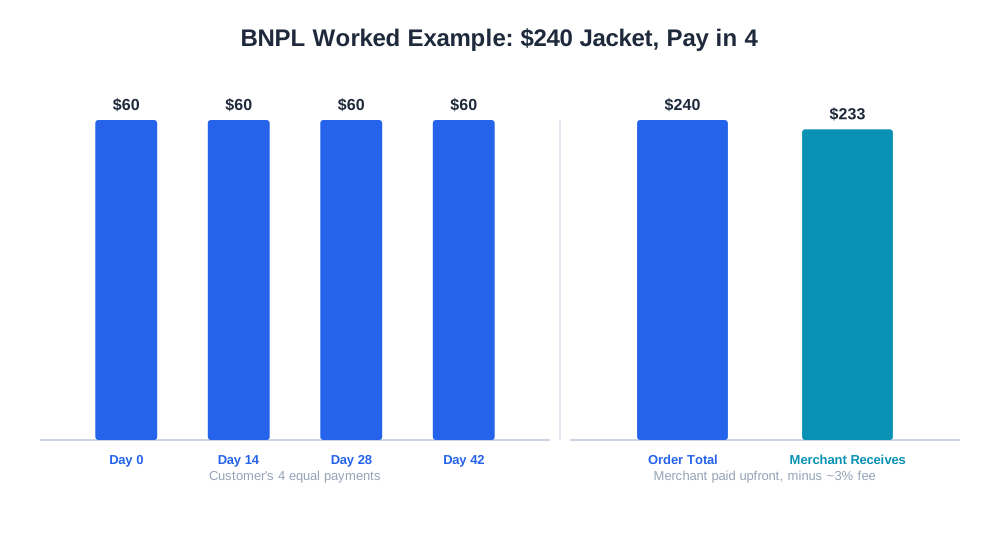
A worked example: a customer buys a $240 jacket using a “Pay in 4” plan. The merchant receives roughly $233 after a hypothetical 3% BNPL fee, deposited within a day or two. The customer pays $60 at checkout and three more $60 installments every two weeks. If the customer misses a payment, that is the provider’s collections problem, not the merchant’s; the merchant already has its money and the order has already shipped.

Ready to Monitor Your AI Visibility?
Track how AI chatbots mention your brand across ChatGPT, Perplexity, and other platforms.
Why BNPL Matters for E-commerce Brands
BNPL has become a standard checkout option because it changes purchase psychology at the margin. Splitting a price into smaller increments lowers the perceived commitment of a purchase, which can pull forward sales that a shopper would otherwise abandon or postpone. Merchants that add BNPL commonly see a lift in average order value, particularly on considered-purchase categories like furniture, electronics, and apparel, where a $300 item feels more attainable framed as four $75 payments. BNPL can also widen the addressable customer base to shoppers who prefer not to use revolving credit cards, and it can reduce cart abandonment among price-sensitive segments who were stalling at the payment step specifically because of sticker shock.
The tradeoff is cost and mix. BNPL transaction fees run higher than standard card processing, so the lift in order value and conversion has to outweigh the extra fee percentage to be worth it. Some categories, especially discretionary fashion, also see a higher share of BNPL orders returned, since the low upfront commitment that helps close the sale can also make impulse purchases and over-ordering (buying multiple sizes to keep one) more common.
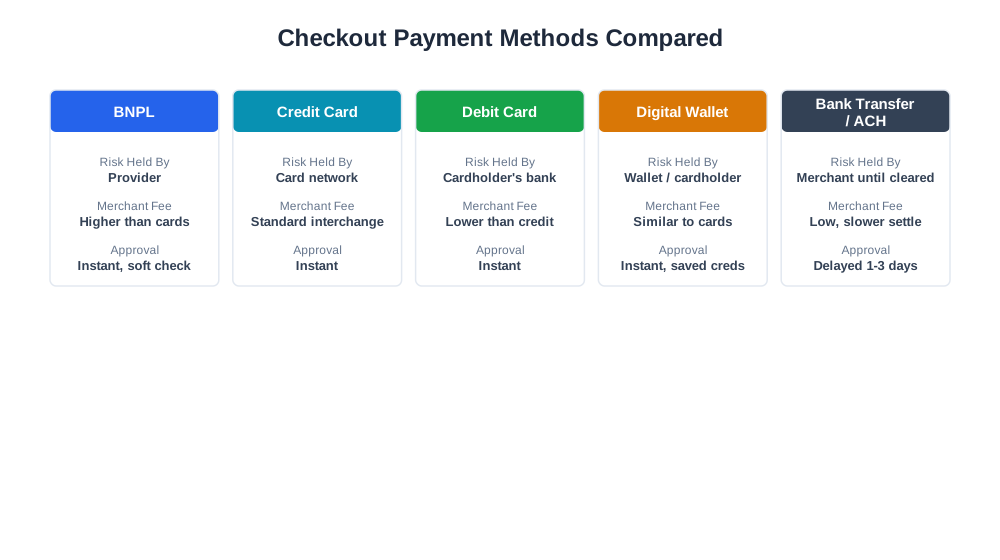
Comparison Table: BNPL vs. Other Checkout Payment Methods
| Method | Risk Held By | Merchant Fee | Approval Speed | Typical Use Case |
|---|---|---|---|---|
| BNPL (Klarna, Afterpay, Affirm) | Provider | Higher than cards | Instant, soft check | Considered purchases, higher AOV items |
| Credit Card | Card network / issuer | Standard interchange | Instant | General-purpose, all order sizes |
| Debit Card | Cardholder’s bank balance | Lower than credit | Instant | Budget-conscious shoppers |
| Digital Wallet (Apple Pay, PayPal) | Wallet provider / cardholder | Similar to cards | Instant, saved credentials | Low-friction repeat checkout |
| Bank Transfer / ACH | Merchant (until cleared) | Low, but slower settlement | Delayed (1-3 days) | Larger B2B or wholesale orders |
Stay Updated on AI Visibility Trends
Get the latest insights on AI mentions, brand monitoring, and optimization strategies.
BNPL and AI-Driven Commerce
As AI shopping assistants like ChatGPT Shopping, Perplexity Shopping, and Amazon Rufus surface product recommendations and comparisons, payment flexibility is increasingly part of what gets compared alongside price and shipping speed. A shopper asking an AI assistant to compare two similarly priced products may see installment availability mentioned as a differentiator, particularly for higher-ticket categories where BNPL adoption is highest. Merchants who expose BNPL availability clearly in product feeds and structured data give both AI assistants and traditional search a more complete picture of the true cost of ownership, which can influence which option gets recommended.
On the analytics side, AmICited’s eshop_get_order_mix reporting can break down orders by payment method, making it possible to see whether BNPL checkouts convert at a different rate than card checkouts, whether they carry a higher or lower average order value, and how their return rate compares. That visibility matters because a BNPL fee that looks expensive in isolation can still be a net win once the incremental conversion and order value lift are accounted for, or a net loss if the category’s return rate erases the gain.
Best Practices for Buy Now Pay Later
- Offer BNPL prominently on product and cart pages, not just at the final checkout step, since seeing the installment price early is what changes purchase intent
- Compare BNPL fee costs against the incremental conversion and average order value lift by category rather than assuming a uniform benefit store-wide
- Track return rates on BNPL orders separately from card orders to catch categories where the payment method is enabling over-ordering
- Make sure BNPL eligibility and installment amounts are reflected in product feeds so price-comparison and AI shopping tools display accurate total-cost information
- Keep refund and chargeback workflows aligned with each BNPL provider’s own return-handling rules, since a returned BNPL order needs to be reconciled with the provider, not just refunded to the customer directly
Common Buy Now Pay Later Mistakes
A common mistake is adding BNPL and evaluating it only by the fee line item, without measuring the conversion and AOV lift it produces; a merchant that looks at the extra processing cost in isolation will often conclude BNPL is not worth it, when the full picture including recovered sales tells a different story. Another frequent issue is applying BNPL uniformly across all product categories rather than promoting it selectively; low-ticket impulse items rarely benefit from installment framing and simply absorb the higher fee for no behavioral change. Some merchants also fail to reconcile BNPL settlement timing correctly in their accounting, treating the provider’s payout as identical to a card settlement when fee structures, hold periods, and refund mechanics differ enough to distort margin reporting if lumped together. A further pitfall is ignoring the return-rate signal by payment method: if BNPL orders are returned meaningfully more than card orders in a given category, the true net margin on those sales can be lower than it appears until returns are netted out. Finally, some stores surface BNPL messaging inconsistently between the product page and checkout, which undermines the psychological benefit entirely, since a shopper who commits mentally to a purchase assuming installments are available and then doesn’t see the option at checkout is more likely to abandon than one who never expected it.