


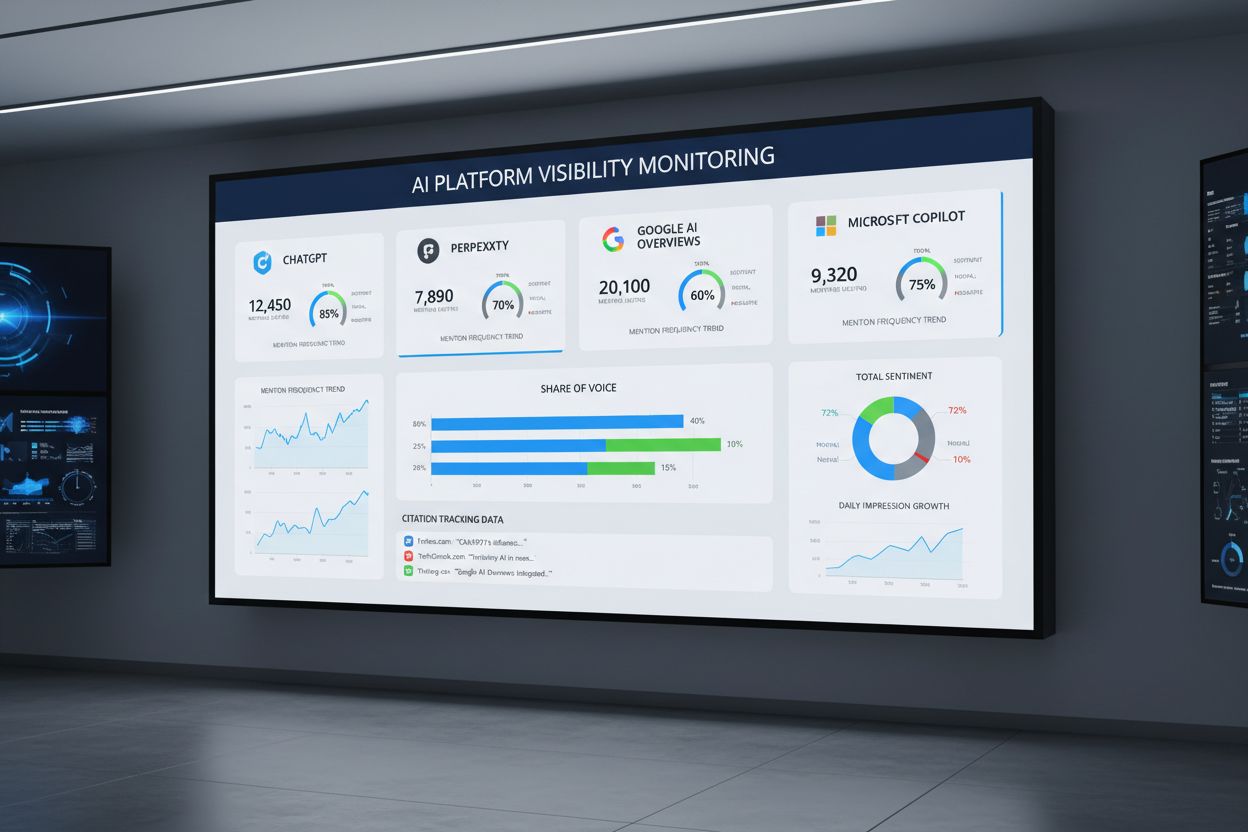
How to Choose an AI Visibility Monitoring Platform
Compare AI visibility monitoring platforms by features, pricing and support for ChatGPT, Perplexity and Google AI.
10 min read

Compare free and paid AI visibility checkers by use case, plan limits, and verified 2026 pricing.
An AI visibility checker answers one question: when someone asks ChatGPT, Perplexity, Gemini or Google’s AI Overviews about your category, does your brand get named? Several good ones are free, take about sixty seconds, and need no account. The catch is that every free AI visibility checker gives you a snapshot, and a snapshot of a system that produces a different answer every time it runs is worth less than it looks.
This page does three things: tells you which tier to pick for your situation, shows what free checkers are genuinely good at and what paid platforms are genuinely good at, and gives you the real September 2026 prices with the pricing pages screenshotted as evidence. If you would rather run a check before reading about them, the free AI Brand Visibility Report I work on asks ChatGPT, Gemini, Perplexity and DeepSeek about your brand and scores every answer in about a minute.
Find your row. The rest of the page is the reasoning behind it.
| Your situation | Pick | Why | Cost |
|---|---|---|---|
| You have never checked | Free checker | You are answering “do I have a problem”, and that needs one run, not a subscription | EUR 0 |
| You checked, you are absent, you have not published anything yet | Free checker, monthly | Nothing to measure yet. Re-check by hand until you have shipped changes worth measuring | EUR 0 |
| You are publishing against the gaps and need a before and after | Entry-level paid | A snapshot cannot show movement, and movement is the only proof your work landed | EUR 29 to 120 |
| You track more than roughly 30 prompts | Entry-level paid | Past 30, re-running checks by hand costs more in time than the subscription costs in money | EUR 29 to 120 |
| You need to know within a day that a competitor displaced you | Entry-level paid | Alerting. Free tools tell you when you remember to look | EUR 29 to 120 |
| Several domains or brands, or client reporting | Mid-tier paid | Multi-domain and white-label are where entry tiers break | EUR 120 to 425 |
| API access, SSO, more than five engines, procurement | Enterprise | You are buying data access and contract terms, not features | EUR 500+ or quote |
The single decision rule, if you only remember one line: if you are asking whether you have an AI visibility problem, a free checker answers it today. If you are trying to fix one, a snapshot cannot tell you whether anything you did worked, and that is the entire thing you are paying for.
Free checkers are not crippled demos. They do four jobs properly, and for those four jobs paying more buys you nothing.
1. Telling you whether you exist in AI answers at all. This is a yes or no question and a free tool answers it in a minute. If four engines all fail to name you in your own category, you have your answer and you did not spend anything to get it.
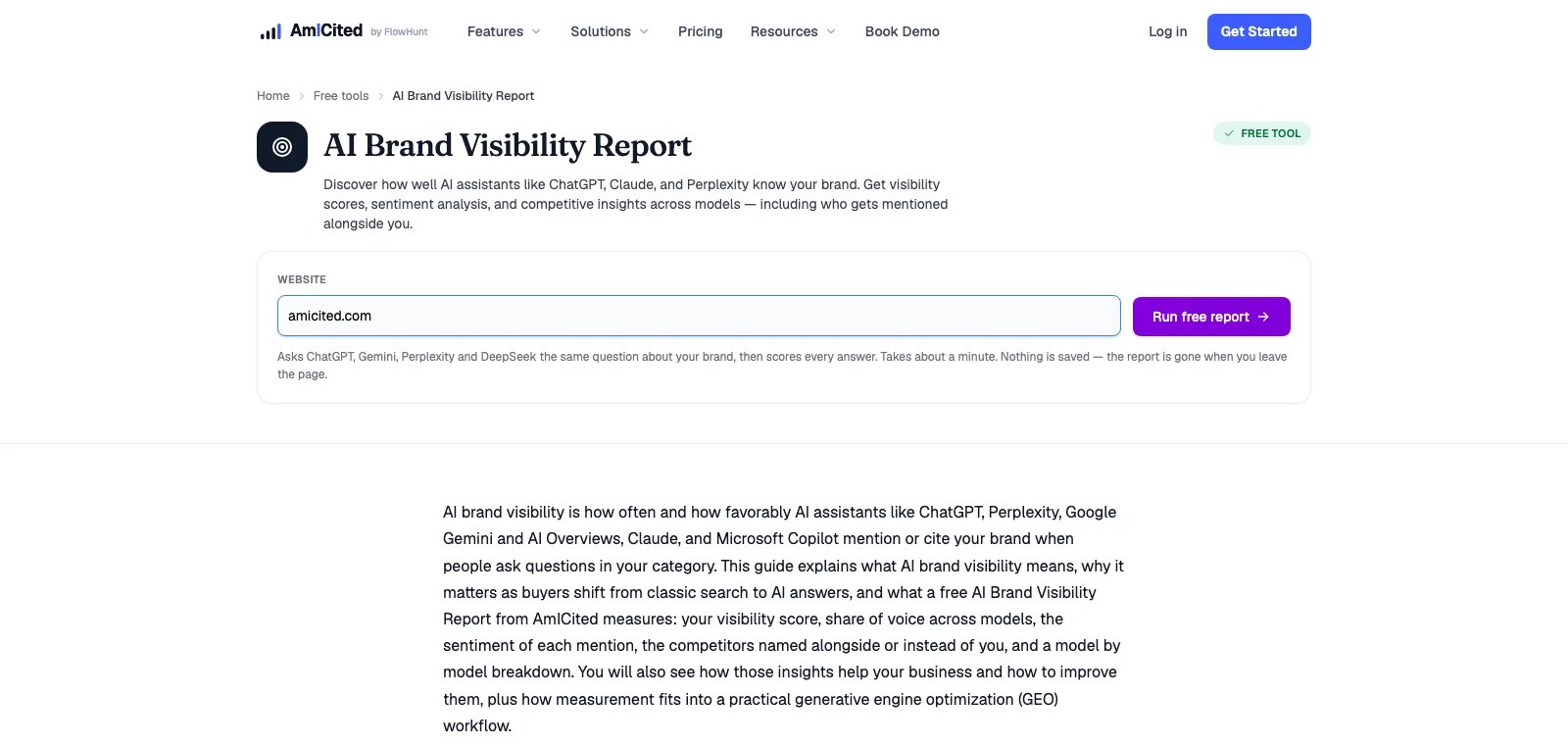

Enter your website and get the visibility score, per-mention sentiment, share of voice and the competitors named instead of you, across ChatGPT, Gemini, Perplexity and DeepSeek. About a minute, free.
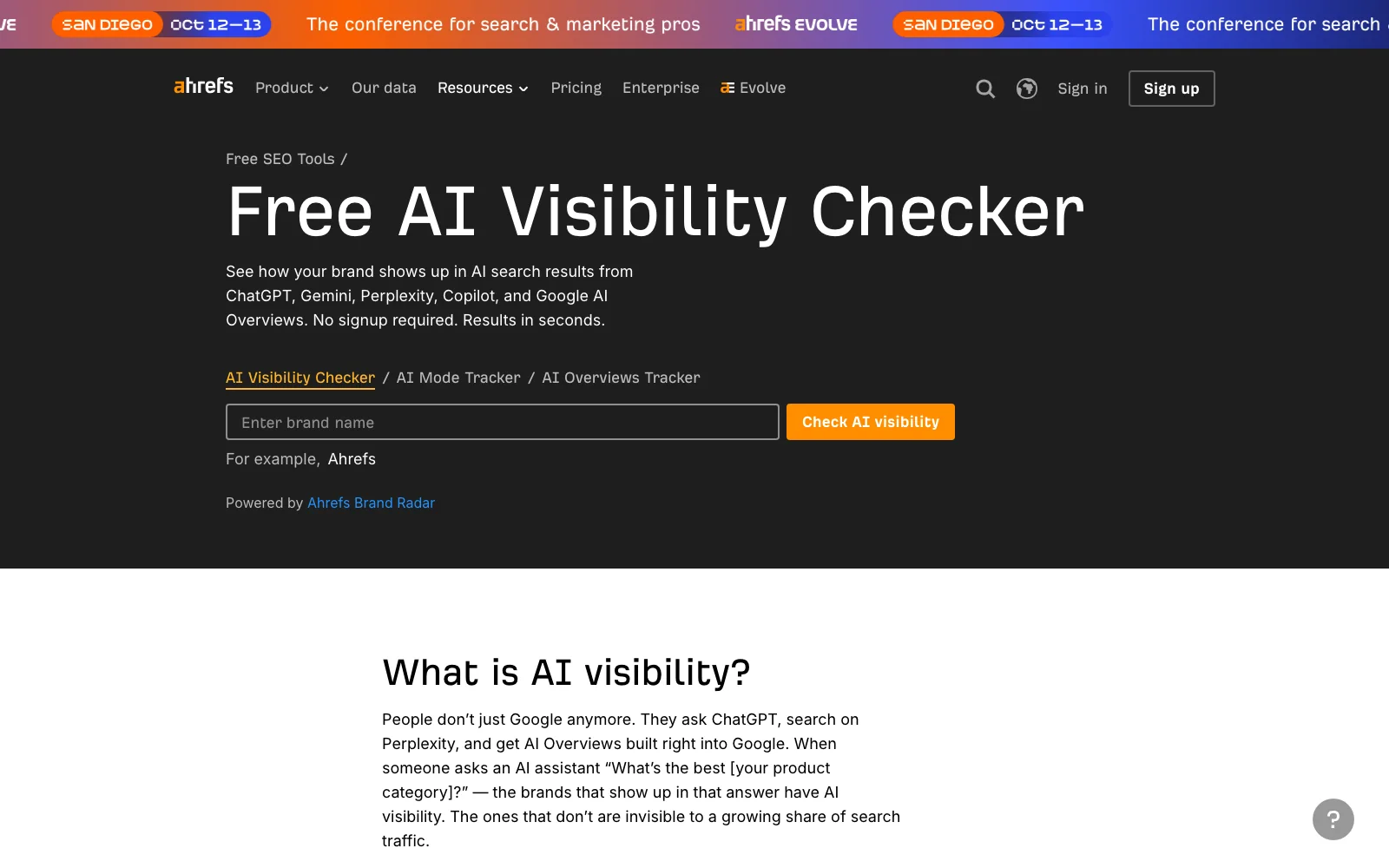
2. Showing you who is named instead of you. The brands that appear in the answers you are missing are your real competitive set in AI search, and it is frequently not the set your marketing plan names. Ahrefs does this best of the no-account tools, because it lists the domains cited alongside your brand.
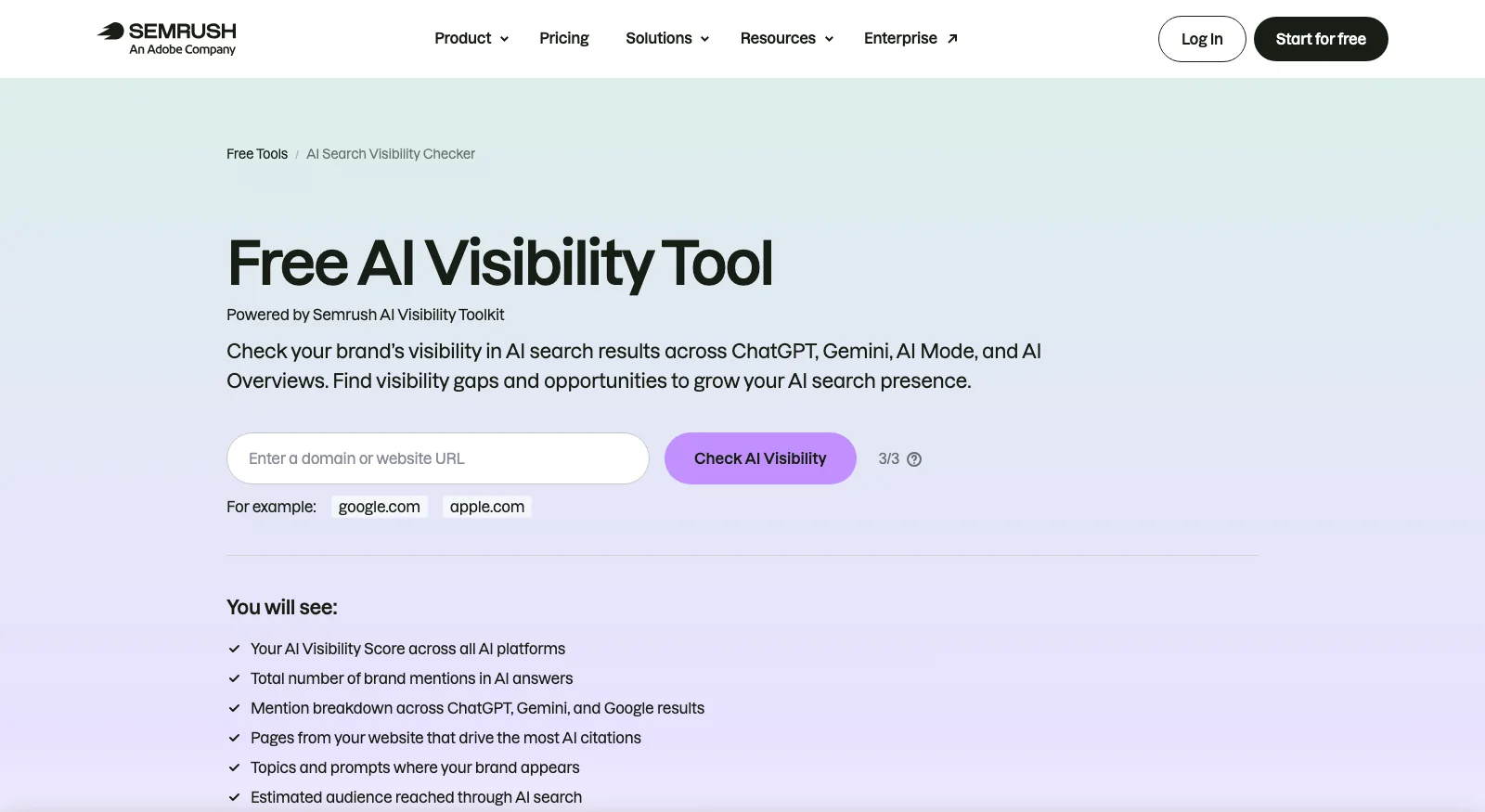
3. Telling you which of your own pages the engines already trust. Semrush is the only free tool that maps citations back to specific URLs you own. That list is the best content brief you will ever get for nothing: those pages already earn citations, so expanding them beats writing something new.
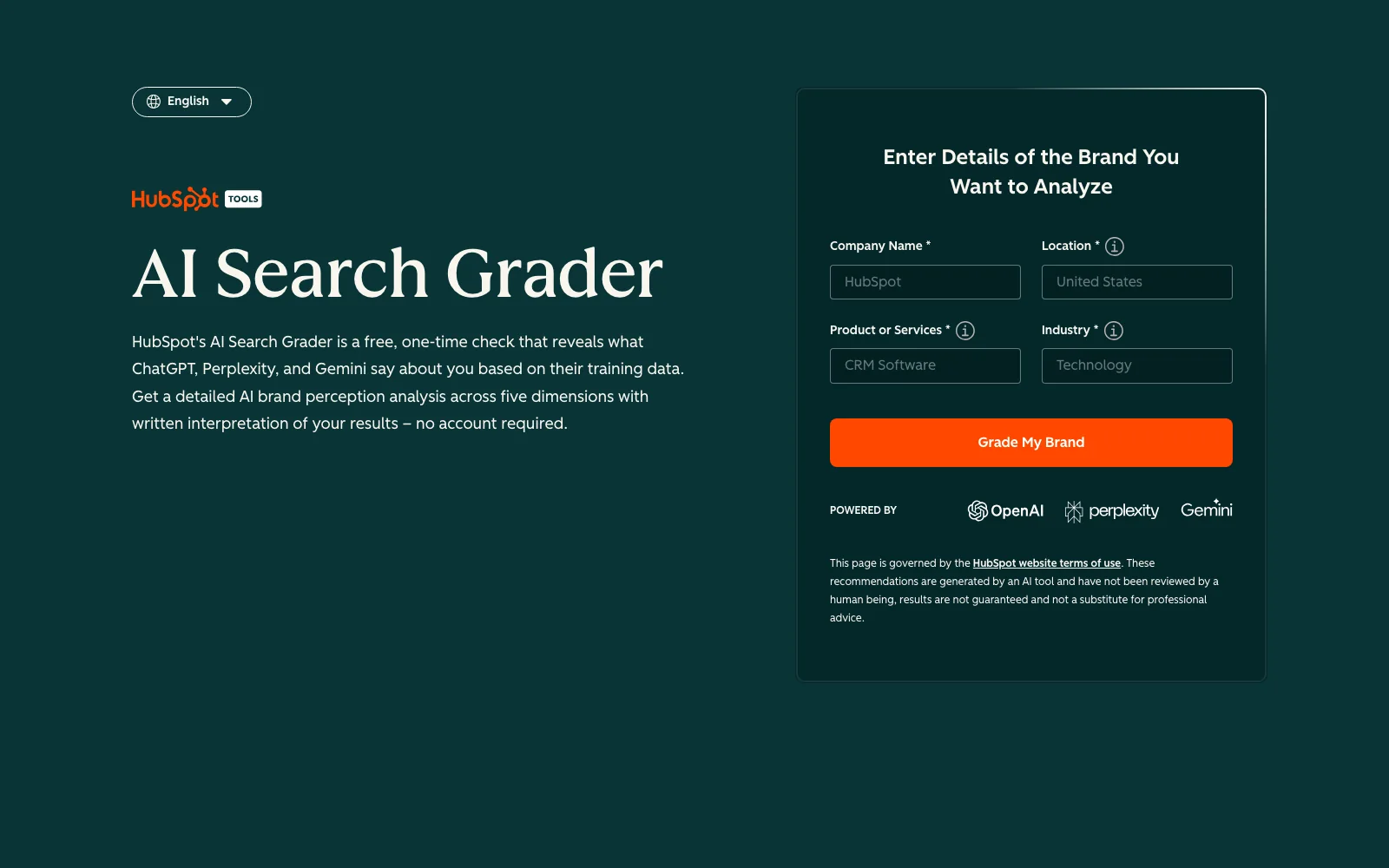
4. Showing you how AI describes you, not just how often. HubSpot’s AI Search Grader is not a counter at all. It scores brand perception across five weighted dimensions, sentiment at 40 points being the largest. Being named as the expensive option and being named as the leading option both count as one mention on every other tool here.
Two of those four are shop windows, which is exactly why they are so generous. The Ahrefs checker is the free face of Ahrefs Brand Radar, and the Semrush tool is a limited view of the Semrush AI Visibility Toolkit. That is not a criticism, but it is worth knowing which paid product each free tool is quietly pitching.
For the full field-by-field breakdown of what each one returns, including the two that now need an account and the one that no longer exists, see my tested roundup of the best free AI visibility checkers . The Am I Cited free tools hub also carries the robots.txt and llms.txt generators referenced later on this page, and the robots.txt one runs entirely in your browser with no account at all.
The limits are the same everywhere, and they are architectural rather than stingy.
None of that makes free checkers bad. It makes them a diagnostic rather than a dashboard. For the longer version of this argument, I wrote up the hidden limitations of one-off reports separately.
Paying does not buy you more engines or a prettier score. It buys four things, and if you do not need these four, do not pay.
1. Your prompt set instead of theirs. You write the fifteen questions you believe your buyers ask and the platform runs exactly those. This is the difference between a generic category read and a measurement of your actual market.
2. The same prompts on a schedule, with history. This is the whole product. A number with no previous number beside it cannot answer “did the thing you published last month change anything?”, and that is the only question that matters once you have started working on it. That is the line between a one-off checker and an AI rank tracker, and continuous monitoring is the whole of what the subscription buys.
3. Repeat runs, so the number means something. Engines are probabilistic. Running each prompt repeatedly and averaging is how a score stops being noise. No free tool does this.
4. Share of voice against a set you choose. Not “who happened to appear near you” but “here are my four named competitors, here is my percentage against them, here is how it moved”. I broke down how to calculate and move that in the share of voice guide.
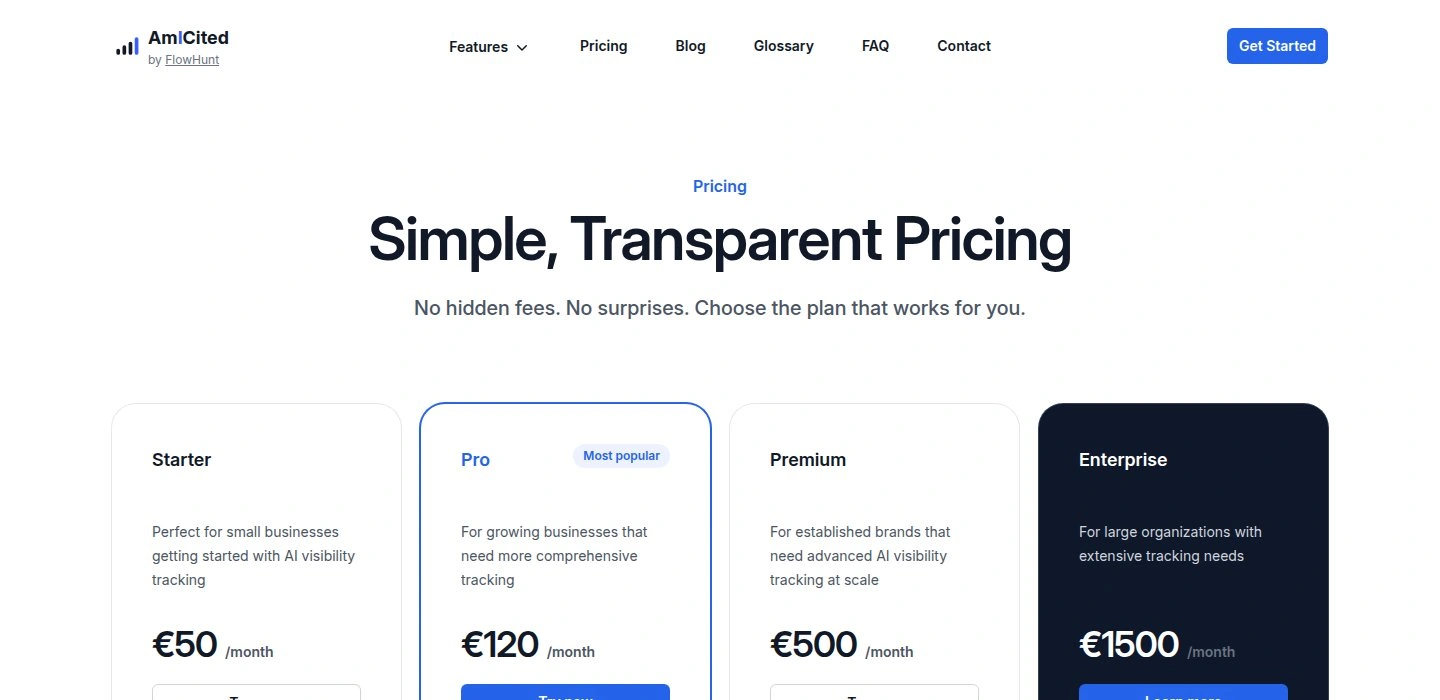
Two useful comparison points at the entry tier. Otterly is the cheapest real entry at EUR 29, but that plan caps you at 15 prompts and tracks four engines, with Claude, Gemini and Google AI Mode sold as add-ons. Peec AI starts higher at EUR 85 for 50 prompts and lets you pick three models.
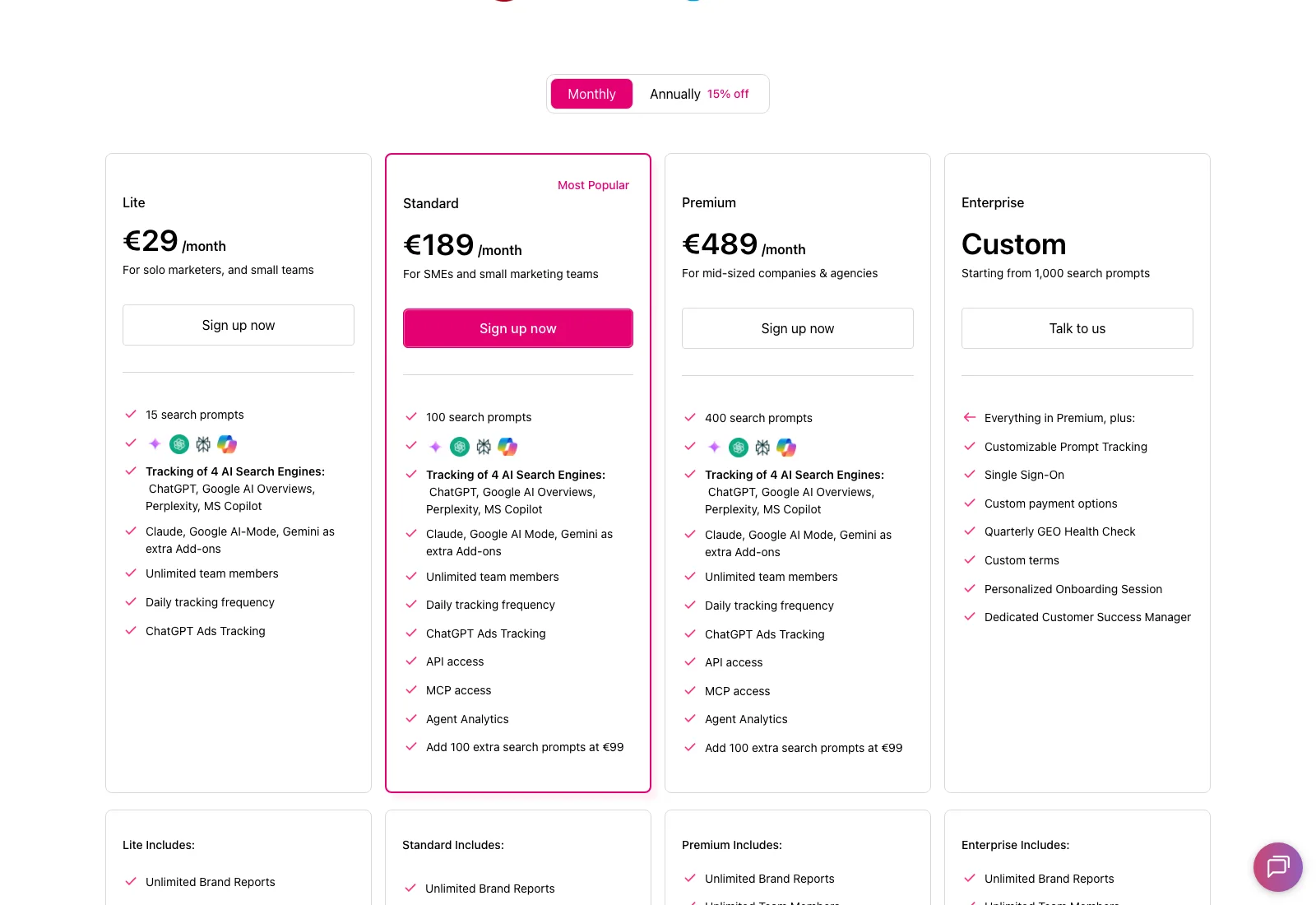
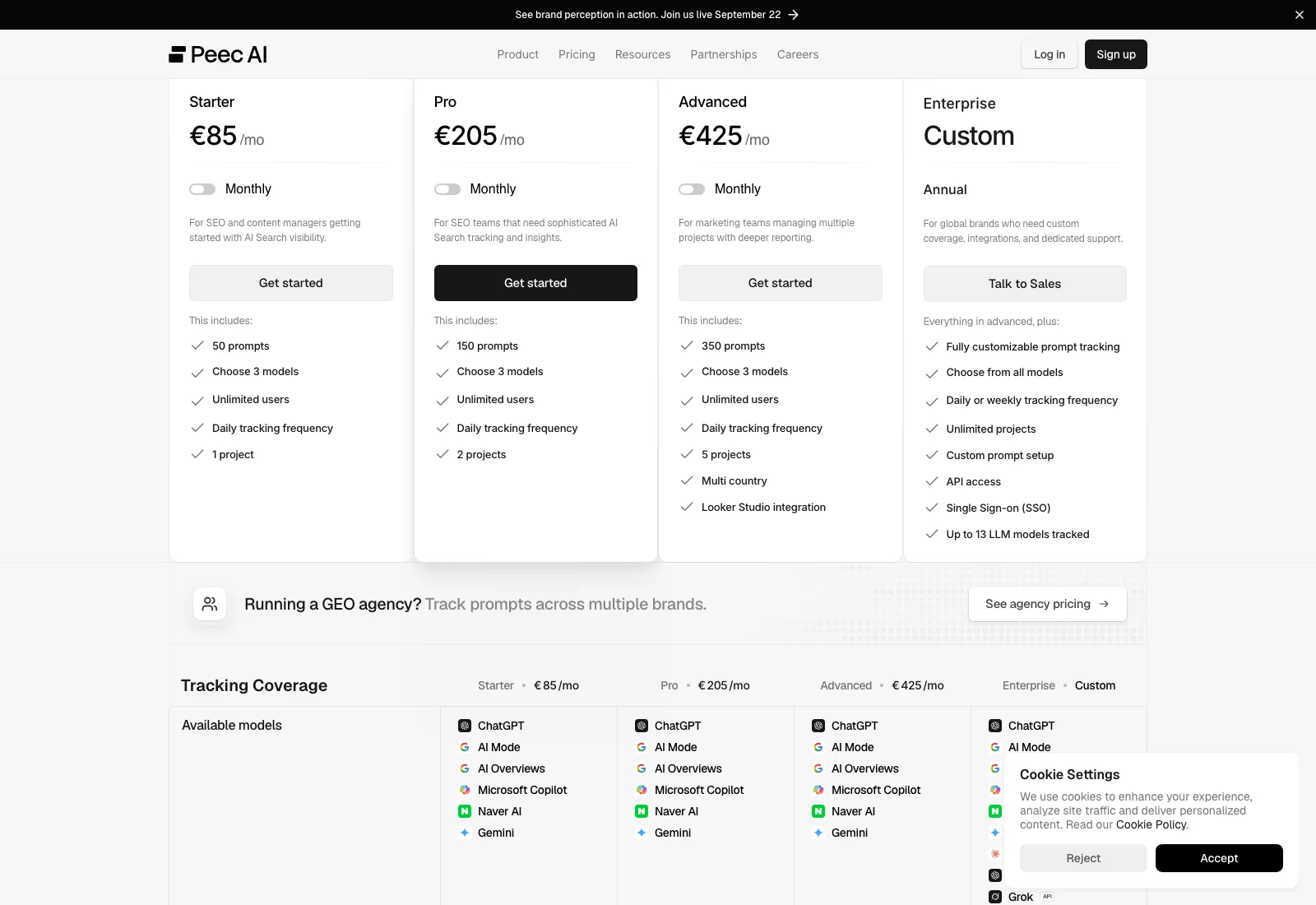
Read those three screenshots together and the real trap of the entry tier appears: the vendors do not sell the same unit, so the sticker prices are not comparable. Otterly and Peec sell prompt slots. Am I Cited sells credits and AI responses, where one response is one prompt answered by one engine: Starter is EUR 50 for 3,000 responses a month on one domain, Pro is EUR 120 for 8,000 across five domains.
To compare them at all you have to convert to the thing you actually consume, which is answers per month. Both Otterly and Peec advertise daily tracking, so at 30 runs a month Otterly Lite works out at 15 prompts on 4 engines, roughly 1,800 answers, and Peec Starter at 50 prompts on 3 models, roughly 4,500. That arithmetic is mine rather than theirs, so treat it as an estimate, but it lands somewhere useful: per answer the entry tier is priced within a rounding error across all three. What genuinely differs is domains, competitor slots, and which engines are included rather than sold as add-ons.
Above roughly EUR 500 a month, the feature lists of the enterprise platforms converge and you are buying data access, engine breadth and contract terms.
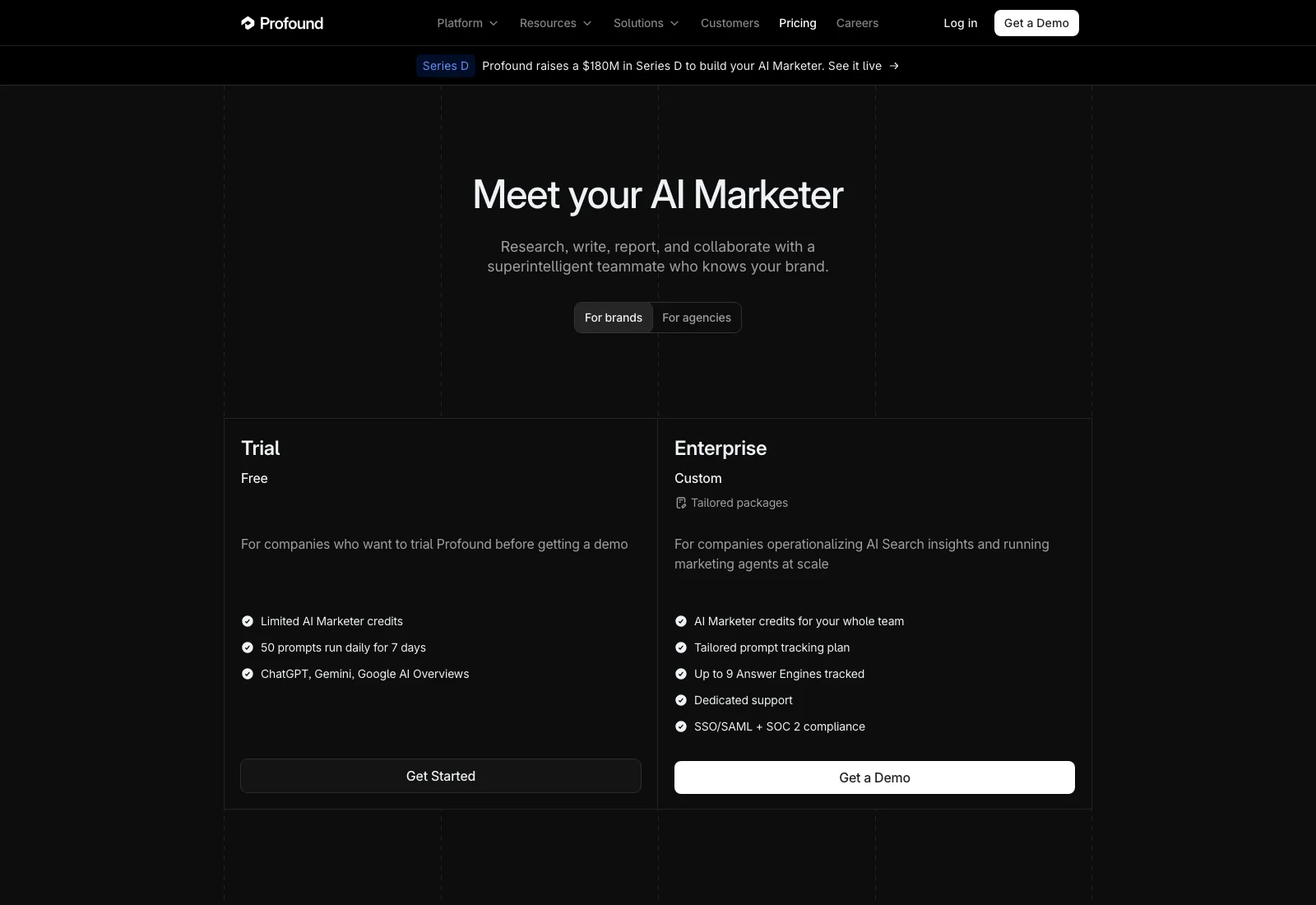
Profound no longer publishes a price at all. Its page now shows a free trial (50 prompts daily for 7 days across ChatGPT, Gemini and Google AI Overviews) and an Enterprise plan on quote, tracking up to nine answer engines with SSO/SAML and SOC 2. That free trial is worth knowing about: it is one of the more generous ways to get real tracking data without paying.
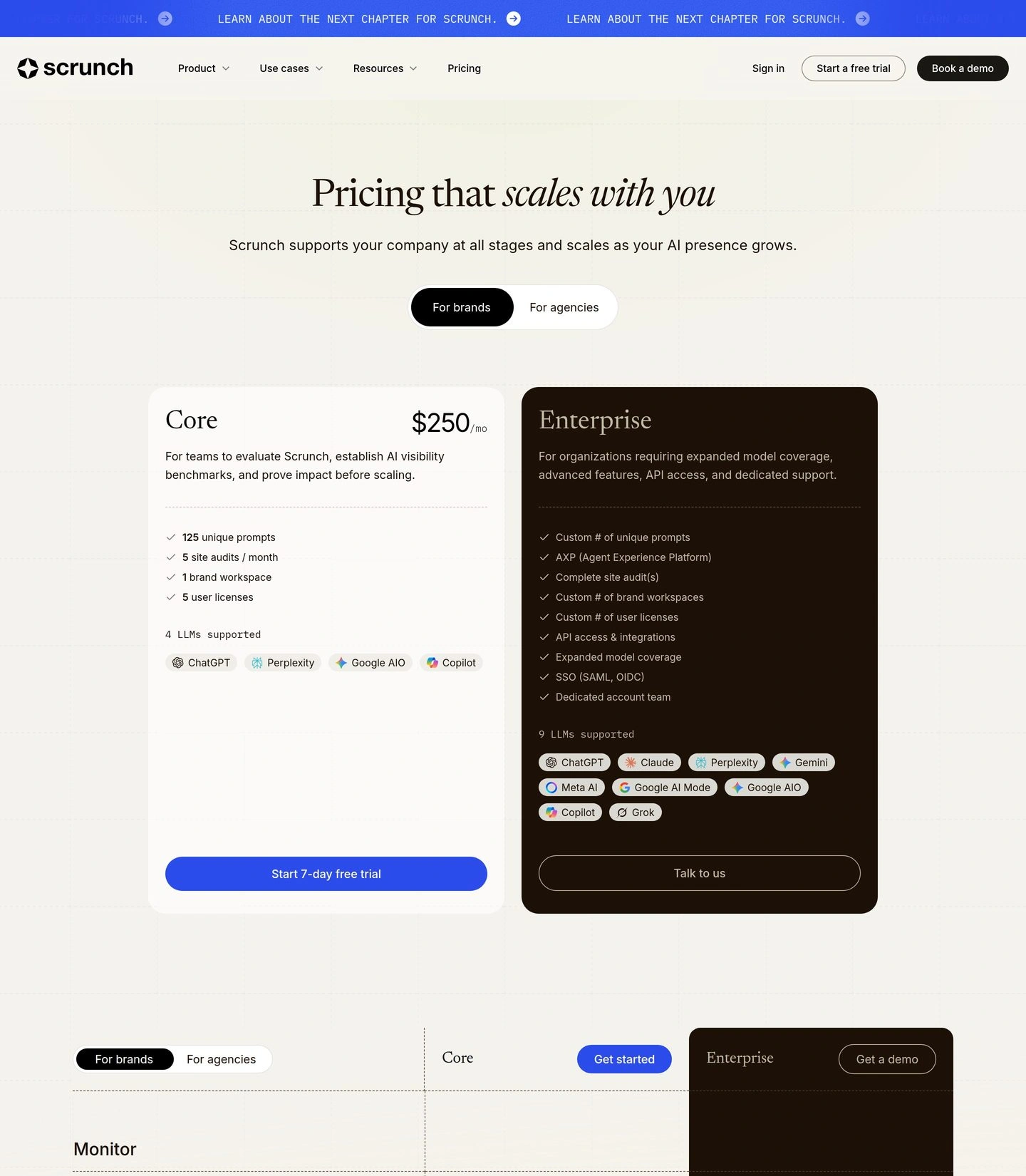
Scrunch publishes a Core plan at USD 250 a month for 125 prompts, five site audits, one brand workspace and four LLMs, with Enterprise adding nine LLMs, API access and SSO. Am I Cited Premium sits at EUR 500 with API access and multi-domain coverage. At this level the decision is rarely about features; it is about whether you can get the data out and what the contract says.
Every figure below came off the vendor’s own pricing page on the date in the heading, screenshotted above. Prices in this category move fast, so treat any roundup without a date on it as fiction.
The units differ by vendor, which is the single most common way these comparisons go wrong.
| Tool | Entry price | What that buys, in the vendor’s own units | Engines |
|---|---|---|---|
| Free checkers | EUR 0 | One run of a prompt set they choose | 3 to 5 |
| Otterly Lite | EUR 29 | 15 search prompts | 4, Claude and Gemini are add-ons |
| Am I Cited Starter | EUR 50 | 50 credits, 3,000 AI responses, 1 domain, 10 competitors | 5 |
| Peec Starter | EUR 85 | 50 prompts, 1 project | choose 3 |
| Am I Cited Pro | EUR 120 | 120 credits, 8,000 AI responses, 5 domains, 30 competitors, MCP | 5 |
| Otterly Standard | EUR 189 | 100 search prompts, API and MCP access | 4 |
| Peec Pro | EUR 205 | 150 prompts, 2 projects | choose 3 |
| Scrunch Core | USD 250 | 125 unique prompts, 5 site audits, 5 licences | 4 |
| Peec Advanced | EUR 425 | 350 prompts, 5 projects, multi-country | choose 3 |
| Otterly Premium | EUR 489 | 400 search prompts, agent analytics | 4 |
| Am I Cited Premium | EUR 500 | 500 credits, 33,000 AI responses, 50 domains, white-label | 5 |
| Profound | Quote only | Free 7-day trial of 50 prompts a day, then custom | up to 9 |
| Scrunch Enterprise | Quote only | Custom prompts, API, SSO, AXP | 9 |
The hidden costs sit outside that table: the hour a week somebody spends reading reports, the extra seats, the annual-versus-monthly gap, and add-on engines that are not in the headline number. Am I Cited pricing is laid out on the same terms.
I tracked five buyer questions about this exact topic in Am I Cited against amicited.com, across ChatGPT, Gemini, Google AI Overviews, Google AI Mode, Grok and Google Search in September 2026. The results say something useful about how to read any roundup, including this one.
| The question asked | What got cited |
|---|---|
| “ai visibility checker” | Tool pages only: the Ahrefs checker at average position 1, then honeyb.ai, birdeye.com, amivisibleonai.com. One YouTube video and one Reddit thread were the only non-tool sources |
| “free vs paid AI visibility tools which should I choose” | Comparison articles: rankability.com, lumentir.com, answersocrates.com, this page at position 4, then a Reddit thread |
| “how much do AI visibility tracking tools cost per month” | Vendor pricing pages: otterly.ai/pricing, peec.ai/pricing, semrush.com/pricing/ai, plus a Capterra listing |
| “is a free AI visibility checker good enough or do I need a paid tool” | Nothing. Gemini, AI Overviews, AI Mode and Grok all answered from model knowledge with zero citations |
| “best free AI visibility checker no signup” | Nothing. Same four engines, same result |
Three things worth taking from that. Different question types pull completely different source types, so “am I visible” is not one number, it is a different number per question. Two of the five questions returned no citations at all, which means a checker reporting zero for those prompts is telling you about the engine’s behaviour, not about you. And the page you are reading is cited for the decision question and not for the tool question, which is exactly what you would predict from the first row: when someone wants a checker, engines cite checkers, not articles about checkers.
There is a specific moment when free stops being enough, and it is not a feeling.
Hit any two of those and the subscription is cheaper than the alternative. Hit none and paying is premature.
Every checker automates a process you can run by hand in about 45 minutes. Doing it once is the fastest way to understand what the tools are actually reporting.
With ChatGPT handling billions of prompts a day and Google’s AI Overviews appearing on a large share of result pages, the answer layer now sits between your buyers and your website. When someone asks an AI platform about your category, your brand either appears in the answer or it does not, and there is no second page to be on. A low AI visibility score is not a vanity metric in that context, it is a count of the buying conversations you were absent from.
| Impact area | Without monitoring | With monitoring |
|---|---|---|
| Brand awareness | You do not know whether AI names you | You know which prompts name you and which do not |
| Customer discovery | Buyers meet competitors in the answer | You see the gaps while they are still fixable |
| Market intelligence | Reactive positioning | You see competitor movement as it happens |
| Content strategy | Guesswork | You know which of your pages earn citations |
| Attribution | AI traffic looks like direct traffic | Citations connect back to specific URLs |
Which of the AI visibility metrics you watch matters more than the headline score, and mention rate beats any composite number for comparability.
| Capability | Free checkers | Entry-level paid | Enterprise |
|---|---|---|---|
| Your own prompt set | No | Yes | Yes |
| Volume | Vendor-chosen, one run | 15 to 400 prompts, or 3,000 to 8,000 answers | Custom |
| Run frequency | On demand | Daily or weekly | Real time |
| History retained | None to 30 days | Full | Full, with export |
| Repeat runs per prompt | Rarely | Yes | Yes |
| Sentiment | HubSpot and Am I Cited only | Yes | Yes |
| Competitor share of voice | Adjacent domains only | Yes, named set | Yes, multi-brand |
| Citations mapped to your URLs | Semrush only | Yes | Yes |
| Alerting | No | Yes | Yes, with SLAs |
| API access | No | Limited | Yes |
| Price | EUR 0 | EUR 29 to 425 | EUR 500+ or quote |
The honest summary: a free AI visibility checker will tell you whether you have a problem, and for many brands that is the only question worth answering this quarter. Paying is what you do once you have decided to fix it, because from that moment the thing you need is not a number, it is the direction that number is moving.
Yasha is a talented software developer specializing in Python, Java, and machine learning. Yasha writes technical articles on AI, prompt engineering, and chatbot development.

Answer the free question before you price the paid one. The AI Brand Visibility Report scores your domain across ChatGPT, Gemini, Perplexity and DeepSeek, with the sentiment of every mention and the competitors named instead of you, in about a minute.
Compare AI visibility monitoring platforms by features, pricing and support for ChatGPT, Perplexity and Google AI.
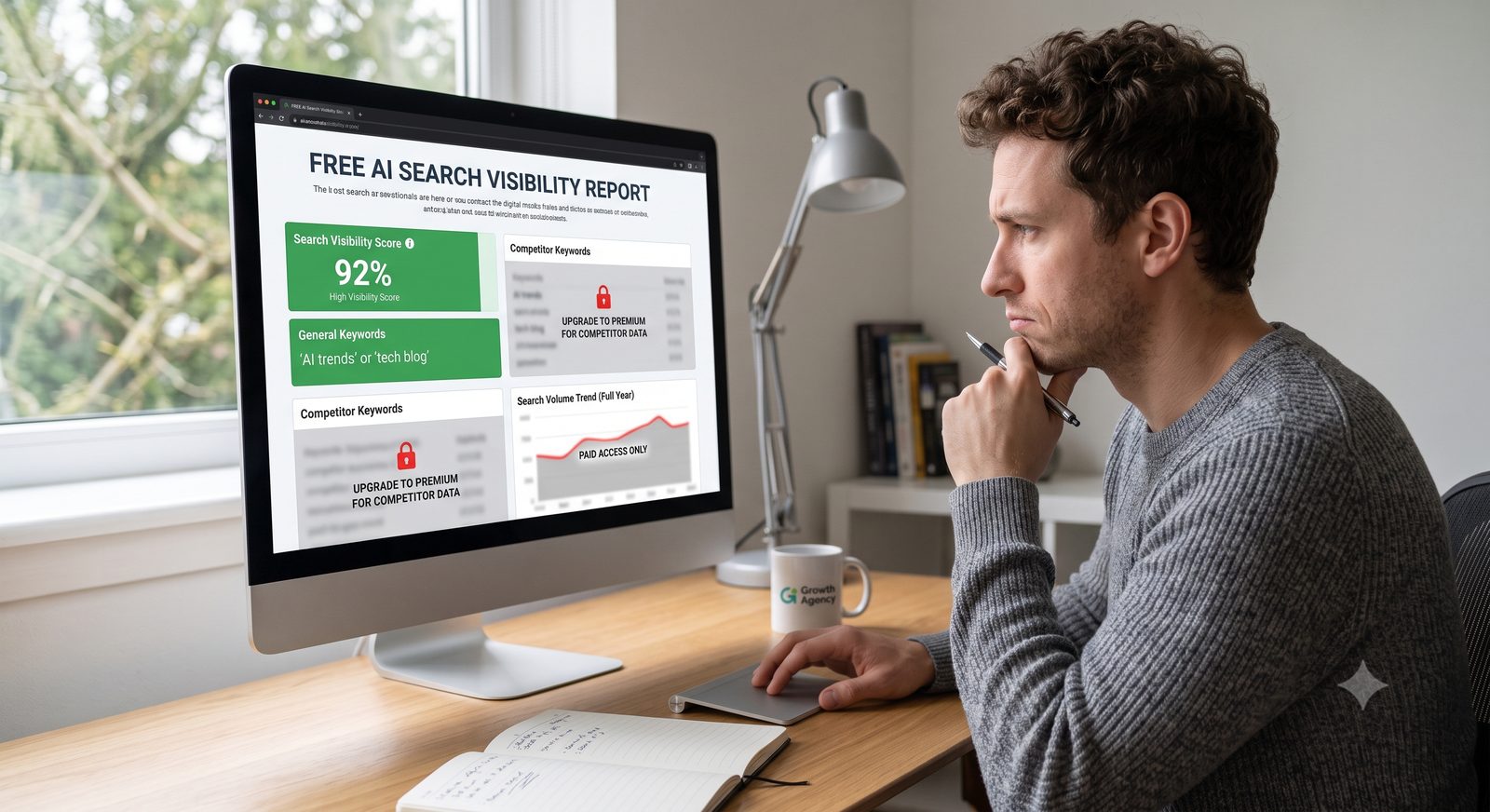
Free AI visibility reports offer limited data. Discover the real limitations, hidden costs, and when you need to upgrade to paid tools for true brand monitoring...

Compare free AI visibility tools by what they track, their limits, and the best fit for your needs across ChatGPT, Perplexity, and Google AI Overviews.
Cookie Consent
We use cookies to enhance your browsing experience and analyze our traffic. See our privacy policy.