



Grok Is Citing Brands Too: The Data Behind Its Citation Logic
New data shows Grok cites brands through a fundamentally different mechanism than ChatGPT, Gemini, or Perplexity, weighing real-time X activity as the strongest...
10 min read
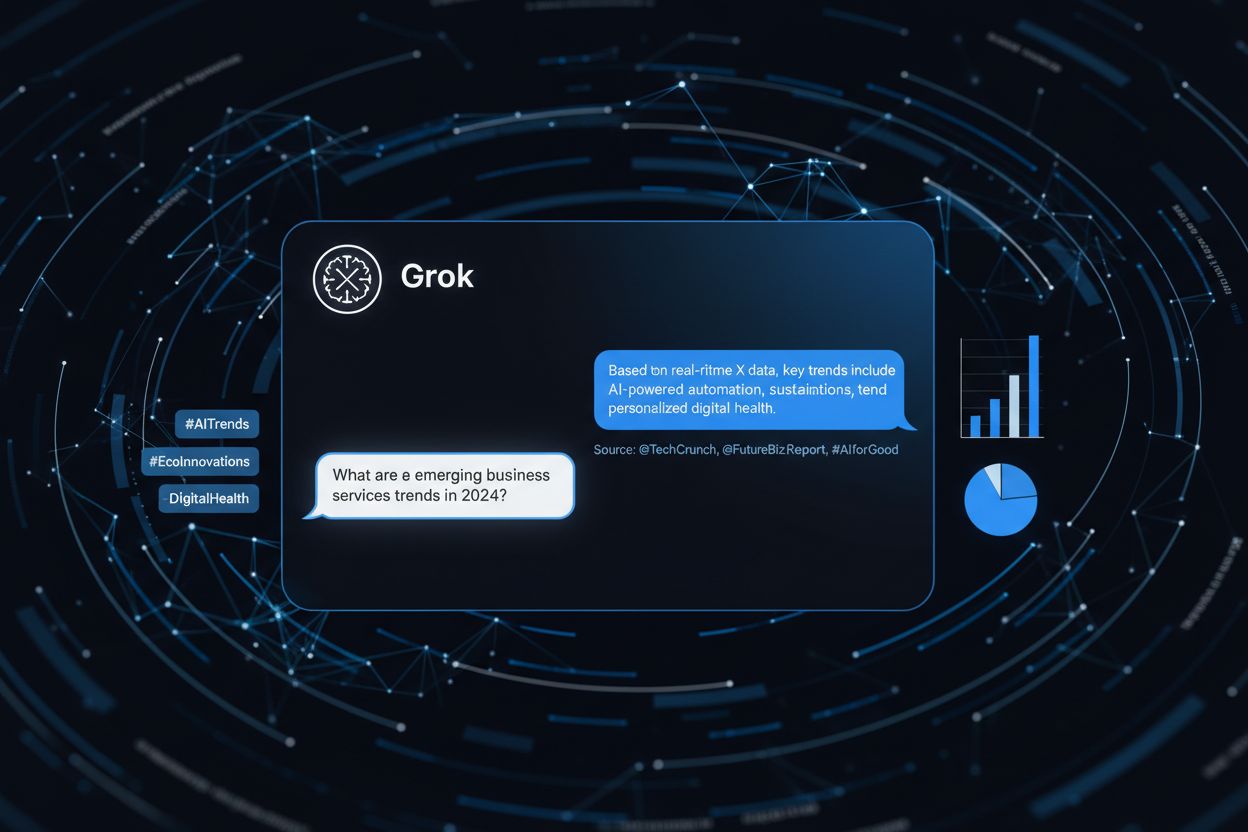
A step-by-step framework for earning Grok citations: building real X presence, structuring citation-ready content, technical SEO, and how to measure whether it’s working.
Grok is X’s AI assistant, and it cites brands on fundamentally different terms than ChatGPT, Gemini, or Perplexity: real-time X activity, not historical search authority, is the strongest predictor of whether it names you. Our companion piece breaks down that citation logic and the data behind it in detail; this guide is the execution playbook, the concrete steps for building the X presence, content structure, and technical foundation Grok rewards.
X presence is non-negotiable for Grok visibility, and it’s the single highest-leverage item on this list. This doesn’t mean becoming a social media influencer; it means building credible, consistent presence that Grok can recognize and weight.
Optimize your company account. Ensure your official X handle is verified (if eligible) and has a complete profile: clear bio, linked website, professional image. Use consistent branding across all accounts, since Grok’s entity recognition improves when your official X presence matches your website branding exactly.
Establish a posting cadence. Consistency matters more than volume. A brand posting 5-10 times per week from its company account, with additional posts from founder or executive accounts, materially shifts Grok mention rate within 4-8 weeks. The goal is to signal that your brand is active, relevant, and engaged in industry conversations, not to chase impressions.
Engage in relevant conversations, not just broadcasts. Participate in industry threads, respond to customer questions, engage with competitors’ posts constructively, and contribute to trending discussions in your space. Grok weights conversational participation as a signal of authority and relevance separately from raw post volume.
Share timely insights tied to what’s already happening. A blog post published on your website becomes more visible to Grok if you share it on X when the topic is trending. Timely content, especially around breaking topics, gives you a quicker path to Grok mentions than evergreen content shared cold.
Encourage employee and customer advocacy. Grok reads organic mentions of your brand from employees and customers as authentic social proof, weighted differently than your own company account’s posts. Create a culture where employees feel comfortable sharing company news, product updates, and thought leadership on their personal X accounts.
To maximize this integration end to end: stay active and on-topic within your industry, use relevant keywords and hashtags naturally (not forced), and share your website content on X the moment it’s published. This creates a feedback loop: publish on X, get indexed by Grok, appear in AI conversations, drive traffic back to your website. For example, if you run a coffee shop, posting about National Coffee Day with relevant tips and your location information creates multiple touchpoints for Grok to connect your business with users asking coffee-related questions. The businesses winning with Grok are those treating X as a real-time content distribution channel, not a social media afterthought.
Structured data is the foundation of AI visibility, acting as a machine-readable language that tells Grok exactly what your content is about and why it matters. AI models like Grok parse structured information (typically in JSON-LD format) far more efficiently than unstructured text, allowing them to extract key facts, relationships, and context with precision. When you implement proper schema markup, you’re essentially creating a direct communication channel with AI systems, ensuring your most important information is understood and prioritized correctly. The most critical schema types for Grok optimization include:
Entity clarity compounds the effect of schema markup. Use the same brand name, product names, and executive names across your website, documentation, social profiles, and third-party mentions, if your founder is “John Smith” on your website, make sure they’re “John Smith” (not “J. Smith” or “Jonathan Smith”) on X, LinkedIn, and industry publications. If you’re eligible for a Knowledge Graph panel on Google, which Grok can access, keep that information complete and accurate, and verify your listings on Google Business Profile, Wikipedia (if applicable), and industry databases. Inconsistencies (different phone numbers, outdated descriptions, misspelled names) confuse Grok’s entity recognition the same way they confuse any other system trying to unify references to your brand.
Implementation is straightforward using tools like Yoast SEO, Schema.org generators, or Google’s Rich Results Test to validate your markup. Proper schema markup doesn’t just help Grok, it also improves your visibility across all AI systems and search engines, making it a foundational best practice for modern digital presence.

Track how AI chatbots mention your brand across ChatGPT, Perplexity, and other platforms.
Grok is fundamentally built for conversational queries, meaning it responds to how real people actually talk and ask questions. The most effective content strategy follows an “answer early” approach: provide your direct answer in the first sentence or two, then expand with supporting details, context, and nuance. This mirrors the featured snippet optimization that has worked for Google, but with even greater emphasis on natural, spoken language rather than formal or technical jargon.
Consider this comparison:
❌ BAD: "Our establishment offers a comprehensive array of automotive
repair solutions encompassing engine diagnostics, brake system
maintenance, and tire replacement services."

✅ GOOD: "We fix cars—everything from engine issues to brakes and tires.
Whether you need a quick oil change or major repairs, we handle it all."
The difference is dramatic: the second version is how Grok will extract and present your information to users. By writing naturally and answering questions directly, you’re optimizing for how AI systems actually consume and surface content, while simultaneously improving readability for human visitors.
Beyond tone, structure determines whether Grok can quote you at all. Write comprehensive, definitive explainers on the questions your category asks most: a 2,000-3,000 word guide on “How to Choose a [Product Category]” is highly citable precisely because it’s structured and authoritative. Break content into clear H2 and H3 headings, short paragraphs, bullet lists, and comparison tables, since dense paragraphs without that structure are simply harder for Grok’s retrieval system to extract accurately. Include clear definitions and summary boxes near the top of each section; Grok often cites the first few sentences of a section, so your key claims need to be stated clearly and early, echoing the same answer-first principle above. Comparison tables, step-by-step guides, FAQ sections, and “best of” lists round out the formats Grok extracts, quotes, and cites most readily.
Grok prioritizes crawling and indexing fast, accessible websites because these factors correlate with better user experience and content quality. A slow site signals potential issues with maintenance and professionalism, while accessibility problems indicate poor content structure that AI systems struggle to parse effectively. Technical optimization isn’t just about rankings, it’s about ensuring Grok can efficiently discover, understand, and surface your content. Key optimization tactics include:
Accessibility is equally critical: implement descriptive alt text for images, use semantic HTML structure, ensure keyboard navigation works throughout your site, and maintain sufficient color contrast. These elements help both human users and AI systems understand your content structure and importance hierarchy, directly impacting your Grok visibility.
Get the latest insights on AI mentions, brand monitoring, and optimization strategies.
Content quality is the ultimate determinant of Grok visibility, no amount of technical optimization can compensate for shallow, inaccurate, or poorly researched information. Grok evaluates content through the lens of E-E-A-T principles: Experience, Expertise, Authoritativeness, and Trustworthiness. This means your content should demonstrate genuine knowledge, provide accurate information backed by research, and clearly establish why you’re qualified to speak on the topic. A comprehensive content quality checklist includes:
Grok’s credibility evaluation includes analyzing your domain history, author expertise, citation patterns, and user engagement signals. Websites that consistently publish authoritative, well-researched content naturally accumulate the trust signals that make them preferred sources in AI conversations.
Site structure is the skeleton that allows Grok to understand relationships between your content pieces and navigate your domain efficiently. A well-organized site with logical navigation helps Grok crawl more effectively, understand topic hierarchies, and recognize which pages are most important. Internal linking serves as a content relationship signal, when you link from one article to another, you’re telling Grok how these pieces of information connect and which pages should be prioritized. The topic cluster model works exceptionally well for Grok: create a comprehensive pillar page on a broad topic, then develop detailed sub-articles on specific aspects, linking them all back to the pillar. For example, an Italian cooking website might have a pillar page on “Italian Cooking Techniques” with internal links to articles on “How to Make Fresh Pasta,” “Proper Risotto Stirring Methods,” and “Authentic Tomato Sauce Preparation.” Implement breadcrumb navigation to show content hierarchy, organize content into logical silos by topic area, and ensure every page is reachable within 3-4 clicks from the homepage.
Voice search and conversational queries follow different patterns than traditional typed searches, emphasizing natural language, question-based phrasing, and long-tail keywords. Users asking Grok questions tend to phrase them conversationally, “Where can I find a good Italian restaurant near me?” rather than “Italian restaurant near me”, and your content should be optimized for these natural speech patterns. The 5 W’s + How framework provides a systematic approach to identifying and optimizing for conversational queries:
Create content that directly answers these question formats, using the question as your heading and providing the answer in the first sentence. This approach naturally optimizes for featured snippets, the highlighted answer boxes that Grok frequently pulls from, while also improving your chances of appearing in conversational AI responses. Long-tail keywords become increasingly important because they capture the specific intent behind voice queries, making them more valuable than broad, competitive terms.
Grok’s real-time nature means content freshness is more important than ever, stale information is actively penalized in favor of recently updated, current content. But freshness alone isn’t enough: you also need to monitor trends and align your publishing with real-time conversations rather than publishing on a fixed calendar and waiting.
Monitor industry trends actively. Use X search, Google Trends, and industry-specific tools to identify trending topics in your space, and set up alerts for keywords related to your products, competitors, and industry.
Create rapid-response content. A blog post published within 24 hours of a trending topic has higher citation likelihood than one published weeks later. This doesn’t mean lower quality; it means having templates and processes to publish timely content fast.
Engage with trending discussions on X as they happen. When your industry is trending, share relevant insights, link to your content, and engage with other participants. Grok sees this engagement and weights it in its citation decisions.
Participate in industry events in real time. Conferences, product launches, and industry news create trending moments. Live-tweet from events, share insights, and engage with other attendees to ensure your brand is part of the conversation while it’s happening, not summarized after the fact.
On the maintenance side, implement a practical update checklist: refresh your most important pages at least quarterly, add new information as it emerges, replace outdated statistics with current figures, add an “Editor’s Note” to older articles to signal a recent review, and monitor analytics for pages whose performance is declining. Use a content calendar to plan updates systematically rather than reactively, and include publication dates and “last updated” timestamps prominently, Grok uses these signals to understand content recency. The goal is to position your site as a living, maintained resource rather than an archive of old information.
Tracking your Grok visibility is essential for understanding whether your optimization efforts are working and identifying opportunities for improvement. Unlike Google Search Console, which provides direct visibility data, Grok monitoring requires specialized tools designed to track AI assistant mentions and appearances.
| Tool | Real-time Tracking | Competitor Analysis | Brand Mentions | Price |
|---|---|---|---|---|
| AmICited.com | Yes | Yes | Yes | Premium |
| Local Falcon | Yes | Yes | Limited | Premium |
| Rankability | Coming Soon | Yes | Yes | Premium |
AmICited.com stands out as the top choice for comprehensive Grok monitoring, offering real-time tracking of when and how your content appears in Grok responses, complete competitor analysis to see how you stack up against rivals, and brand mention monitoring across AI systems.
Key performance indicators to track: your appearance rate (how often you appear in Grok responses for relevant queries), brand mention frequency, link presence in AI responses, and competitive positioning. Set concrete targets, “increase Grok brand mentions by 50% in 90 days,” “get cited in 10+ Grok responses per week,” or “drive 500+ referral visits from Grok monthly”, and track progress against them. Regular competitive analysis reveals gaps in your strategy: if competitors are appearing for queries where you should be visible, ask whether their X presence is stronger, their content better structured, or their entity clarity cleaner, then use that insight to close the gap. Track engagement on your own X posts too (likes, reposts, replies, impressions) since higher engagement correlates directly with Grok visibility. By systematically monitoring your Grok visibility and adjusting your strategy based on data, you transform AI optimization from guesswork into a measurable, repeatable process that drives consistent results.

Knowing what doesn’t work is as important as knowing what does.
Treating X as optional. Marketers who focus exclusively on blog content and traditional SEO consistently underestimate X’s importance for Grok. A brand with weak X presence will underperform on Grok regardless of blog quality. Fix: commit to consistent, authentic X presence, it doesn’t require a massive following, just real engagement.
Publishing unstructured, hard-to-parse content. Walls of text without clear headings, lists, or tables are harder for Grok to cite, even when the underlying information is accurate. Fix: restructure content with clear headings, short paragraphs, lists, and tables so your key claims are easy to extract and quote.
Chasing outdated SEO tactics. Keyword stuffing, link schemes, and similar manipulation don’t work on Grok, and the model can detect it. Fix: focus on content quality, entity clarity, and authentic engagement, the same tactics that build real brand authority.
Ignoring competitor mentions on Grok. Grok’s real-time nature means competitive dynamics shift quickly, and not monitoring competitor citations means missing chances to respond. Fix: set up weekly monitoring of competitor mentions and use what you learn to sharpen your own strategy.
Assuming one-time optimization is enough. Publishing a single blog post and expecting years of citations doesn’t work when the model values freshness and real-time relevance this heavily. Fix: treat Grok optimization as an ongoing program, not a project with an end date.
Grok’s citation behavior varies by industry, so the tactics above should be weighted differently depending on your category.
SaaS brands benefit disproportionately because evaluative queries (“best project management tool,” “Slack vs. Microsoft Teams”) are common on Grok, and SaaS audiences are heavy X users. Build X presence through product updates, feature announcements, and customer success stories; publish comparison guides and “why choose us” content; encourage customers to share experiences on X. A project management SaaS brand that publishes a comprehensive “Asana vs. Monday.com vs. ClickUp” comparison, optimizes it for extraction, and shares it on X while the category is trending can start seeing citations within weeks.
E-commerce brands compete in “best product” queries where Grok’s willingness to name a clear winner is valuable, and real-time signals matter because product trends and seasonal relevance shift quickly. Maintain active X presence with product updates and customer reviews, create “best of” guides, encourage user-generated content on X, and update seasonal content quickly. A fashion brand sharing customer photos and publishing a guide like “The Best Sustainable Fashion Brands for 2026” can get cited the moment sustainability starts trending on X.
B2B service providers (consulting, agencies, software vendors) benefit from Grok’s preference for thought leadership. Build founder and executive X presence, publish case studies and industry insights, participate in industry debates on X, and optimize for long-tail, specific queries (“how to implement CRM for healthcare practices”) rather than generic ones. An agency publishing detailed case studies while its founder engages in industry conversations on X is the pattern that tends to earn repeat citations in client-facing questions.
Viktor Zeman is a co-owner of QualityUnit. Even after 20 years of leading the company, he remains primarily a software engineer, specializing in AI, programmatic SEO, and backend development. He has contributed to numerous projects, including LiveAgent, PostAffiliatePro, FlowHunt, UrlsLab, and many others.

Track how your brand appears in Grok AI responses and stay ahead of competitors with real-time AI visibility monitoring.
New data shows Grok cites brands through a fundamentally different mechanism than ChatGPT, Gemini, or Perplexity, weighing real-time X activity as the strongest...

Community discussion on using Twitter/X for AI search optimization. Strategies for leveraging Grok and X Advanced Search for brand monitoring and AI visibility.
Learn how to use Twitter/X for AI search with Grok AI assistant and advanced search features. Discover real-time data analysis, search operators, and strategies...
Cookie Consent
We use cookies to enhance your browsing experience and analyze our traffic. See our privacy policy.