AI Traffic Conversion Rates: How to Track and Improve Them
A practical guide to tracking AI traffic conversion rates, calculating ROI, and optimizing content for ChatGPT, Perplexity, Copilot, and Gemini referrals.
According to Ahrefs data, AI-sourced visitors convert at rates 23x higher than traditional organic search traffic, even though AI platforms currently drive less than 1% of total website traffic. Our companion post on why AI traffic converts better than Google
walks through the behavioral data and intent signals behind that gap. This post skips the “why” and goes straight to the “how”: the KPIs to track, the ROI math to run, the content changes to make, and the platform-by-platform and industry-by-industry tactics that turn a small but high-intent traffic source into a measurable growth line.
Setting Up AI Traffic Tracking
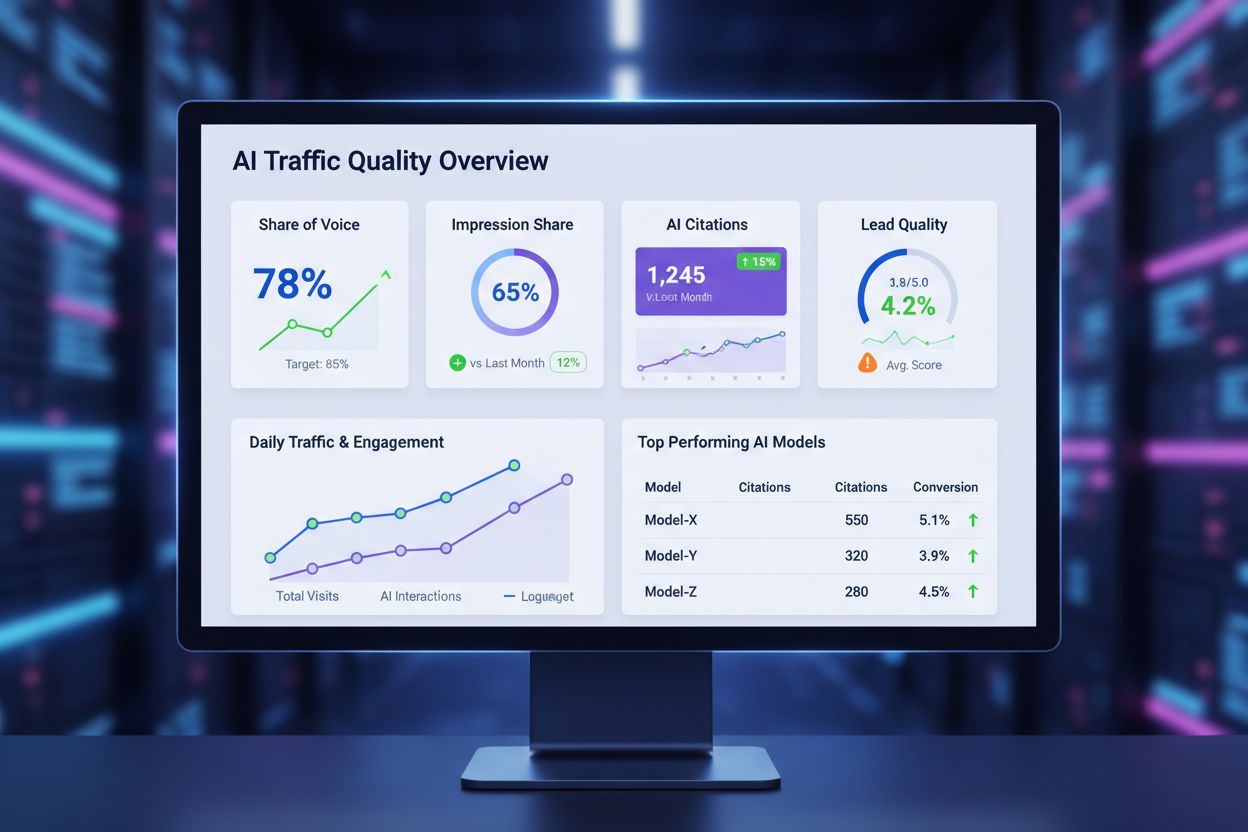
Traditional web analytics metrics—pageviews, bounce rate, time on site—provide incomplete pictures of AI traffic performance and can actually mislead optimization efforts. The unique characteristics of AI-driven visitors demand a dedicated framework of key performance indicators built to capture conversion quality and platform-specific dynamics, not just volume—AI platforms recommend only the most relevant sources for a given query, so the visitors they send are pre-filtered in a way pageviews and bounce rate were never built to measure. Only 16% of brands currently track AI performance, which means setting this up properly is itself a competitive advantage. Start with these:
AI Conversion Rate by Platform: Track ChatGPT, Copilot, Perplexity, and Gemini separately to identify which platforms drive highest-value customers
AI Customer Lifetime Value: Compare CLV of AI-sourced customers against other channels to quantify long-term value creation
Citation Frequency and Recency: Monitor how often AI platforms cite your content and the freshness of cited pages
AI Traffic Attribution Window: Extend attribution modeling to capture multi-touch journeys involving AI platforms
Recommendation Velocity: Track the speed at which new content gets picked up and recommended by AI systems
AI-to-Conversion Path Analysis: Map the specific journey from AI recommendation through conversion to identify optimization opportunities
Platform-Specific ROI: Calculate return on investment separately for each AI platform to guide budget allocation
Ready to Monitor Your AI Visibility?
Track how AI chatbots mention your brand across ChatGPT, Perplexity, and other platforms.
Once tracking is in place, the financial case becomes concrete. Google still sends 345x more traffic than all AI platforms combined, so the raw traffic comparison looks lopsided—but run the conversion math and the picture changes. A website receiving 10,000 monthly organic visitors converting at 0.18% generates 18 conversions, while just 100 AI visitors converting at 4.2% generate roughly 4.2 conversions—nearly a quarter of the output from a fraction of a percent of the traffic. As AI traffic continues its 155.6% year-over-year growth rate, the crossover point where AI becomes a primary conversion driver approaches faster than the raw volume numbers suggest. The ROI calculation gets more favorable still once you factor in acquisition cost: AI traffic often requires less paid promotion than search engine marketing while delivering superior conversion performance. Model this quarterly, not annually—at this growth rate, last year’s numbers understate what’s happening now.
Content Optimization Tactics That Move the Needle
Capturing and converting AI traffic requires a different content approach than traditional SEO, one that accounts for how AI systems discover, evaluate, and recommend content:
Refresh content on a fixed cadence: AI systems prioritize recently updated content—research shows AI cites content that is 25.7% fresher than what traditional search engines rank. Keep your most important pages current.
Add comprehensive schema markup: Structured data helps AI systems understand your content’s context, relevance, and credibility, increasing the likelihood of recommendations.
Build E-E-A-T signals: Emphasize Experience, Expertise, Authoritativeness, and Trustworthiness through author bios, credentials, and original research—the same signals AI systems weight heavily when deciding whether to recommend you.
Lead with direct answers: Structure information so it directly addresses the specific questions AI systems are trained to answer, using clear headers and AI-friendly structure that’s easy to extract and cite.
Monitor citations and double down: Track which content pieces AI systems already recommend, then invest further in those topics to compound your existing citation advantage.
Together these five tactics form a real optimization strategy—not a one-time audit, but an ongoing content operating rhythm.
Stay Updated on AI Visibility Trends
Get the latest insights on AI mentions, brand monitoring, and optimization strategies.
Platform-by-Platform Optimization
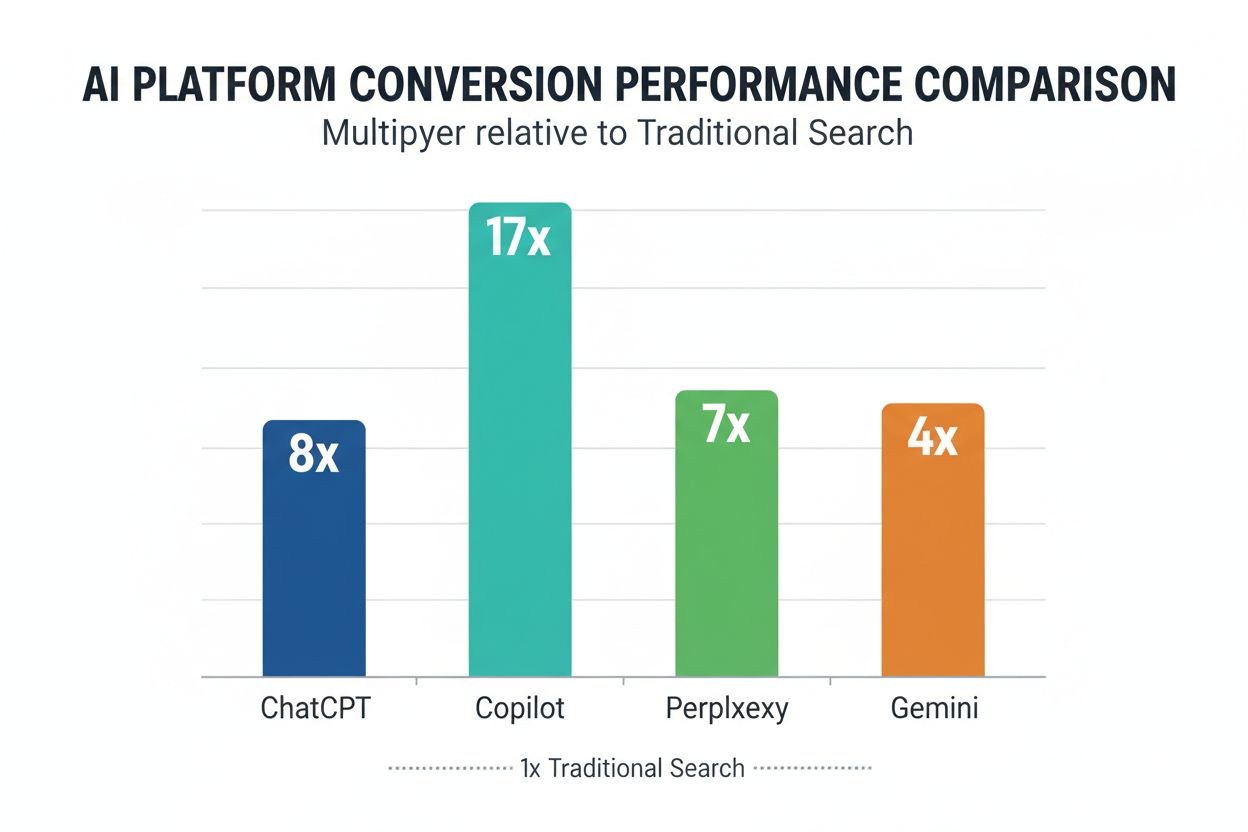
Different AI platforms reward different things, so a single generic content strategy leaves conversion on the table. The table below shows the conversion multiple each platform delivers, and the tactic that drives it:
AI Platform
Conversion Rate vs. Search
User Base Focus
What to Optimize For
Copilot
12x higher
Enterprise/Professional
Workflow integration, Microsoft 365 and Windows context
ChatGPT
6x higher
General/Broad
Scale, accessibility, broad topical coverage
Perplexity
5x higher
Researchers/Analysts
Research-driven queries, citation transparency
Gemini
2.5x higher
Google ecosystem users
Search integration, freshness signals
Microsoft Copilot’s enterprise focus and workflow integration produce the highest conversion multiples, so content aimed at professional, in-workflow use cases pays off disproportionately there. Perplexity’s research-focused audience rewards depth and citable evidence. ChatGPT’s broad reach means volume plays and general accessibility matter more than platform-specific tuning. Gemini’s tie to the Google ecosystem means the recommendations and the intent behind them lean on freshness and search-integration signals more than any other platform. The practical takeaway: don’t optimize for “AI” as a single channel—optimize for multiple AI platforms individually, tailoring content presentation to each one’s recommendation mechanism.
Industry Playbooks
The conversion advantage of AI traffic manifests differently across industries, so tactics should be tailored to how your buyers actually use AI. In e-commerce, AI traffic shows exceptional performance for high-consideration purchases where customers benefit from AI-curated product recommendations and comparative analysis—luxury goods, electronics, and specialized equipment see the largest lift over traditional search. B2B and SaaS companies see particularly strong AI traffic performance because their buyers actively use AI tools for solution research and vendor evaluation; these visitors arrive pre-educated about your value proposition and competitive positioning, so content should focus on differentiation rather than basic education. Local service businesses see moderate but growing AI traffic benefits as platforms like Perplexity increasingly surface location-specific recommendations—optimize for service-area and “near me” style queries. Financial services benefit from AI’s trust-transfer effect, since recommendations from authoritative AI systems carry significant weight in investment and banking decisions. Healthcare and wellness organizations see strong performance for informational queries but need to navigate compliance considerations around medical claims. Across all of these, the common thread is the same: AI traffic converts best when your content directly answers the specific, well-defined questions your buyers are asking AI systems.
Aligning AI Optimization with Existing SEO
Google still sends 345x more traffic than all AI platforms combined, so none of the tactics above should replace traditional SEO—they should sit alongside it. Fortunately, the fundamentals overlap significantly: both channels reward fresh, authoritative, well-structured content that directly addresses user intent. The divergence is in emphasis and execution: traditional SEO prioritizes keyword optimization, backlink profiles, and technical performance metrics, while AI optimization emphasizes content freshness, E-E-A-T signals, and direct-answer formatting. Treat these as complementary layers on a unified content foundation rather than competing priorities—maintain your existing SEO infrastructure (keyword research, link building, technical performance) while adding the AI-specific enhancements from the section above. Organizations that integrate both channels build a more resilient traffic mix, where a dip in one can be offset by growth in the other.
Building Your AI Traffic Roadmap
Current projections put AI-driven conversions on track to match Google search conversions by late 2027 to early 2028 (see our companion piece
for the timeline reasoning)—which gives you roughly an 18-24 month window to build advantage before the channel saturates. The 52% of sites already converting AI traffic are the early movers; the roadmap for catching up, or extending your lead, looks like this: audit current content for AI-friendliness, implement the refresh cadence and schema work from the optimization section above, stand up the KPI tracking described earlier in this guide, and build platform-specific expertise rather than treating “AI traffic” as one undifferentiated channel. Brands that treat this as a standing operating practice—not a one-time project—are the ones capturing outsized value as the channel scales.
Frequently asked questions
Move beyond traditional metrics like pageviews and bounce rate. Track AI-specific KPIs including: AI conversion rate by platform, customer lifetime value of AI-sourced customers, citation frequency in AI responses, AI traffic attribution windows, and platform-specific ROI. Only 16% of brands currently track AI performance, creating a competitive advantage opportunity.
Compare conversions per visitor, not just conversions. A site getting 10,000 monthly organic visitors at a 0.18% conversion rate generates 18 conversions, while just 100 AI visitors at 4.2% generate roughly 4.2 conversions—nearly a quarter of the output from 1% of the traffic. Factor in that AI traffic often requires less paid promotion than search engine marketing to make the comparison complete.
ChatGPT dominates AI referral traffic, accounting for over 80% of all AI-driven visits to websites. However, Copilot shows the highest conversion multiple at 12x traditional search, ChatGPT converts at 6x, Perplexity at 5x, and Gemini at 2.5x. Prioritize based on where your target audience actually spends time, not just raw referral volume.
Implement regular content refresh cycles (AI cites content 25.7% fresher than traditional search), add comprehensive schema markup, build E-E-A-T signals through author credentials and original research, structure content with direct answers first, and monitor AI citations to identify which topics are already generating recommendations so you can double down on them.
No. Google still sends 345x more traffic than all AI platforms combined, making traditional SEO non-negotiable. The winning approach integrates both: keep your SEO foundation—keyword research, link building, technical performance—while layering on AI-specific work like content freshness cycles, schema markup, and E-E-A-T signals.
Yes. E-commerce sees the strongest lift for high-consideration purchases like electronics and luxury goods, where AI-curated comparisons matter most. B2B and SaaS buyers research vendors through AI before ever visiting a site, so pre-educated traffic converts especially well. Local service businesses benefit as platforms add location-specific recommendations, and financial services gain from AI's trust-transfer effect on high-stakes decisions.
Start by auditing current content for AI-friendliness, then implement fresh content cycles, establish AI-specific KPI tracking, and build platform-specific expertise. The 52% of sites already converting AI traffic represent early movers building compounding advantages—the roadmap is less about a single fix and more about establishing the tracking and content habits that keep paying off as the channel scales.
Viktor Zeman is a co-owner of QualityUnit. Even after 20 years of leading the company, he remains primarily a software engineer, specializing in AI, programmatic SEO, and backend development. He has contributed to numerous projects, including LiveAgent, PostAffiliatePro, FlowHunt, UrlsLab, and many others.
Viktor Zeman
CEO, AI Engineer
Track and Improve Your AI Traffic Performance
AmICited gives you the citation monitoring and platform-level data you need to measure AI traffic ROI and act on it across ChatGPT, Perplexity, Copilot, and Gemini.
How to Track AI Search Traffic: Methods for ChatGPT, Perplexity & Google AI
Learn how to track AI search traffic in GA4, monitor ChatGPT and Perplexity referrals, and measure AI visibility across platforms. Complete guide to AI traffic ...
How to Track AI-Driven Conversions from ChatGPT, Perplexity and Other AI Tools
Learn how to track conversions from AI-powered search engines and answer generators like ChatGPT, Perplexity, and Gemini using GA4, custom channels, and convers...
Setting Up AI Traffic Tracking: Complete Technical Guide
A technical guide to tracking AI traffic beyond GA4: server-side log analysis, real-time monitoring platforms, API-based tracking, and building a unified dashbo...
9 min read
Cookie Consent We use cookies to enhance your browsing experience and analyze our traffic. See our privacy policy.