


What Is Avg Citation Rank?
Learn what AmICited’s Avg Citation Rank measures, why a lower rank is better and how it differs from visibility and share of voice.

Avg Citation Rank answers a question the other headline metrics don’t: when you do get cited, how high up are you? Being mentioned is good, being mentioned first is far better, because the earliest sources in an AI answer carry the most weight.
At a Glance
- Avg Citation Rank is your average position (
#1,#2.1, etc.) among the sources cited in an AI answer, counted only from the answers where you actually appeared. - Lower is always better:
#1.0means you’re cited first every time. - Find it as the third headline stat on the Dashboard, next to Visibility Score and Share of Voice.
- It measures placement quality, not frequency, so always read it alongside Visibility Score to get the full picture.
- Segment by engine to spot cases where you rank near the top on one platform but land far lower on another.
What is citation position, and why does it matter?
When an AI assistant like ChatGPT, Perplexity, Gemini, or Google AI Overviews answers a question, it rarely draws on a single source. It typically synthesizes an answer from several sources and cites them: sometimes as numbered footnotes, sometimes as inline links, sometimes as a list of references at the end. The order those sources appear in is not random. It reflects, roughly, how much the model trusted or weighted each source when constructing its answer. The technical term for this is citation position : the location of a given citation within an AI response, counted from the first source cited to the last.
Citation position matters because attention is not evenly distributed. Research into how users read AI-generated answers, and how the underlying retrieval-augmented systems weight sources, consistently shows that earlier citations get more visual attention, are more likely to be clicked when a user checks sources, and are more likely to be treated by the model itself as the primary basis for its claim. Two brands can have identical citation rates (the percentage of tracked prompts where they get mentioned at all) and still be in very different competitive positions if one is consistently cited first and the other is consistently cited fifth or sixth. This is the idea behind position-adjusted citation rate : a citation isn’t a binary yes/no event, it has a quality dimension determined by where it lands.
This distinction is central to generative engine optimization (GEO): the practice of optimizing content and entity signals so AI models cite you, and cite you prominently, rather than optimizing for blue-link rankings the way traditional SEO does. In classic search engine optimization, position on the page is everything: rank #1 gets the click, rank #11 is invisible. In AI search, the equivalent concept is citation order within the answer itself. A brand buried at the bottom of a long reference list is functionally similar to a page-two Google result: technically present, rarely seen.
This is also why raw “did we get mentioned” tracking is an incomplete way to measure AI search visibility . A tool that only reports whether your brand appeared, without reporting where it appeared relative to competitors, is missing half the picture. Avg Citation Rank exists specifically to close that gap: it converts citation position from something you’d have to eyeball prompt-by-prompt into a single trend line you can track over time and compare across AI engines.
Where to find it in AmICited

#1.0 means you’re always cited first. The metric only counts answers where you actually appeared, so always read it next to your Visibility Score.Avg Citation Rank is the third of the three headline stats at the top of the Dashboard, sitting to the right of Visibility Score
and Share of Voice
. It’s displayed as a rank number prefixed with #: in the example above, #2.1. The same figure also reappears as one of the four secondary counters just below the headline row, so you’ll see it echoed in two places on the same screen: once as a top-line KPI, once alongside the more granular breakdown metrics.
Placing it next to Visibility Score and Share of Voice is deliberate. Those two metrics tell you how often you’re cited and what proportion of the competitive conversation you own; Avg Citation Rank tells you how good those citations are. Reading all three together, rather than any one in isolation, is what turns the dashboard from a vanity counter into a diagnostic tool.
What the number actually means
Every time your brand appears in an AI answer that AmICited tracks, the platform records the position it was cited in (first source referenced, second source, third, and so on) for that specific prompt and engine. Avg Citation Rank is simply the average of those recorded positions across every tracked answer where you were cited.
A few mechanics worth understanding:
- Lower is better, and the scale starts at 1. A perfect
#1.0means you’re the first source cited in every single answer you appear in. A#2.1means that, on average, you land right around the second citation slot, sometimes first, sometimes third or fourth, averaging out to just past second position. - It’s conditional on appearing at all. The metric only factors in answers where your brand was actually cited: it says nothing about the prompts where you weren’t mentioned. That’s precisely why it should never be read alone: a brand cited only once, but cited first that one time, could show a flattering
#1.0while actually having very poor overall reach. Pairing it with Visibility Score, which does account for how often you show up, corrects for that blind spot. - It measures quality of placement, not frequency. Two brands can have the same Visibility Score and wildly different Avg Citation Rank: one is landing near the top of the AI’s source list, the other is an afterthought buried near the bottom. That difference is often invisible in raw citation-rate tracking, which is one reason position-based metrics like this one, and concepts like AI Overviews citation ordering, have become a standard part of how AI rank tracker tools report results.
- It’s engine-specific under the hood, but shown blended by default. The dashboard’s headline number reflects your selected model filter, by default this is often blended across engines, but you can narrow it down (see below) to see how position varies by assistant.
How to use Avg Citation Rank strategically
- Track the trend, not just the snapshot. A single day’s
#2.1tells you where you stand; a falling trend line over weeks tells you AI engines are increasingly treating you as a primary, trustworthy source rather than a secondary mention. Rising numbers are an early warning that competitors are displacing you from top citation slots even if your overall citation rate hasn’t dropped yet. - Segment by engine using the All AI Models filter. ChatGPT, Perplexity, Gemini, and Google AI Overviews each build their answers differently, and they don’t necessarily rank the same sources the same way. You might be the first citation in Perplexity’s answers but land fourth or fifth in Gemini’s. Filtering the dashboard by individual engine surfaces those gaps so you know where to focus content and authority-building work.
- Always pair it with Visibility Score. The two-by-two read is the useful part: high visibility and a low (good) Avg Citation Rank is the strong position: you show up often, and you show up near the top. High visibility with a poor rank means you’re being mentioned frequently but consistently outranked within the answer by other sources, which usually signals a content-authority or specificity problem rather than a discoverability one. Low visibility with a good rank means that on the rare occasions you do get cited, you’re trusted: the priority there is increasing how often you’re surfaced at all, for example by widening the set of prompts you track brand mentions in ChatGPT and other engines for.
- Use it to prioritize content and authority work. If your rank is consistently worse than a named competitor’s on the same prompts, that’s a signal to strengthen the depth, specificity, and citability of the content addressing that topic, not necessarily to publish more content, but to make the existing content a more obviously authoritative single source. If you want a deeper look at how citation position differs from raw citation frequency as a ranking signal, see position vs. citation as competing metrics for AI-powered search.
- Watch it after content or technical changes. If you update a page, add structured data, or improve how machine-readable your site is, Avg Citation Rank is one of the more sensitive indicators of whether that change actually moved the needle: a shift in position often shows up before a shift in raw citation frequency does.
Reading it alongside the rest of the dashboard
Avg Citation Rank doesn’t exist in a vacuum, and treating it as a standalone score misses most of its value. Visibility Score tells you reach, Share of Voice tells you competitive share, and Avg Citation Rank tells you placement quality: the three together describe not just whether AI engines know you exist, but how much they trust you relative to everyone else answering the same question. Teams that only watch citation frequency often miss slow erosion in trust and positioning until a competitor has already claimed the top slot on their most important prompts; teams that watch position alongside frequency catch that shift while there’s still time to respond.
If you’re new to AI visibility measurement generally, it’s worth reading how Avg Citation Rank fits into the broader set of AI visibility metrics and KPIs that matter, since citation position is one input among several (alongside citation rate, share of voice, and sentiment) that determine how strong a brand’s overall standing is in generative search. And if your rank is stuck or worsening despite steady citation frequency, that’s the moment to move from monitoring into action: dig into which competing sources are consistently outranking you on your priority prompts, and treat closing that gap as its own workstream rather than an afterthought to general content production.
Frequently asked questions
It's your average position among the sources cited in an AI answer, counted only from the answers where your brand actually appeared. It measures placement quality, not how often you're cited, so a number close to #1.0 means you're consistently the first source cited.
The scale starts at 1, so #1.0 means you're cited first in every answer you appear in. Earlier citations get more attention, are more likely to be clicked, and are more likely to be treated by the model as the primary basis for its claim, so lower numbers reflect stronger placement.
Visibility Score tells you how often you're cited at all; Avg Citation Rank tells you how prominently, counted only among the answers where you appeared. A brand cited once but ranked first could show a flattering #1.0 while having very poor overall reach, which is why the two should always be read together.
ChatGPT, Perplexity, Gemini and Google AI Overviews each build answers and weigh sources differently, so you might be cited first on one and fourth or fifth on another. Use the All AI Models filter to segment the dashboard by engine and see exactly where you're strong versus where you're being outranked.
More tutorials in this section
 How to Read Your Visibility Score
Learn what the AmICited Visibility Score measures and how its gauge and platform breakdown show your AI …
Read guide →
How to Read Your Visibility Score
Learn what the AmICited Visibility Score measures and how its gauge and platform breakdown show your AI …
Read guide →
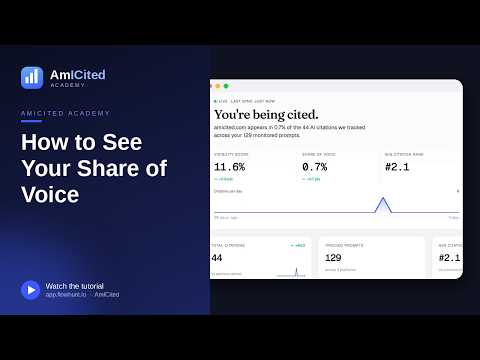 How to See Your Share of Voice
Find your AmICited Share of Voice and learn how it compares with your Visibility Score.
Read guide →
How to See Your Share of Voice
Find your AmICited Share of Voice and learn how it compares with your Visibility Score.
Read guide →
 How to Use the Domain Semantic Map
Explore the AmICited Domain Semantic Map to find clusters and topic gaps across prompts, fan-out queries and …
Read guide →
How to Use the Domain Semantic Map
Explore the AmICited Domain Semantic Map to find clusters and topic gaps across prompts, fan-out queries and …
Read guide →Ready to put it into practice?
Free check · 7-day trial · card required